


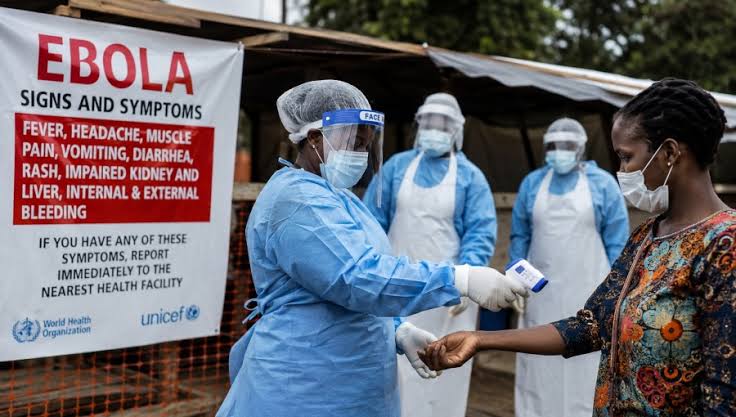
For health workers in the volatile eastern Democratic Republic of the Congo (DRC), overcoming local suspicions is as challenging as combating the Ebola virus, which has plagued the region for six months.
In the rural community of Bulambo-Isale, AFP saw a small crowd gather this week along a dirt track, determined to stop an ambulance carrying the body of a local Ebola victim from reaching a burial site.
Victims of the highly contagious haemorrhagic fever, which spreads through direct contact with bodily fluids, must be buried in sealed body bags to prevent the virus from spreading from the corpse.
Specially trained health workers conduct burials, concealed in protective suits. Some locals allege that the workers are brought in from outside the community and do not speak local languages.
But local custom dictates that the deceased be buried by their family and that their body be returned to the earth of their ancestors.
“The authorities have imposed the Ebola response on locals without first making sure how they interpret it,” said Patricien Kambale, who became a livestock farmer after university.
“The sick victim gets carted away in a vehicle, and locals don’t know where they’re being taken. Then we learn later that the person has died, so locals think the doctors are using poisoned medicine to kill people,” he said.
Suspicions of ‘profiteering’
Locals say they distrust Congolese authorities, who have a reputation for corruption and nepotism.
Left to cope with the hardships inflicted by the myriad armed groups that have stalked their mineral-rich region for more than three decades, they fear their customs and lives matter little to those in power.
Wilson Kasyani, chief doctor for the Vuhovi health district, which includes Bulambo-Isale in North Kivu province, said he was worried about the ambulance and its occupants.
“Weapons are everywhere” in the mountainous region, he said.
Medical workers face almost daily attacks because of local hostility towards efforts to respond to the outbreak, which has killed more than 5,000 people out of over 11,000 cases since May.
“Today, people entered a nurse’s home and wounded her son,” Kasyani said.
“And yesterday we had to stop someone who wanted to attack investigators with a machete.”
Roland Vivaya, head of the local youth council, said “most people” in Bulambo-Isale “don’t believe Ebola exists”.
He admitted that he had not “really” believed it himself until he nearly died from the virus.
Vivaya said the main challenge was not defiance but a lack of understanding, despite memories of the previous Ebola outbreak, which lasted from 2018 to 2020.
Images of “doctors protected by the military scared the community,” Kambale said.
No vaccine or specific treatment currently exists for the Bundibugyo strain of Ebola, which is responsible for the current outbreak.
“How can you explain to locals—many of whom have never been to school—why there’s this sudden focus on this disease, when we’ve been dying for decades from the conflicts here?” Vivaya said.
“Personally, I only understood the virus when I had to go to the treatment centre, because they put on information sessions. But these meetings don’t get the message across to everyone,” he added.
Vivaya said suspicions partly stemmed from health workers not being trained in local customs or languages, leading to “resistance” among residents.
“They think it might be some kind of profiteering,” he added.
Communicating with the Dead
Bulambo-Isale is the cultural and religious heart of the Nande people, one of the largest ethnic groups in eastern DRC.
From his palm-frond hut, blackened by wood smoke, traditional chief Pimbo Kakule watches over one of Bulambo-Isale’s 12 sacred hills, a pipe clenched between his teeth.
As in many rural communities affected by Ebola, efforts to contain the disease are running up against longstanding traditions.
“Our people believe there is life after death, and our customs must be respected when a person is buried. Otherwise, we think they’ve been sacrificed,” he said.
Nande custom dictates that a person should be buried by their family and that their body should enter the soil of their ancestors, allowing the living to speak to them in the afterlife.
“A person who isn’t able to communicate with their dead can’t get into heaven,” Kakule said.
He said there were better ways to manage the issue than the current top-down approach.
“If we were to say, ‘Your brother’s died. We’re going to teach you how to bury him,’ we might reach an agreement, and there wouldn’t be all this tension,” he said.
“We are fighting the disease, not the response teams.”
The salaries offered to some locally recruited workers joining the Ebola response are also a source of mistrust.
Their wages, which are higher than the local average, fuel jealousy and conspiracy theories.
When Kambale was vaccinated against the Zaire strain of Ebola in 2020, during the epidemic at the time, his neighbours accused him of taking a bribe to spread the virus and threatened to set fire to his house.
“Even protecting yourself has become a problem,” he said.
“Pressure groups” made up of members of youth organisations linked to local politicians exploit the tensions and sometimes prevent health workers from reaching sick people.
In Vuhovi, such incidents are often caused by troublemakers who feel marginalised, said Salama Mwengesyali, who coordinates public Ebola information sessions.
“If we could bring all these individuals in, train them and get them involved in tackling Ebola, we could overcome this resistance,” she said.
“What we lack are the means to do that.”
Mwengesyali said her team lacked the funds to encourage locals in rural farming communities to attend lengthy Ebola information sessions or to pay health workers to call them or travel to their homes.
“It’s come down to us having to go door to door to plead for body bags,” Kasyani said.
The Ebola treatment centre is cobbled together from wooden planks, and patients “put up with intolerable conditions”, he said.
Two patients have run away in recent days.
“People tell themselves that if they go there, they’re going to die.”
