


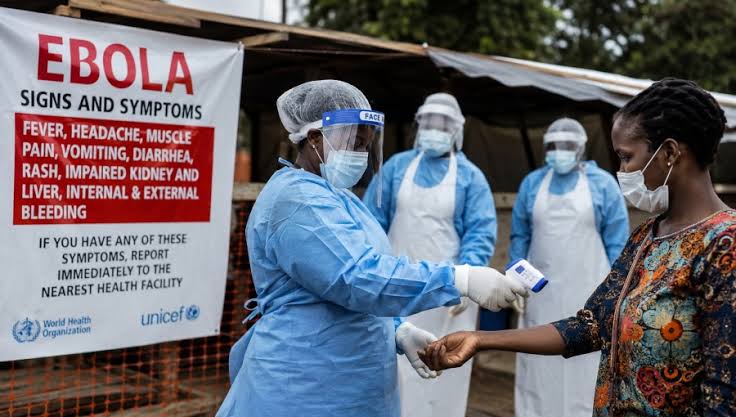
The Africa Centres for Disease Control and Prevention (Africa CDC) reports progress in the Ebola response but notes that challenges are outpacing efforts in the Democratic Republic of the Congo (DRC).
Dr. Wessam Mankoula, Head of the Continental Initiative for Maximising Student Development (IMSD) for Ebola response, made this statement on Thursday during a webinar on the outbreak.
He said the continental Incident Management Support Team is now operational from Uganda, coordinating response efforts with support from partners across Africa.
Mankoula also highlighted progress in implementing a memorandum of understanding between DRC and Uganda to strengthen cross-border Ebola surveillance and response.
“Laboratory capacity has significantly improved, enabling health authorities to conduct over 2,000 Ebola tests daily in affected areas,” he said.
“Clinical trials for Ebola therapeutics have begun, marking another milestone in improving treatment outcomes during the outbreak.”
However, he warned that confirmed Ebola cases increased by 25 percent over the past week, raising concerns about ongoing transmission.
“Ebola treatment units are under severe pressure, with bed occupancy reaching 95 percent across affected facilities,” Mankoula added.
He noted that contact tracing remains inadequate, with only seven contacts identified per confirmed case, well below the recommended target.
Health workers continue to face high risks, with infections among frontline personnel remaining a major concern.
“The Africa CDC described Uganda’s response as encouraging, demonstrating that Ebola can be controlled through strong surveillance and rapid action,” Mankoula said.
“Uganda has recorded 20 Ebola cases, mostly linked to imported infections, but authorities quickly contained transmission,” he added.
Currently, Uganda has only one patient receiving treatment, with two deaths and 17 recoveries reported.
He reported that Uganda has achieved complete contact tracing for all identified contacts, helping to halt further spread.
“Africa CDC notes that Uganda’s success shows early detection, prompt isolation, and effective contact tracing are key to controlling Ebola,” Mankoula said.
In contrast, the DRC has recorded 1,759 confirmed Ebola cases as of July 7, including 353 new cases in the past week.
The outbreak has claimed 600 lives, with a case fatality rate of about 34 percent.
Among healthcare workers, 112 infections and 35 deaths have been reported.
Mankoula described the outbreak as the fastest-growing Ebola epidemic ever recorded, surpassing previous outbreaks in the first six weeks.
“The virus continues to outpace response efforts, with an estimated reproductive number of 1.4, indicating ongoing transmission,” he said.
“This means that for every 10 infected individuals, approximately 14 new cases are generated, and the outbreak is still evolving,” he added.
The outbreak has affected 37 health zones in DRC, with 94 percent of cases reported from Ituri Province.
Six zones have not reported new cases in the past 21 days, suggesting some progress.
Most infections occur among people aged 15 to 44, with women accounting for 53 percent of cases.
Security challenges in North Kivu hinder response efforts, contributing to high fatality rates and limiting access for emergency teams.
Mankoula called for a 50 percent increase in treatment beds, faster case detection, stronger community engagement, and sustained funding.
He announced the deployment of additional experts and 4,000 community health workers, while Uganda and DRC continue joint border surveillance under their bilateral agreement.
