


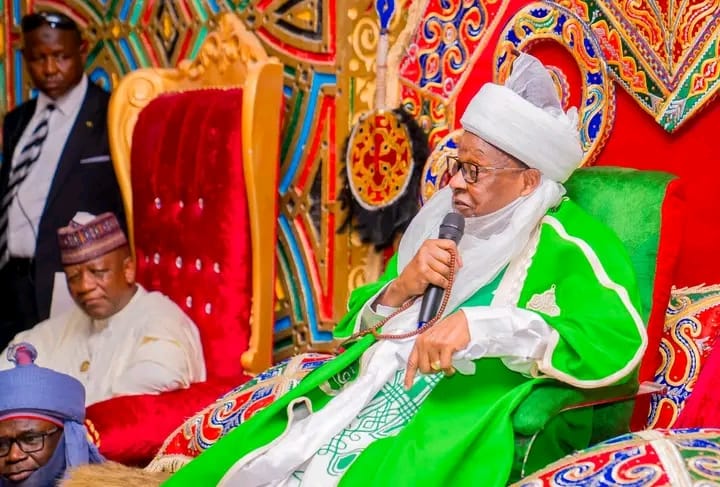
The Emir of Katsina, Abdulmumini Kabir Usman, has challenged Senator Abdulaziz Yari, Governor Dikko Umaru Radda and other political leaders to prioritise insecurity and economic hardship over political ambitions ahead of the 2027 general elections.
The monarch spoke during a visit to his palace by a delegation led by Yari, a former governor of Zamfara State and Director-General of President Bola Tinubu’s campaign, according to a video circulating on social media.
The delegation included Radda, former Katsina State Governor Aminu Bello Masari and other political stakeholders. It also visited the Emir of Daura.
In the video, the Emir criticised politicians who seek the prayers and support of traditional rulers during election campaigns but abandon their constituents after securing political offices.
“Every four years you come to my palace with cap in hand, asking for prayers, asking for support. After election, you disappear to Abuja, to Lagos. You don’t come back until next election,” the monarch was quoted as saying.
He condemned what he described as a culture of selfishness in Nigerian politics, arguing that many political leaders appeared more concerned about personal interests than the welfare of the people they were elected to serve.
The Emir urged politicians to demonstrate genuine commitment to public service, warning that campaign visits and electoral promises would mean little without tangible improvements in people’s lives.
Insecurity, livelihoods under threat
The monarch expressed concern that political leaders were preoccupied with contests for positions and political influence ahead of 2027 while communities continued to face attacks by armed groups.
He drew attention to the effects of banditry on education, agriculture and economic activities in Katsina State, reportedly noting that several schools had been closed because of insecurity.
He also said farmers in 12 local government areas were struggling to access their farmlands, threatening agricultural production and rural livelihoods.
The Emir further referred to reports of families paying millions of naira in ransom to secure the release of kidnapped relatives, highlighting the financial and emotional toll of abductions on affected communities.
He challenged political leaders to produce measurable results in the fight against banditry rather than concentrate on campaign activities while residents remained exposed to security threats.
Questions over Northern economic decline
The Emir also criticised the economic difficulties facing ordinary Nigerians, drawing attention to the rising cost of living and the struggle by households to afford basic necessities.
He questioned the closure of major industrial establishments in Northern Nigeria, citing the Peugeot automobile plant in Kaduna and Arewa Textiles, and called on political leaders and stakeholders to take urgent steps to revive the region’s economy.
He also questioned the effectiveness of the various forums established to address Northern Nigeria’s challenges, urging stakeholders to demonstrate greater commitment to economic recovery and the common good.
The monarch’s intervention highlighted concerns about the connection between insecurity, industrial decline, unemployment and the deteriorating livelihoods of residents across the region.
Campaign handouts not enough
In one of the politically significant portions of the video, the Emir warned that distributing food and money during election campaigns would not necessarily secure voters’ support.
He urged politicians to focus on community development, economic opportunities and public welfare rather than relying on material inducements to win elections.
The monarch argued that political leaders who neglected the needs of ordinary citizens risked losing their support at the ballot box.
His remarks come as political actors begin positioning themselves ahead of the 2027 general elections, with the All Progressives Congress seeking to consolidate support for President Tinubu’s re-election.
The delegation’s visits to the Emirs of Katsina and Daura also underscore the continuing role of traditional institutions in Nigeria’s political landscape.
For Katsina State, where banditry has disrupted education, farming and commercial activities, the message attributed to the Emir raises a critical question: will political leaders prioritise the security and economic needs of their constituents, or allow the pursuit of electoral advantage to overshadow their responsibilities?
