

• Home
  • Agric
  • Sci & Tech
  • Health
  • Environment
  • Hausa News
  • More
    • Business/Banking & Finance
    • POLITICS
    • Entertainments & Sports
    • International
    • Investigation
    • Law & Human Rights
    • Africa
    • ACCOUNTABILITY/CORRUPTION
    • Hassan Gimba
    • Column
    • Prof. Jibrin Ibrahim
    • Prof. M.K. Othman
    • Defense/Security
    • Education
    • Energy/Electricity
    • Entertainment/Arts & Sports
    • Society and Lifestyle
    • Food & Agriculture
    • Health & Healthy Living
    • International News
    • Interviews
    • Investigation/Fact-Check
    • LAW & HUMAN RIGHTS
    • Oil & Gas/Mineral Resources
    • PRESS FREEDOM/JOURNALISM/PR
    • General News
    • Presidency
  • About Us
    • Contact Us
    • Board Of Advisory
    • Privacy Policy
    • Ethics Policy
    • Teamwork And Collaboration Policy
    • Fact-Checking Policy
    • Advertising
  • Media OutReach Newswire
    • Wire News
  • The Stories
Facebook Twitter Instagram
Trending
  • FUTA wins 2026 Young Ocean Scholars University Research Competition, gets N10m prize money
  • Anambra aims to eliminate mother to child HIV, hepatitis, syphilis
  • FUTA teaching hospital: Success depends on stakeholder support
  • Benue deputy gov assures transparent distribution of UNFPA kits
  • ESDAN: Egg powder not the solution to egg glut
  • Despite tight monetary policy, Nigeria’s broad money supply climbs to N129.21trn in May
  • Nigerians keep N5.19trn outside banks despite cashless drive
  • Santuscom’s fertilizer to improve soil, crops
Facebook Twitter Instagram YouTube
AsheNewsAsheNews
  • Home
  • Agric

    ESDAN: Egg powder not the solution to egg glut

    June 23, 2026

    Santuscom’s fertilizer to improve soil, crops

    June 23, 2026

    Nigeria’s neem advantage: Unlocking a strategic bioeconomy industry for climate, agriculture and industrial growth, Dr Fakunle Aremu

    June 22, 2026

    AFAN predicts drop in food prices after fertiliser distribution

    June 22, 2026

    Northern Nigeria’s poultry economy: Unlocking a multi-billion dollar investment opportunity across the value chain, By Dr. Fakunle Aremu

    June 19, 2026
  • Sci & Tech

    FUTA wins 2026 Young Ocean Scholars University Research Competition, gets N10m prize money

    June 23, 2026

    DSN CEO: Data classification key to Nigeria’s data sovereignty

    June 23, 2026

    Lagos to increase investment in tech, innovation

    June 23, 2026

    ALTON supports CBN’s local data hosting mandate

    June 20, 2026

    NDPC seeks INEC data records over breach allegations

    June 20, 2026
  • Health

    Anambra aims to eliminate mother to child HIV, hepatitis, syphilis

    June 23, 2026

    FUTA teaching hospital: Success depends on stakeholder support

    June 23, 2026

    Benue deputy gov assures transparent distribution of UNFPA kits

    June 23, 2026

    RCCG freedom court parish holds community cleanup for 18th anniversary

    June 23, 2026

    NAFDAC holds workshop on medicine safety in Karu

    June 22, 2026
  • Environment

    Nigeria’s national metering rate rises to 57%

    June 23, 2026

    Nigeria’s local petrol production hits 48m litres daily

    June 23, 2026

    Lagos joins global under2 climate coalition

    June 23, 2026

    FAAN considers extending airport taxi upgrade deadline to October

    June 23, 2026

    Floods, Windstorm devastate Ebonyi farmlands, shops

    June 22, 2026
  • Hausa News

    UNA signs MoU to launch air Bissau in Guinea-Bissau

    June 15, 2026

    Otti plans 250-room 5-star hotel in Umuahia

    April 11, 2026

    Anti-quackery task force seals 4 fake hospitals in Rivers

    August 29, 2025

    [BIDIYO] Yadda na lashe gasa ta duniya a fannin Ingilishi – Rukayya ‘yar shekara 17

    August 6, 2025

    A Saka Baki, A Sasanta Saɓani Tsakanin ‘Yanjarida Da Liman, Daga Muhammad Sajo

    May 21, 2025
  • More
    1. Business/Banking & Finance
    2. POLITICS
    3. Entertainments & Sports
    4. International
    5. Investigation
    6. Law & Human Rights
    7. Africa
    8. ACCOUNTABILITY/CORRUPTION
    9. Hassan Gimba
    10. Column
    11. Prof. Jibrin Ibrahim
    12. Prof. M.K. Othman
    13. Defense/Security
    14. Education
    15. Energy/Electricity
    16. Entertainment/Arts & Sports
    17. Society and Lifestyle
    18. Food & Agriculture
    19. Health & Healthy Living
    20. International News
    21. Interviews
    22. Investigation/Fact-Check
    23. LAW & HUMAN RIGHTS
    24. Oil & Gas/Mineral Resources
    25. PRESS FREEDOM/JOURNALISM/PR
    26. General News
    27. Presidency
    Featured
    Recent

    FUTA wins 2026 Young Ocean Scholars University Research Competition, gets N10m prize money

    June 23, 2026

    Anambra aims to eliminate mother to child HIV, hepatitis, syphilis

    June 23, 2026

    FUTA teaching hospital: Success depends on stakeholder support

    June 23, 2026
  • About Us
    1. Contact Us
    2. Board Of Advisory
    3. Privacy Policy
    4. Ethics Policy
    5. Teamwork And Collaboration Policy
    6. Fact-Checking Policy
    7. Advertising
    Featured
    Recent

    FUTA wins 2026 Young Ocean Scholars University Research Competition, gets N10m prize money

    June 23, 2026

    Anambra aims to eliminate mother to child HIV, hepatitis, syphilis

    June 23, 2026

    FUTA teaching hospital: Success depends on stakeholder support

    June 23, 2026
  • Media OutReach Newswire
    • Wire News
  • The Stories
AsheNewsAsheNews
Home»Food & Agriculture»Food crisis, Inflation forcing people back to unsafe farms in Nigeria’s Borno state
Food & Agriculture

Food crisis, Inflation forcing people back to unsafe farms in Nigeria’s Borno state

Abdoulaye KayBy Abdoulaye KayAugust 8, 2024Updated:August 8, 2024No Comments5 Mins Read
Share
Facebook Twitter LinkedIn Pinterest Email

Goni Ari, 45, sits under the shade of a large neem tree on a worn mat, deftly stitching a nearly completed cap. The vibrant blue, green, and red patterns of the cap contrast with his faded blue Chelsea jersey and black jeans. He answers my questions as he sews, occasionally glancing at the nearby water pump. The rhythmic clanking of the pump mingles with the laughter of girls taking turns to fetch water.

By Abubakar Muktar Abba

“We just have to risk it all and return to the farm… At least one will get something to eat.”

Ari, a father of two, returned to Bama — a popular town in central Borno state, North East Nigeria — in 2019, a year after it was resettled. He was fortunate to get land near the town, which he farmed for four years. However, the landowner returned this year and took the property without notice, leaving him without a farm. His own farm is too dangerous to access. Now, he only sews caps, hardly earning a living.

He barely earns 30,000 naira ($18), Nigeria’s former minimum wage, after selling a cap that takes him a month to make. He wishes to return to farming, a life he knows and loves.

“The country is hard. Even those who are doing well are returning to their farms. Many people like me can’t farm this year,” he told HumAngle.

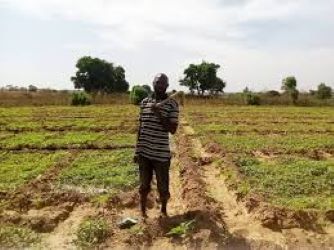
Like Ari, several other farmers can’t get to their farms due to the presence of Boko Haram terrorists in the bush. Farmers in the region risk many things, including their lives, to continue to work, with some performing unusual tasks for Boko Haram terrorists to remain safe.

ALSO READ Inflation: Stakeholders advocate gender-sensitive budget

Northeast Nigeria battles a dual challenge of conflict and food insecurity. Since 2009, the Boko Haram insurgency has displaced millions of people and disrupted the economy in the Lake Chad region. According to the World Food Programme, 4.4 million people are food insecure in northeastern Nigeria. The organisation adds that “three million of them are in Borno state, the epicentre of [the] insurgency.”

Agriculture has long been the backbone of Nigeria’s economy. Studies show that over 70 per cent of the country’s households are involved in agricultural practice. However, the ongoing conflict in the North East has severely impacted productivity and food supply, causing severe food insecurity.

Despite the risks, farmers like Mohammad Kalli are returning to their fields. 

In 2022, Kalli and two other friends ventured into farming, cultivating several hectares of land. They anticipated a bountiful harvest of 100 bags of beans. However, as the harvest season approached, a new wave of terror swept through their area. Boko Haram terrorists began kidnapping farmers, instilling fear in the hearts of those who dared to work their land. Kalli and his friends decided to lay low for two weeks, praying the danger would subside. When they finally returned to their farm, their hopes were shattered. They discovered their fields had been raided. Boko Haram had harvested their crops, and the remnants were burned. The sight of their ruined farm was devastating. The three friends swore never to farm again.

But this year, driven by desperation, they reconsidered. Food prices had soared to unimaginable heights. “A bag of beans that sold for ₦60,000 is now ₦240,000,” Kalli explained. “We just have to risk it all and return to the farm… At least one will get something to eat.” 

The decision was not easy. As they scouted their fields, tension hung in the air. Would they face the same fate again? Surprisingly, they found their neighbours had also returned to the farm this season.

To combat food insecurity, the Nigerian government has partnered with various non-governmental organisations, implementing key initiatives such as providing seeds, farming tools, and enhanced security measures. The Borno State government also offers subsidised tractors, requiring farmers to cover only the fuel costs.

The Victim Support Fund (VSF) launched a three-year intervention (2023-2025) in Gamboru Ngala and Gwoza Local Government Areas, supporting 3,000 farmers in dry season farming. Additionally, the state government plans to resettle 50,000 farmers back to their ancestral homes in Mafa LGA to revitalise agricultural activities in the area.

However, in 2023, the Nigerian president announced the withdrawal of fuel subsidies, which caused food prices to skyrocket in a few days and led to hardship. In the same year, Nigeria recorded one of the highest inflation rates in the world, at around 25 per cent, making the situation brutal. It has since gotten much worse. The World Food Programme warned that 26.5 million nationwide would face acute hunger in the June-August 2024 lean season, a sharp increase from the 18.6 million food-insecure people at the end of 2023.

In the North East, internally displaced persons (IDPs) have faced increased hardship as food support from NGOs dwindles due to the decline in global humanitarian aid.

Though a large portion of Borno’s farmlands is not safe, especially those in remote areas, many farmers are undeterred. 

“I will go to the bush to farm. If Boko Haram does not kill me, hunger will kill me,” said Lawan Bor, an internally displaced person living at the Government Science Senior Secondary School IDP camp, which hosts over 105,000 people. Lawan Bor was displaced from Kajeri, a village in Bama. Some IDPs at the camp told HumAngle they are ready to risk farming their land, even if it involves running errands for Boko Haram, such as purchasing food items and drugs.

HumAngle

Borno state food crisis hunger inflation Unsafe farms
Share. Facebook Twitter Pinterest LinkedIn WhatsApp Reddit Tumblr Email
Abdoulaye Kay
  • Website

Related Posts

ESDAN: Egg powder not the solution to egg glut

June 23, 2026

Santuscom’s fertilizer to improve soil, crops

June 23, 2026

Nigeria’s neem advantage: Unlocking a strategic bioeconomy industry for climate, agriculture and industrial growth, Dr Fakunle Aremu

June 22, 2026

Leave A Reply Cancel Reply

FUTA wins 2026 Young Ocean Scholars University Research Competition, gets N10m prize money

June 23, 2026

Anambra aims to eliminate mother to child HIV, hepatitis, syphilis

June 23, 2026

FUTA teaching hospital: Success depends on stakeholder support

June 23, 2026

Benue deputy gov assures transparent distribution of UNFPA kits

June 23, 2026
About Us
About Us

ASHENEWS (AsheNewsDaily.com), published by PenPlus Online Media Publishers, is an independent online newspaper. We report development news, especially on Agriculture, Science, Health and Environment as they affect the under-reported rural and urban poor.

We also conduct investigations, especially in the areas of ASHE, as well as other general interests, including corruption, human rights, illicit financial flows, and politics.

Contact Info:
  • 1st floor, Dogon Daji House, No. 5, Maiduguri Road, Sokoto
  • +234(0)7031140009
  • ashenewsdaily@gmail.com
Facebook Twitter Instagram Pinterest
© 2026 All Rights Reserved. ASHENEWS Daily Designed & Managed By DeedsTech

Type above and press Enter to search. Press Esc to cancel.