


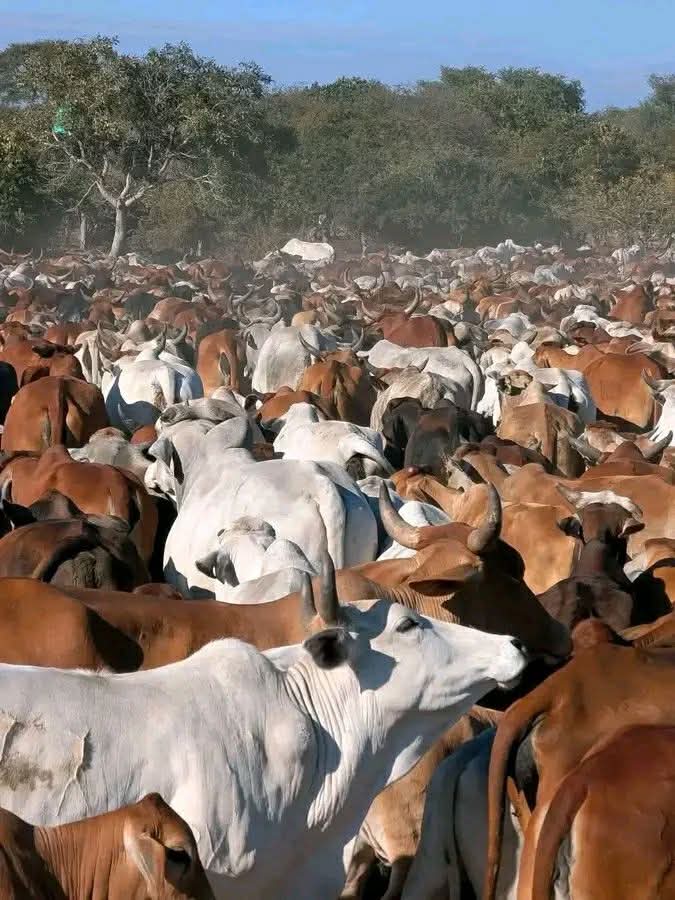
The Federal Government has described livestock production as key to sustainable retirement, self-employment, wealth creation, economic development and food security.
The Minister of Livestock Development, Idi Maiha, said this on Monday in Abuja at the presentation of Guide to Self-Employment and Sustainable Retirement Plan through Livestock Production and the Dr Gabriel Ugwu Knowledge Platform.
The book was authored by animal scientist Dr Gabriel Ugwu.
Maiha was represented at the event by Prof. Eustace Iyayi, his Special Assistant on Feed and Fodder Development.
According to him, the establishment of the ministry by President Bola Tinubu two years ago was a deliberate step to transform Nigeria’s livestock sector into a vibrant, sustainable and globally competitive industry.
He said the ministry’s mandate aligned with Tinubu’s Renewed Hope Agenda, particularly its focus on food security, job creation, economic empowerment and the development of productive sectors.
Maiha described the book as more than a publication; it is a practical contribution to creating productive Nigerians who can generate income, create employment and build sustainable livelihoods through livestock enterprises.
According to him, livestock offers opportunities across the entire value chain — from cattle, sheep, goats, poultry and pigs to feed and fodder production, animal health services, processing, transportation, marketing and value addition.
“Retirement from formal employment should not mean retirement from economic productivity. With appropriate knowledge, planning and investment, livestock can provide income security during retirement.
“For young Nigerians, livestock can provide a pathway to self-employment. For farmers, it can provide opportunities for enterprise expansion and value addition.
“It can become part of a carefully planned investment portfolio for professionals and those approaching retirement,” he said.
Maiha commended the author for presenting livestock not just as a way of life but as a business, an investment and a source of sustainable livelihood.
He urged young people, farmers and professionals to translate the book’s lessons into practical enterprises.
Also speaking, the chairman of the occasion, Dr Sanusi Abubakar, said the gathering was not merely to present a book, but to celebrate knowledge, enterprise and the possibilities that knowledge can unlock.
Abubakar is the National Project Coordinator of the Livestock Productivity and Resilience Support Project (L-PRES).
He was represented by Dr Wasiu Adeoye, Technical Operations Manager of L-PRES, who said the subject of the publication was both timely and significant.
He noted that the search for sustainable sources of livelihood, self-employment and long-term financial security has become increasingly important in a changing economic environment.
“Livestock production, with its diverse opportunities across the value chain, offers considerable possibilities for enterprise development and wealth creation.
“This book, therefore, represents a viable contribution to the conversation on how individuals can acquire knowledge, develop productive ventures and plan responsibly for their future.
“It is more than printed words; it is a repository of knowledge, experience and ideas capable of inspiring action and transforming lives,” he said.
Ugwu said his book would help non-professionals build livelihoods through livestock.
He said his motivation was to provide a practical guide for non-professionals seeking self-employment and a sustainable source of income before and after retirement.
Ugwu explained that the book was conceived to address real challenges people face in livestock production, including access to finance, land and technical know-how.
“The essence of the book is to ensure that non-professional practitioners have enough basic information to venture into livestock production as a viable livelihood.
“As a professional animal scientist, starting a livestock enterprise comes easier, but non-professionals need foundational knowledge to ask the right questions and avoid costly mistakes.
“The book targets workers, graduates and young people, helping them prepare early for post-graduation and post-retirement challenges,” he said.
While reviewing the book, Prof. Ndubuisi Machebe of the Department of Animal Science, University of Nigeria, Nsukka, said the eight chapters were chosen to show the exciting breadth of animal agriculture and the opportunities it holds.
“The author showcased means through which one can truly alleviate poverty by investing in animal-related agribusiness, especially now that the future in the country seems undefined,” he said.
Machebe noted that animal husbandry measures and techniques are dynamic, adding that individuals need access to books that enhance their knowledge of the sector.
