


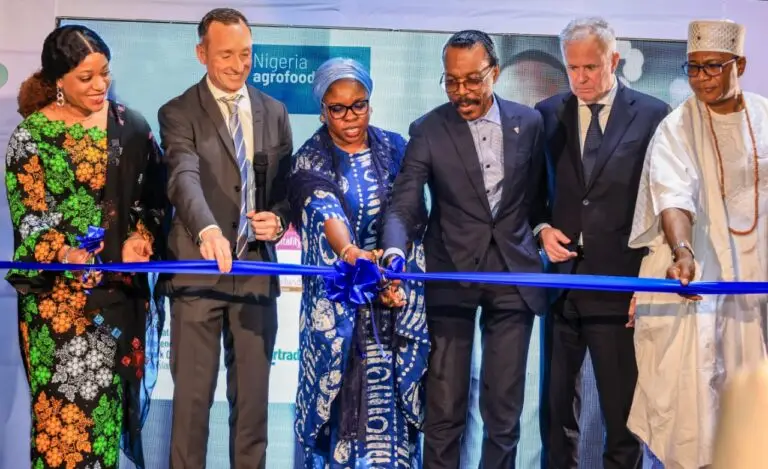
Stakeholders across Nigeria’s agro-food ecosystem say achieving world-class food security is attainable through intentional and sustained investment, policy consistency, and value-chain integration, transforming the sector into a globally competitive and value-driven industry.
They made the assertion at the 11th Agro-food Nigeria Conference and Exhibition in Lagos, themed “Achieving World-Class Food Security in Nigeria.”
The event, a West African business platform for the agro-food industry, highlighted growing opportunities and challenges within Nigeria’s food system.
The Governor of Lagos State, Mr Babajide Sanwo-Olu, said the disconnect between Nigeria’s vast agricultural potential and farmers’ low incomes underscores the need for urgent reforms.
Sanwo-Olu, represented by the Commissioner for Agriculture and Food Systems, Ms Abisola Olusanya, described Lagos as Africa’s largest single food consumption market.
He said the state government is addressing food system challenges through the development of agro-produce hubs and last-mile distribution outlets to reduce waste and improve food access.
The Chief Executive Officer of Financial Derivatives Company Ltd., Mr Bismarck Rewane, said agriculture used to be Nigeria’s largest employer and a key contributor to Gross Domestic Product (GDP).
Rewane said recent geopolitical tensions in the Middle East have disrupted global supply chains, raising fuel and fertiliser costs and driving up food prices.
He, however, noted that Nigeria can leverage its large domestic market and production capacity to strengthen agro-value chains and increase export earnings.
Rewane warned that rising input costs, logistics bottlenecks, insecurity, and power shortages could limit the sector’s growth potential.
He projected continued pressure on food prices due to high production costs, adding that prices may ease if global tensions subside.
The President of the Manufacturers Association of Nigeria (MAN), Mr Francis Meshioye, citing United Nations World Food Programme data, said about 733 million people faced hunger in 2023.
He noted that Africa bears the most severe burden, with about 30 million hungry people in Nigeria, signalling a systemic emergency.
Meshioye said reliance on small-scale farming is insufficient, adding that subsistence agriculture cannot secure Nigeria’s economic future.
He said Nigeria must scale up agro-industrial complexes to feed its population and the continent.
“To achieve world-class food security, Nigeria must prioritise both agriculture and industry.
“Farming alone is inadequate while millions of tonnes of food remain unprocessed. We must add value to what we produce,” he said.
The President of the Nigerian Association of Chambers of Commerce, Industry, Mines and Agriculture (NACCIMA), Dr Jani Ibrahim, called for repositioning agriculture as a driver of industrialisation and inclusive growth.
He said although agriculture contributes about 23 per cent to Nigeria’s GDP, its benefits have not been fully realised due to productivity constraints, weak value addition, and poor market linkages.
Ibrahim said persistent youth unemployment highlights the urgent need to reposition agribusiness as a vehicle for job creation and economic inclusion.
He added that the pathway to food security must go beyond primary production and be anchored on value-chain integration linking agriculture to industry, logistics, finance, and regional markets.
“From the perspective of the organised private sector, we must move from fragmented interventions to coordinated ecosystems that support farmers, processors, and agribusinesses across the value chain.
“It is in this integration that we unlock scale, competitiveness, and resilience, particularly under the African Continental Free Trade Area (AfCFTA),” he said.
The Managing Director of Fairtrade, the organiser of the event, Mr Paul Marz, said the 2026 edition recorded its largest international participation, with over 100 exhibitors from Africa, Asia, Europe, and the Middle East.
Marz said Nigeria’s food market is projected to reach 258 billion dollars in 2026, with an annual growth rate of 10.76 per cent between 2025 and 2030.
He added that Nigeria imported food and packaging technology worth 265 million euros in 2024, while food imports stood at 6.1 billion dollars in 2023.
According to him, the conference facilitates technology transfer, strengthens supply chains, and supports investment decisions across West Africa.
“With backing from over 20 reputable organisations, including international chambers, government ministries, trade agencies, and industry associations, Agro-food Nigeria 2026 reinforces its position as West Africa’s leading hub for the agro-food and packaging sectors.
“Active involvement from key Nigerian and international ministries, authorities, and associations will ensure a comprehensive industry perspective,” he said.
