


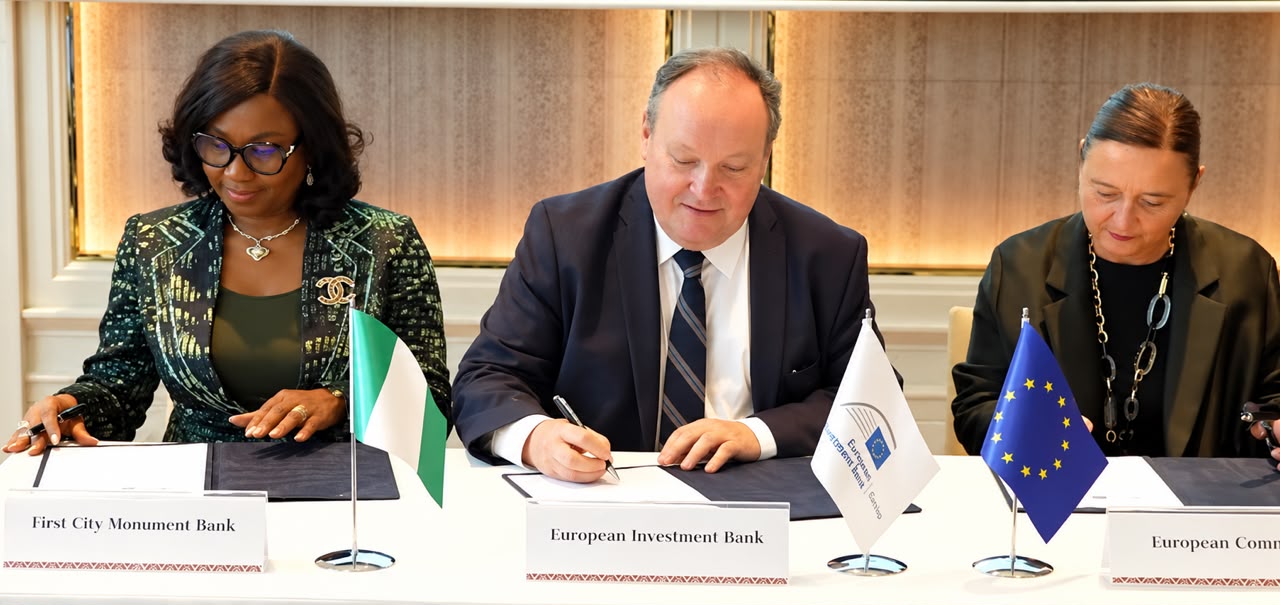
The European Investment Bank Group’s development arm, EIB Global, and First City Monument Bank (FCMB) have committed €85 million to finance Nigerian businesses across agricultural value chains, with at least 70 per cent of the funding earmarked for cocoa and dairy production and processing.
The financing, announced at the 2026 Annual Meetings of the International Monetary Fund and World Bank Group in Bangkok, Thailand, is aimed at expanding agricultural processing, improving farmers’ access to finance and promoting sustainable private-sector growth.
The announcement was made in the presence of EIB Group President Nadia Calviño, Nigeria’s Minister of Finance and Coordinating Minister of the Economy, Taiwo Oyedele, EIB Vice-President Ambroise Fayolle, European Commissioner for International Partnerships Jozef Síkela and FCMB Chief Executive Officer, Yemisi Edun.
The investment marks EIB Global’s first financing operation covering the dairy sector outside the European Union. It is designed to address funding gaps in Nigeria’s dairy industry while supporting businesses that need increased milk supplies and stronger local value chains.
For the cocoa sector, the funding will support processing capacity, provide liquidity to farmers and cooperatives, and improve product traceability. The initiative is also expected to help Nigerian exporters comply with the European Union Deforestation Regulation (EUDR), while promoting biodiversity conservation and environmentally responsible production.
Alongside the credit facility, EIB Global will provide technical assistance to strengthen FCMB’s climate action strategy and improve the Nigerian agricultural sector’s capacity to manage environmental and social risks.
Speaking on the partnership, Calviño said agricultural value chains were major drivers of food security and economic growth in Africa, adding that the investment would also create business opportunities for European companies.
“Through this financial partnership with First City Monument Bank, EIB Global concretely supports Nigerian agribusinesses to grow competitively while meeting international environmental and social standards,” Fayolle said.
He described the investment as important for employment, public health and economic development, adding that it demonstrated the European Union’s Global Gateway initiative in action.
Síkela said Nigeria’s agricultural potential could translate into more jobs, stronger businesses and wider economic opportunities if more value was created and retained locally.
He said the investment would help businesses across the cocoa and dairy value chains access the financing required to expand production and local processing, strengthening the EU-Nigeria economic partnership.
Edun said access to long-term financing could help farmers and agribusinesses move beyond selling raw produce to processing more products, increasing earnings and creating jobs.
“By combining financing with technical support, we aim to strengthen rural livelihoods, promote sustainable growth and help build a more resilient agricultural sector,” she said.
The project aligns with Nigeria’s development priorities and the EU’s strategy for sustainable food systems and food security. It also supports the Team Europe Initiative on Green Economy, which promotes climate-smart agriculture, inclusive agribusiness and improved access to rural and agricultural markets.
EIB Global’s investment forms part of the EIB Group’s broader engagement in Nigeria. Since beginning operations in the country in 1978, the group has invested €2.3 billion in areas including sustainable urban transport, climate adaptation, innovation, digitalisation, agribusiness logistics and financing for small and medium-sized enterprises.
