

• Home
  • Agric
  • Sci & Tech
  • Health
  • Environment
  • Hausa News
  • More
    • Business/Banking & Finance
    • POLITICS
    • Entertainments & Sports
    • International
    • Investigation
    • Law & Human Rights
    • Africa
    • ACCOUNTABILITY/CORRUPTION
    • Hassan Gimba
    • Column
    • Prof. Jibrin Ibrahim
    • Prof. M.K. Othman
    • Defense/Security
    • Education
    • Energy/Electricity
    • Entertainment/Arts & Sports
    • Society and Lifestyle
    • Food & Agriculture
    • Health & Healthy Living
    • International News
    • Interviews
    • Investigation/Fact-Check
    • LAW & HUMAN RIGHTS
    • Oil & Gas/Mineral Resources
    • PRESS FREEDOM/JOURNALISM/PR
    • General News
    • Presidency
  • About Us
    • Contact Us
    • Board Of Advisory
    • Privacy Policy
    • Ethics Policy
    • Teamwork And Collaboration Policy
    • Fact-Checking Policy
    • Advertising
  • Media OutReach Newswire
    • Wire News
  • The Stories
Facebook Twitter Instagram
Trending
  • Niger State records fresh polio, diphtheria cases
  • FG to raise ₦1.2trn through reopening of 2 FGN bonds
  • Naira hits strongest level since April, closes at N1,356/$
  • UTME 2026: JAMB releases mop-up results, begins candidate ranking for admissions
  • Dangote expects over $4bn annual forex earnings from fertiliser exports
  • Naira holds steady at N1,850 against British pound despite global GBP rebound
  • Ericsson reports rapid growth in global 5G subscriptions
  • Anambra reaffirms commitment to telemedicine expansion
Facebook Twitter Instagram YouTube
AsheNewsAsheNews
  • Home
  • Agric

    Dangote expects over $4bn annual forex earnings from fertiliser exports

    June 16, 2026

    AFAN Kano calls for fertilizer subsidy to boost agriculture

    June 16, 2026

    Food security expert urges youth involvement in agriculture

    June 16, 2026

    Jigawa farmers hope for bumper harvest

    June 15, 2026

    Association raises alarm over job losses, rising costs in food sector

    June 15, 2026
  • Sci & Tech

    Ericsson reports rapid growth in global 5G subscriptions

    June 16, 2026

    Musk predicts SpaceX could generate $1trn revenue by 2030

    June 15, 2026

    NCDMB trains 160 youths in AI, data analytics

    June 12, 2026

    Stakeholders urge Nigeria to boost local food ingredient production

    June 10, 2026

    Perplexity AI locks in 2028 IPO date, won’t wait for Anthropic or OpenAI to market

    June 9, 2026
  • Health

    Niger State records fresh polio, diphtheria cases

    June 16, 2026

    Anambra reaffirms commitment to telemedicine expansion

    June 16, 2026

    KSCHMA urges traditional leaders to boost healthcare utilization

    June 16, 2026

    NGO launches pilot program to tackle drug abuse in Kano

    June 16, 2026

    NBC develops strategies to strengthen border security

    June 16, 2026
  • Environment

    All injured passengers discharged after train accident

    June 16, 2026

    SWEEP calls for waste management reforms in Lagos

    June 16, 2026

    Chairman pledges continued crackdowns on criminal hideouts

    June 16, 2026

    ACR calls for national honor for plastic bottle house pioneer

    June 15, 2026

    UNA signs MoU to launch air Bissau in Guinea-Bissau

    June 15, 2026
  • Hausa News

    UNA signs MoU to launch air Bissau in Guinea-Bissau

    June 15, 2026

    Otti plans 250-room 5-star hotel in Umuahia

    April 11, 2026

    Anti-quackery task force seals 4 fake hospitals in Rivers

    August 29, 2025

    [BIDIYO] Yadda na lashe gasa ta duniya a fannin Ingilishi – Rukayya ‘yar shekara 17

    August 6, 2025

    A Saka Baki, A Sasanta Saɓani Tsakanin ‘Yanjarida Da Liman, Daga Muhammad Sajo

    May 21, 2025
  • More
    1. Business/Banking & Finance
    2. POLITICS
    3. Entertainments & Sports
    4. International
    5. Investigation
    6. Law & Human Rights
    7. Africa
    8. ACCOUNTABILITY/CORRUPTION
    9. Hassan Gimba
    10. Column
    11. Prof. Jibrin Ibrahim
    12. Prof. M.K. Othman
    13. Defense/Security
    14. Education
    15. Energy/Electricity
    16. Entertainment/Arts & Sports
    17. Society and Lifestyle
    18. Food & Agriculture
    19. Health & Healthy Living
    20. International News
    21. Interviews
    22. Investigation/Fact-Check
    23. LAW & HUMAN RIGHTS
    24. Oil & Gas/Mineral Resources
    25. PRESS FREEDOM/JOURNALISM/PR
    26. General News
    27. Presidency
    Featured
    Recent

    Niger State records fresh polio, diphtheria cases

    June 16, 2026

    FG to raise ₦1.2trn through reopening of 2 FGN bonds

    June 16, 2026

    Naira hits strongest level since April, closes at N1,356/$

    June 16, 2026
  • About Us
    1. Contact Us
    2. Board Of Advisory
    3. Privacy Policy
    4. Ethics Policy
    5. Teamwork And Collaboration Policy
    6. Fact-Checking Policy
    7. Advertising
    Featured
    Recent

    Niger State records fresh polio, diphtheria cases

    June 16, 2026

    FG to raise ₦1.2trn through reopening of 2 FGN bonds

    June 16, 2026

    Naira hits strongest level since April, closes at N1,356/$

    June 16, 2026
  • Media OutReach Newswire
    • Wire News
  • The Stories
AsheNewsAsheNews
Home»Environment/Climate Change»Researchers build connection between forests and drinking water
Environment/Climate Change

Researchers build connection between forests and drinking water

A team of MSU researchers has shown there’s “untapped potential” for ensuring that Michigan forests provide clean and abundant drinking water.
Abdallah el-KurebeBy Abdallah el-KurebeOctober 20, 2024Updated:October 20, 2024No Comments6 Mins Read
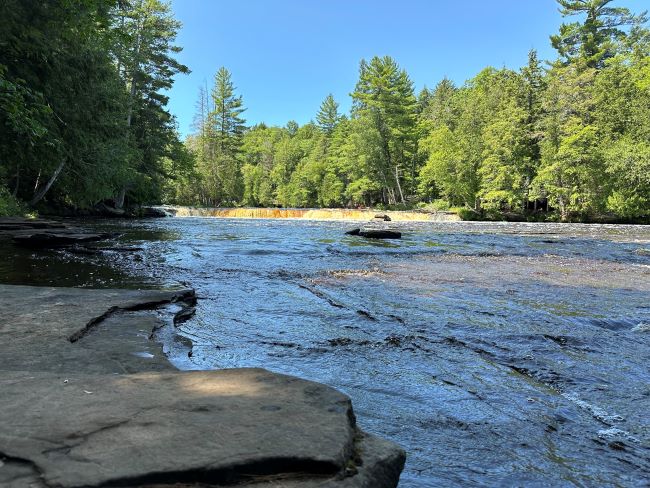
The Lower Tahquamenon Falls surrounded by forests in Michigan's Upper Peninsula. Photo Credit Mike Smalligan
Share
Facebook Twitter LinkedIn Pinterest Email

The benefit of Michigan’s 20 million acres of forests can be seen through a variety of lenses. Michigan forests play a key role in offsetting greenhouse gas emissions through carbon storage, provide wildlife habitats and increase biodiversity, offer ample recreational opportunities to the state’s population and visitors, and supply timber resources and other forestry products — which contributed over $26 billion to Michigan’s economy in 2022, according to the latest data from the Michigan Department of Natural Resources (DNR).

Research from a team of Michigan State University scientists shows there’s another benefit people derive from forests, but they might not recognize it: filtering and supplying clean drinking water.

In 2022, Emily Huff, an associate professor in the Department of Forestry; Asia Dowtin, an assistant professor in the Department of Forestry; Emily Huizenga, a former master’s student in the Department of Forestry; and Jo Latimore, an aquatic ecologist and outreach specialist in the Department of Fisheries and Wildlife, published their findings on how stakeholders view forests for their ability to provide clean drinking water in the Journal of American Water Resources Association.

Stakeholders in this study were broken into seven categories: water consumers, water utility providers, forest landowners, industry partners, policymakers, local governments and nonprofit organizations. Huff said the team hypothesized that people wouldn’t connect forests to their ecological service — a benefit that ecosystems provide to humans — of yielding clean drinking water, which she said was confirmed through her team’s research.

“Generally speaking, most people understood that where there are forests, there’s cleaner and more abundant water,” Huff said. “However, they didn’t make the functional link that conserving forests results in cleaner drinking water.

“The conclusion we came to for why this is, is partly because Michigan is varied when it relates to where water comes from and flows to throughout different watersheds. There’s a huge focus on overall Great Lakes water quality, but maybe less so specifically on drinking water.”

Moreover, Huff said that unless people have a well, many don’t know where their drinking water comes from or how (and how much) forests contribute to clean water.

According to the U.S. Forest Service, more than 150 million people in the U.S. rely on forests to filter drinking water. In Michigan, 56% of residents get their drinking water from surface water, while 44% get it from groundwater, as reported by the Michigan Department of Health and Human Services.

Forests aid in the purification of drinking water through multiple processes. Tree leaves and branches buffer heavy rainwater from the forest floor and inhibit the erosion of sediment into bodies of water, sheltering surface water from pollution. As rainwater soaks through the soil as groundwater, it’s filtered through tree roots which absorb nutrients.

From their findings, Huff said there’s now data showing an opportunity — or “untapped potential” as it’s described in the title her team’s published research, “Untapped Potential: Do Stakeholders Value Forests for Providing Clean Drinking Water?” — to educate people on the direct impact forests have on drinking water.

“Our next steps have been to think about outreach,” Huff said. “We want to make people more aware of the functional link between forests and water and inspire them to learn more about where their drinking water comes from. If there’s an opportunity to protect a forest that will contribute to a town or city’s drinking water, we want to raise awareness of the benefits it presents.” 

One way of accomplishing this has been to collaborate with state agencies. Mike Smalligan, the Michigan DNR forest stewardship coordinator, oversees Forest to Mi Faucet, a Michigan DNR program aimed at providing education around the relationship between Michigan forests and drinking water. The initiative engages a variety of partners from different backgrounds, including those from watershed councils, land conservancies and conservation districts, as well as forestry and water organizations at the regional, state and national level.

The program officially began in 2022 just as the research from Huff and her team was published, but Smalligan said conversations about how to better link forests to water quality started in 2016 among him, Huff and Huizenga. Smalligan said Huff and her team narrowed the general topic of water quality to drinking water, which eventually helped shape Forest to Mi Faucet.

“That was a very insightful narrowing of the focus because, of course, everyone in Michigan drinks water,” Smalligan said. “In 2016, we were only a couple of years removed from the beginning of the Flint water crisis when drinking water was a crisis in Michigan and something we needed to pay more attention to. I wanted forests and the Michigan DNR to be more relevant to a conversation about drinking water.”

Forest to Mi Faucet was developed from a broader, national program implemented by the U.S. Forest Service called Forests to Faucets, which identifies U.S. watersheds serving as sources of drinking water that would benefit from forest conservation or restoration projects.

In addition to educating stakeholders on the connection between forests and drinking water, Forest to Mi Faucet also helps find ways to lower water treatment costs for communities through forest filtration, protects forests from land-use changes, teaches landowners how to responsibly manage forests, and grows forests through the strategic planting of trees.

“If we want to protect our drinking water, the most important thing we can do is manage the land well,” Smalligan said.

Huff said protecting forests for drinking water doesn’t mean landowners can’t manage forests. Both she and Smalligan said there are sustainable ways to harvest forest products that don’t interrupt water ecosystems, such as putting the proper infrastructure in place loggers can use to avoid disturbing watersheds and knowing which areas to leave trees untouched to ensure water protection in the future.

“Healthy forests protect clean drinking water, and healthy forests are sometimes actively managed for forest products,” Huff said. “There are ways to log forests that are sensitive to water quality and quantity, and at the end of the day, having forests where they are far surpasses any other land use when it comes to water quality and quantity. Being able to market timber products is sometimes what we need to do to protect lands as forests.”

A longer-term goal Huff said she’d like to build upon from her team’s research is to explore the possibility of creating a market that would compensate landowners or forest managers for the water-based ecosystem services their forests provide.

“That would essentially mean that money moves from the consumer or utility provider upstream to the forest landowner or manager so that forests are protected via a system where the beneficiaries — the consumers of water — pay forest landowners or managers to keep their lands as forests,” Huff said. “We know there are land-use tradeoffs, and sometimes forests aren’t the highest value that a particular piece of land might hold, so this might be one way to counter the appeal of converting forests to other land uses.”

By Jack Falinski

Credit: MSU

Drinking water Emily Huff Forests MSU researchers
Share. Facebook Twitter Pinterest LinkedIn WhatsApp Reddit Tumblr Email
Abdallah el-Kurebe
  • Website
  • Facebook
  • Twitter
  • LinkedIn

Related Posts

Ericsson reports rapid growth in global 5G subscriptions

June 16, 2026

All injured passengers discharged after train accident

June 16, 2026

SWEEP calls for waste management reforms in Lagos

June 16, 2026

Leave A Reply Cancel Reply

Niger State records fresh polio, diphtheria cases

June 16, 2026

FG to raise ₦1.2trn through reopening of 2 FGN bonds

June 16, 2026

Naira hits strongest level since April, closes at N1,356/$

June 16, 2026

UTME 2026: JAMB releases mop-up results, begins candidate ranking for admissions

June 16, 2026
About Us
About Us

ASHENEWS (AsheNewsDaily.com), published by PenPlus Online Media Publishers, is an independent online newspaper. We report development news, especially on Agriculture, Science, Health and Environment as they affect the under-reported rural and urban poor.

We also conduct investigations, especially in the areas of ASHE, as well as other general interests, including corruption, human rights, illicit financial flows, and politics.

Contact Info:
  • 1st floor, Dogon Daji House, No. 5, Maiduguri Road, Sokoto
  • +234(0)7031140009
  • ashenewsdaily@gmail.com
Facebook Twitter Instagram Pinterest
© 2026 All Rights Reserved. ASHENEWS Daily Designed & Managed By DeedsTech

Type above and press Enter to search. Press Esc to cancel.