


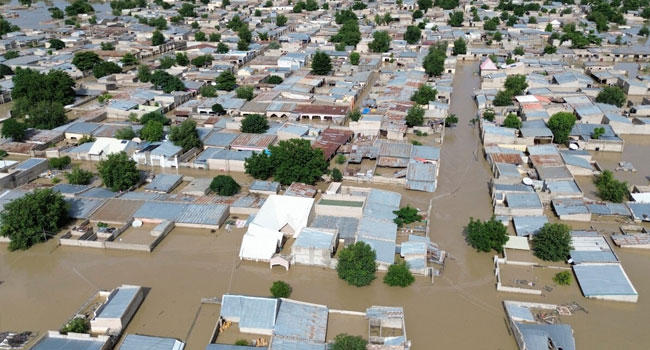
The Anambra, Ebonyi and Enugu state governments have intensified measures to mitigate flooding through improved preparedness, evacuation plans and public sensitisation campaigns.
The three states made the assertion in separate interviews while reacting to a survey by reporters on flood mitigation strategies.
They said the measures form part of a proactive response to the annual flood predictions and reflect their commitment to safeguarding lives, property and critical infrastructure.
The Ebonyi State Commissioner for Environment, Mr Sylvester Nwite, said emergency response agencies have been placed on alert, while vulnerable communities identified through risk assessments have been earmarked for possible evacuation should floodwaters exceed safe levels.
“Temporary shelters have been designated in strategic locations to accommodate displaced persons, with relevant ministries, departments and agencies directed to coordinate emergency response efforts,” Nwite stated.
He urged residents living in flood-prone areas to heed early warning messages and cooperate with emergency management officials whenever evacuation becomes necessary.
“I call on community leaders, traditional rulers and residents to support the state government’s efforts by maintaining clean drainage systems. Refrain from indiscriminate waste disposal and promptly report emerging erosion or flooding incidents to the appropriate authorities,” he said.
On the ecological fund, Nwite added: “I just resumed office as the new Commissioner and I am yet to have such records.”
Also speaking, the Executive Secretary of the Ebonyi State Emergency Management Agency (EBSEMA), Mr Clement Ovuoba, said his team had been working round the clock to check flooding incidents.
Ovuoba said the agency had intensified public awareness campaigns through radio, television, community engagements and social media platforms to educate residents on flood risks, safety precautions, and the need to avoid building on waterways or blocking drainage channels.
On erosion control and flood mitigation, he said ecological fund allocations had been deployed to execute drainage projects, desilt waterways, reclaim erosion sites and construct flood-control infrastructure in vulnerable communities.
He explained that the interventions were aimed at improving water flow, reducing the incidence of gully erosion and minimising the impact of heavy rainfall on residential areas, roads and public facilities.
It will be recalled that the Ebonyi State Government budgeted over N2 billion for the ecological fund to manage natural disasters, flooding and soil erosion in the 2026 fiscal year.
The Enugu State Government has commenced statewide mass media campaigns on flood prevention and alertness in both English and Igbo languages across various radio and television stations.
The Executive Secretary of the Enugu State Emergency Management Agency (SEMA), Mrs Chinasa Mbah, said the sensitisation exercise would ensure that the National Emergency Management Agency (NEMA) 2026 Flood Prediction message reaches all residents.
According to her, the ongoing jingles in English and Igbo are a directive from the governor, who is passionate about the safety of all residents of the state.
Mbah said the various local government councils had carried out the governor’s “Operation Desilt All Drains and Waterways” directive, which had helped contain flash floods in some areas.
She added that the state SEMA, through the council chairmen, had reactivated all Local Emergency Management Committees (LEMCs) in the 17 local government areas.
“We have met with the various council LEMCs, briefed them on their functions, and set up WhatsApp groups for ease of communication and evidence-based feedback from communities,” she said.
“The council LEMCs will take the flood prediction sensitisation to communities, form community flood committees with focal persons, and establish early warning systems. They will update their activities to the chairmen fortnightly, who will transmit same to the office of the Secretary to the State Government (SSG) and SEMA. They are to report any flood emergency immediately to SEMA or the SSG.”
Mbah said the governor had directed chairmen to reactivate and prepare all Internally Displaced Persons (IDP) holding camps. She added that the governor approved training and retraining of SEMA staff, three of which have already been conducted. The agency is also conducting council-area sensitisation and collaborative meetings with stakeholders.
“We are also planning a flood preparedness simulation training with NEMA and other stakeholders soon to test our response timing, rescue and welfare operations,” she said.
The Information Officer of NEMA, Mr Nnayalugo Ezeani, said the agency had started flood preparedness sensitisation in some moderate flood-risk communities in Ezeagu LGA and concluded arrangements for massive engagements across council areas and selected communities in Enugu State.
He noted that NEMA was collaborating with Sahel Consulting to deliver tailored sensitisation to farmers in flood-prone agrarian communities.
In Anambra State, the government has declared a state of emergency on flooding and erosion, sensitising citizens and residents to clear drains and waterways near them.
The Commissioner for Environment, Dr Clem Aguiyi, said the measure was part of efforts to tackle erosion and flooding, especially in line with the 2026 Seasonal Climate Prediction (SCP) by the Nigerian Meteorological Agency (NiMet).
NiMet had warned of variable rainfall patterns, prolonged dry spells, a severe August break in some parts of the country, and generally warmer temperatures. The agency predicted that 32 states, including Anambra, would experience heavy rainfall.
“The state government is doing everything possible to eliminate human factors that block drains across the state. That was why we commenced the emergency clearance of drains on July 4, and citizens turned out in large numbers to participate,” Aguiyi said.
He added that the state of emergency, which began on July 4, would last for three months. Citizens are being mobilised at community, local government and state levels to clear nearby drains.
The commissioner said the government had invested heavily in drainage construction in the last four years, with most new roads having drains on both sides.
He noted that the state would soon enforce environmental laws mandating every house to own a catchment pit for runoff water instead of channelling it into public drains. The government has also started planting bamboo trees and restricting the felling of existing ones to combat gully erosion.
Aguiyi added that the government was considering establishing an environmental trust fund for communities to enable quick responses to environmental emergencies. Emergency centres have also been established across the state for residents in erosion and flood-prone areas.
The Permanent Secretary, Ministry of Environment, Mr Tochukwu Obodogha, said the government had intensified drainage clearance, public sensitisation and early warning campaigns in collaboration with NEMA, targeting flood-prone areas such as Ayamelum, Ogbaru, Anambra East, Awka North, Ihiala, Ekwusigo, Onitsha North and Onitsha South.
An authoritative source at the Anambra State Emergency Management Agency (SEMA) said 27 IDP holding centres had been established across affected local government areas.
The Head, Department of Environment and Ecology in the Ministry of Environment, Mrs Ijeoma Onyekwelu, identified indiscriminate refuse dumping, blocked drainage systems, unregulated construction and excessive paving of compounds as major causes of flooding and erosion.
She said the ministry had commenced a statewide desilting exercise and would enforce the Anambra Environmental Management Protection and Administration Law, 2024, which requires property owners to leave at least 35 per cent of their compounds as bare earth and provide catchment pits.
The Deputy Governor, Dr Onyekachukwu Ibezim, called on the federal government to construct dams and dredge rivers nationwide to reduce the impact of flooding.
Meanwhile, the Chairman of Onitsha South Local Government Area, Mr Emeka Orji, said the ongoing clearance of drains and evacuation of sand deposits was part of efforts to reduce flooding and improve road safety. The exercise is currently ongoing at the Uga Junction Express Road.
Ms Maria Ngu, who was seen clearing the drain in front of her compound near Nkwo Amaenyi in Awka, said the exercise was also helping to reduce mosquitoes around her home.
