


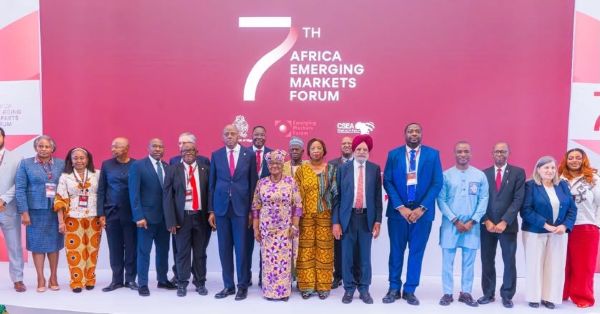
The Central Bank of Nigeria (CBN) hosted the 7th Africa Emerging Markets Forum (AEMF 2026) in Abuja from Wednesday, July 29, to Thursday, July 30, 2026, bringing together policymakers, economists, development experts and industry leaders to examine strategies for building a more resilient and inclusive African economy.
Attended by senior policymakers, central bankers, ministers, development partners, private-sector leaders and economists, the event, themed “Building Resilience Amidst Geoeconomic Uncertainties,” was organised by the CBN in collaboration with the Emerging Markets Forum (EMF) and the Centre for the Study of the Economies of Africa (CSEA).
Over the two-day forum, participants discussed the impact of global economic shocks, monetary policy, regional integration, cross-border payments, artificial intelligence, technology transfer, foreign investment, sustainable urbanisation and job creation, while stressing the need for bold reforms, stronger institutions and coordinated policies to unlock Africa’s growth potential.
ALSO READ Cardoso, Okonjo-Iweala to lead Abuja forum on Africa’s economic resilience
The 7th Africa Emerging Markets Forum underscored that Africa’s economic future will depend on bold reforms, strong institutions, innovation, regional cooperation and the ability to respond strategically to global disruptions.
Africa must move from reaction to strategic action: Global economic shocks, inflation, geopolitical uncertainty and fragile financial conditions require African countries to anticipate risks, strengthen policy coordination and build greater economic resilience.
Macroeconomic stability remains the foundation for growth: Effective monetary policy, fiscal discipline, accountability and close coordination between fiscal and monetary authorities are essential to controlling inflation, restoring confidence and sustaining investment.
Africa must take advantage of its current reform momentum: The continent cannot afford to wait for perfect conditions before acting. Governments, investors and development partners must match ongoing reforms with capital, confidence and long-term partnerships.
Nigeria’s economic ambitions require measurable implementation: The target of a $1 trillion Nigerian economy by 2030 can only be achieved through sound policies, disciplined public finance, institutional accountability, productivity growth and effective coordination across government.
Artificial intelligence is a development opportunity, not merely a technological trend: African countries need bold and forward-looking AI strategies that address its use in governance, workplaces, education, healthcare, agriculture and democratic institutions, while also managing ethical, regulatory and employment-related concerns.
Africa must transition from technology consumer to technology producer: Sustainable development will require stronger investment in research, innovation, skills development and the commercialisation of local knowledge and inventions.
Technology transfer should be central to foreign investment: Africa needs quality investments that create jobs, build local capacity, strengthen domestic industries and facilitate the transfer of technology, rather than investments that simply extract resources without broad economic benefits.
Regional integration must move from aspiration to implementation: Cross-border payments, fintech, infrastructure development, policy harmonisation and stronger cooperation among African countries are critical to expanding intra-African trade and building a more connected continental market.
Digital payments can accelerate economic integration: Efficient, affordable and interoperable payment systems can reduce transaction costs, support small businesses, facilitate trade and make it easier for individuals and firms to operate across African borders.
Inclusive growth must remain the central measure of economic success: Growth should translate into improved livelihoods, decent jobs, wider economic opportunities and better access to services, particularly for young people, women and vulnerable communities.
Fragile and post-crisis economies require tailored policy responses: Food inflation, weak institutions, insecurity and limited policy transmission can undermine economic recovery. Such countries need policies that combine macroeconomic stability with social protection, institutional rebuilding and targeted development support.
Sustainable urbanisation can become a major engine of job creation: Africa’s expanding cities must be supported with reliable infrastructure, affordable housing, efficient transport, digital connectivity and effective planning to convert urban growth into productivity and employment.
Investment in people is as important as investment in infrastructure: Africa’s economic transformation will depend on education, technical skills, research capacity, digital literacy and the ability of institutions to prepare citizens for changing labour markets.
Partnerships are indispensable to Africa’s transformation: Governments, central banks, investors, private-sector actors, researchers and international institutions must work together to develop practical solutions and scale successful initiatives.
Overall message
AEMF 2026 made clear that Africa is entering a decisive phase. The continent has significant opportunities in technology, urbanisation, regional trade, innovation and investment, but unlocking them will require courageous leadership, credible institutions, coordinated policies and a commitment to ensuring that economic growth is broad-based, sustainable and inclusive.
