


Security, intelligence, and legal experts have jointly cautioned that, while Civilian Harm Mitigation and Response (CHMR/CHM) is increasingly central to modern air operations, it should not be mistaken for automatic compliance with international law.
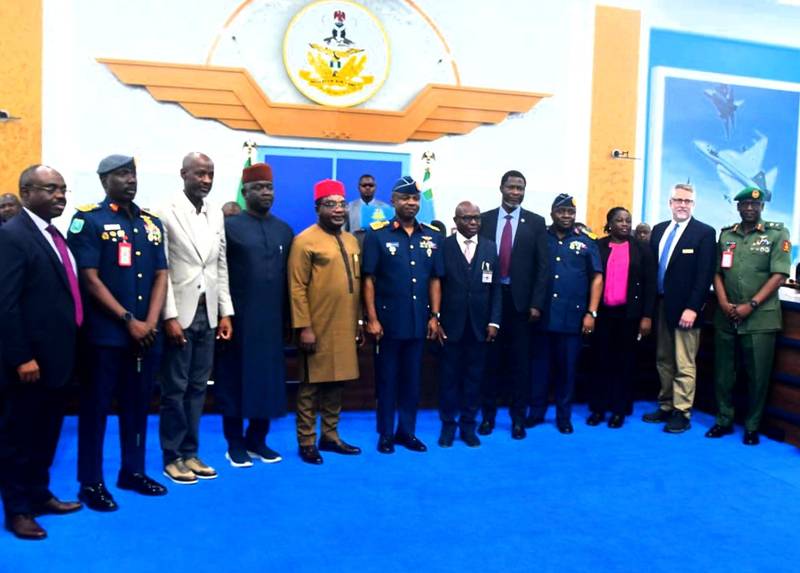
This consensus was reached during a multi-paper presentation on Tuesday in Abuja at a seminar on Civilian Harm Mitigation and Response for strategic-level officers, organized by the Civil-Military Relations Branch.
Dr. Larry Lewis, Dr. Kabiru Adamu, and Dr. Livinus Jatto, in separate presentations, examined the operational, institutional, and legal aspects of civilian harm mitigation in contemporary conflict environments.
The experts agreed that CHMR is a strategic enabler of air power, enhancing legitimacy, intelligence flow, and operational effectiveness. However, they emphasized that its value depends on correct doctrinal, institutional, and legal application.
Dr. Livinus Jatto issued a key legal caution, warning that minimal civilian harm does not automatically equate to compliance with international law.
“Civilian harm mitigation during an operation does not necessarily mean the operation complies with the law,” he stated.
Jatto explained that International Humanitarian Law (IHL), or the law of armed conflict, applies strictly during armed conflicts, where military objectives may be lawfully targeted—even if incidental civilian harm occurs under regulated conditions.
In contrast, International Human Rights Law (IHRL) governs force outside armed conflict and imposes stricter limits on lethal force, making civilian deaths more legally significant.
He stressed that a major operational challenge is correctly classifying the operating environment, as misclassification between conflict and non-conflict situations can pose serious legal and operational risks.
Earlier, Dr. Larry Lewis described CHMR as a product of battlefield learning from Iraq and Afghanistan. He argued that modern warfare is a “competition of learning,” where faster-adapting forces gain strategic advantages.
Lewis noted that mishandling civilian harm can undermine military success, fuel insurgency, and weaken legitimacy—citing operations like Fallujah as examples where tactical gains led to long-term setbacks.
Analysis of over 2,000 civilian harm cases revealed predictable patterns, enabling militaries to develop preventive measures such as tactical patience, improved targeting discipline, and alternatives to kinetic action.
Dr. Kabiru Adamu focused on Nigeria’s complex security environment, describing CHMR as essential in a context of civilian–insurgent intermixing, intelligence uncertainty, and air–ground coordination challenges.
He emphasized that CHMR enhances operational effectiveness, preserves intelligence, and supports strategic communication. It also denies insurgents propaganda advantages and builds community trust.
However, he warned that CHMR becomes an obstacle when treated as a bureaucratic post-incident exercise rather than an embedded operational doctrine.
Adamu called for institutional reforms, including dedicated civilian protection structures, better air–ground integration, AI-enabled intelligence fusion, and structured post-strike response mechanisms.
The experts concluded that modern air operations are now judged not just by kinetic outcomes but by broader standards of legality, legitimacy, intelligence impact, and civilian protection.
They stressed that CHMR is at the intersection of law, operations, and strategy, and must be fully integrated into doctrine, planning, execution, and accountability systems.
“Civilian harm mitigation is not just about reducing casualties; it’s about ensuring lawful, legitimate, and strategically effective air power,” the experts collectively emphasized.
The seminar brought together senior active and retired military officers, security and intelligence experts, legal professionals, and media representatives.
