



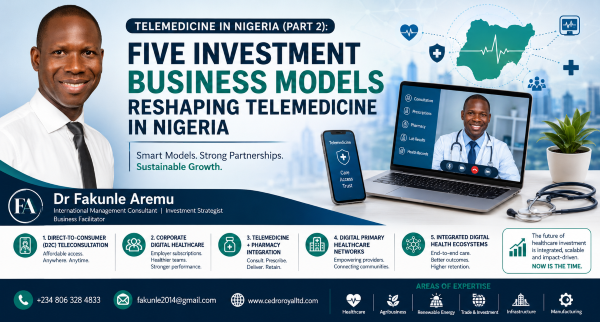
Not every telemedicine business model performs equally well in Nigeria. Investors who align their strategies with local healthcare realities are significantly more likely to achieve sustainable growth. Below are the top five investment business models that are currently dominate the telemedicine business in Nigeria
1. Direct-to-Consumer (D2C) Teleconsultation
Patients subscribe individually and access doctors through mobile applications or websites.
This model generates recurring revenue through consultation fees, subscriptions and medicine delivery commissions.
Examples include DRO Health and Mobihealth International, both of which provide virtual consultations, prescription services and healthcare coordination. Mobihealth has expanded beyond Nigeria into multiple African countries and international markets, demonstrating the scalability of this approach, while DRO Health has built a broad customer base through affordable digital consultations and integrated pharmacy services.
Why it works in Nigeria
- Affordable consultation costs.
- Reduced transportation expenses.
- Twenty-four-hour accessibility.
- High smartphone adoption.
2. Corporate Digital Healthcare
Employers purchase healthcare subscriptions for employees.
Revenue comes through annual corporate contracts rather than individual consultations.
Companies such as Critical Rescue International (CRICare) and Mobihealth International have developed corporate health programmes that include telemedicine, occupational health services, emergency medical support and employee wellness management.
Investment advantage
Corporate clients generate predictable recurring income while reducing customer acquisition costs.
3. Telemedicine Plus Pharmacy Integration
Healthcare consultation is combined with medicine fulfilment.
Patients consult a doctor online before prescriptions are transmitted electronically to partner pharmacies for home delivery.
Companies including DRO Health and MyMedicalBank have adopted variations of this integrated healthcare model.
Why investors like this model
Revenue is diversified across:
- consultation fees;
- pharmacy commissions; and
- laboratory referral income.
This increases customer lifetime value while improving patient retention.
4. Digital Primary Healthcare Networks
Rather than competing with hospitals, technology companies enable hospitals and clinics to become digitally connected.
Examples include TalktoMeDoc and eMedical Comprehensive Consults, which support healthcare providers through virtual consultations, appointment systems and digital patient management.
This business-to-business model benefits from long-term institutional contracts and lower marketing costs than purely consumer-facing platforms.
5. Integrated Digital Health Ecosystems
This represents the most advanced investment model.
Instead of offering only virtual consultations, companies integrate:
- telemedicine;
- electronic medical records;
- laboratory networks;
- diagnostics;
- insurance;
- AI-enabled decision support;
- chronic disease management; and
- remote patient monitoring.
Companies such as Mobihealth International and MyMedicalBank are gradually evolving toward ecosystem-based healthcare delivery.
Globally, ecosystem models tend to generate higher customer retention because patients remain within a single healthcare platform throughout their care journey.
Lessons for Investors
A review of Nigeria’s leading telemedicine companies reveals three consistent success factors.
First, successful firms position themselves as integrated healthcare platforms rather than simple video consultation providers.
Second, strategic partnerships with hospitals, laboratories, pharmacies, insurers and employers create diversified revenue streams and reduce dependence on one market segment.
Third, investor confidence is strengthened by strong clinical governance, compliance with data protection requirements and the ability to scale across multiple African markets. Recent studies of Nigeria’s digital health ecosystem show that sustainable growth is driven by governance quality, regulatory readiness and ecosystem partnerships as much as by technology itself.
Dr. Fakunle Aremu is an international management consultant and investment strategist who facilitates business growth across healthcare, agribusiness, renewable energy, trade, infrastructure and manufacturing. He advises governments, investors and development partners on investment, market entry, public-private partnerships and private sector development, driving sustainable economic growth and enterprise competitiveness.
