

• Home
  • Agric
  • Sci & Tech
  • Health
  • Environment
  • Hausa News
  • More
    • Business/Banking & Finance
    • POLITICS
    • Entertainments & Sports
    • International
    • Investigation
    • Law & Human Rights
    • Africa
    • ACCOUNTABILITY/CORRUPTION
    • Hassan Gimba
    • Column
    • Prof. Jibrin Ibrahim
    • Prof. M.K. Othman
    • Defense/Security
    • Education
    • Energy/Electricity
    • Entertainment/Arts & Sports
    • Society and Lifestyle
    • Food & Agriculture
    • Health & Healthy Living
    • International News
    • Interviews
    • Investigation/Fact-Check
    • LAW & HUMAN RIGHTS
    • Oil & Gas/Mineral Resources
    • PRESS FREEDOM/JOURNALISM/PR
    • General News
    • Presidency
  • About Us
    • Contact Us
    • Board Of Advisory
    • Privacy Policy
    • Ethics Policy
    • Teamwork And Collaboration Policy
    • Fact-Checking Policy
    • Advertising
  • Media OutReach Newswire
    • Wire News
  • The Stories
Facebook Twitter Instagram
Trending
  • Niger connects NUJ secretariat to 24hr broadband, targets 156 public offices
  • NCF urges collective action on climate change
  • Pamilerin urges Lagos to improve flood control
  • Katsina health strike disrupts hospital services
  • Makoda council procures N2.5m drugs for children
  • LPPC gives Gadzama, Malami 14 days to explain why SAN privileges should not be suspended
  • INEC trains staff on electoral offences ahead of 2027 polls
  • Sokoto to engage traditional rulers on community needs
Facebook Twitter Instagram YouTube
AsheNewsAsheNews
  • Home
  • Agric

    Mango association targets 1bn trees in 4 years

    October 17, 2026

    Bayelsa targets food sufficiency through farming

    October 17, 2026

    LIFE-ND deploys N6bn infrastructure in Delta

    October 17, 2026

    Ogun supports 10,000 rice, cassava farmers

    October 17, 2026

    Nigeria’s agriculture records 4.39% growth in Q2 2026

    October 16, 2026
  • Sci & Tech

    Niger connects NUJ secretariat to 24hr broadband, targets 156 public offices

    October 17, 2026

    Tesla unveils flying roadster prototype

    October 17, 2026

    ESDIAC secures licence for Nigeria’s data market

    October 16, 2026

    Nigeria turns abattoir waste into renewable energy

    October 16, 2026

    Cloudvantage launches local cloud platform for banks

    October 15, 2026
  • Health

    Katsina health strike disrupts hospital services

    October 17, 2026

    Makoda council procures N2.5m drugs for children

    October 17, 2026

    Edo reviews VAPP law to strengthen SGBV protection

    October 17, 2026

    NAFDAC debunks claims linking corps member’s death to fake drugs

    October 17, 2026

    NUJ, Women centre partner on empowerment

    October 16, 2026
  • Environment

    NCF urges collective action on climate change

    October 17, 2026

    Pamilerin urges Lagos to improve flood control

    October 17, 2026

    United Nigeria airlines plans ₦20bn commercial paper

    October 16, 2026

    NAHCON advocates investment in Hajj infrastructure

    October 16, 2026

    Kogi assesses climate finance readiness

    October 15, 2026
  • Hausa News

    UNA signs MoU to launch air Bissau in Guinea-Bissau

    June 15, 2026

    Otti plans 250-room 5-star hotel in Umuahia

    April 11, 2026

    Anti-quackery task force seals 4 fake hospitals in Rivers

    August 29, 2025

    [BIDIYO] Yadda na lashe gasa ta duniya a fannin Ingilishi – Rukayya ‘yar shekara 17

    August 6, 2025

    A Saka Baki, A Sasanta Saɓani Tsakanin ‘Yanjarida Da Liman, Daga Muhammad Sajo

    May 21, 2025
  • More
    1. Business/Banking & Finance
    2. POLITICS
    3. Entertainments & Sports
    4. International
    5. Investigation
    6. Law & Human Rights
    7. Africa
    8. ACCOUNTABILITY/CORRUPTION
    9. Hassan Gimba
    10. Column
    11. Prof. Jibrin Ibrahim
    12. Prof. M.K. Othman
    13. Defense/Security
    14. Education
    15. Energy/Electricity
    16. Entertainment/Arts & Sports
    17. Society and Lifestyle
    18. Food & Agriculture
    19. Health & Healthy Living
    20. International News
    21. Interviews
    22. Investigation/Fact-Check
    23. LAW & HUMAN RIGHTS
    24. Oil & Gas/Mineral Resources
    25. PRESS FREEDOM/JOURNALISM/PR
    26. General News
    27. Presidency
    Featured
    Recent

    Niger connects NUJ secretariat to 24hr broadband, targets 156 public offices

    October 17, 2026

    NCF urges collective action on climate change

    October 17, 2026

    Pamilerin urges Lagos to improve flood control

    October 17, 2026
  • About Us
    1. Contact Us
    2. Board Of Advisory
    3. Privacy Policy
    4. Ethics Policy
    5. Teamwork And Collaboration Policy
    6. Fact-Checking Policy
    7. Advertising
    Featured
    Recent

    Niger connects NUJ secretariat to 24hr broadband, targets 156 public offices

    October 17, 2026

    NCF urges collective action on climate change

    October 17, 2026

    Pamilerin urges Lagos to improve flood control

    October 17, 2026
  • Media OutReach Newswire
    • Wire News
  • The Stories
AsheNewsAsheNews
Home»Science/Tech & Innovation/R&D»Smartphone-operated tool uses light beam to detect malaria
Science/Tech & Innovation/R&D

Smartphone-operated tool uses light beam to detect malaria

NewsdeskBy NewsdeskDecember 19, 2022Updated:December 19, 2022No Comments4 Mins Read
Share
Facebook Twitter LinkedIn Pinterest Email

By Neena Bhandari

A smartphone-operated spectrometer has been developed to detect changes in blood caused by malaria.

Speed read

  • Non-invasive tool could speed up malaria diagnosis
  • Smartphone operated tool can detect malaria in real time
  • Technology can also be used to detect dengue and Zika diseases

A quick, affordable, non-invasive detection tool could help accelerate progress in meeting the UN Sustainable Development Goals’ target to eliminate malaria, say researchers who developed it.

The WHO’s global technical strategy for malaria 2016–2030 aims to reduce malaria incidence and mortality rates by at least 75 per cent by 2025 and at least 90 per cent by 2030 against a 2015 baseline.

“This infrared signature is a reflection of what is present in the bloodstream of a person. [As] malaria infects red blood cells causing both structural and chemical changes — these changes are what is observed in the reflected signature.”

But by 2021, malaria case incidence and deaths are both off track by 48 per cent. Based on the current trajectories, the world will be off track in reaching the malaria targets by 88 per cent, according to Abdisalan Noor, head of the Strategic Information for Response Unit, WHO Global Malaria Programme.

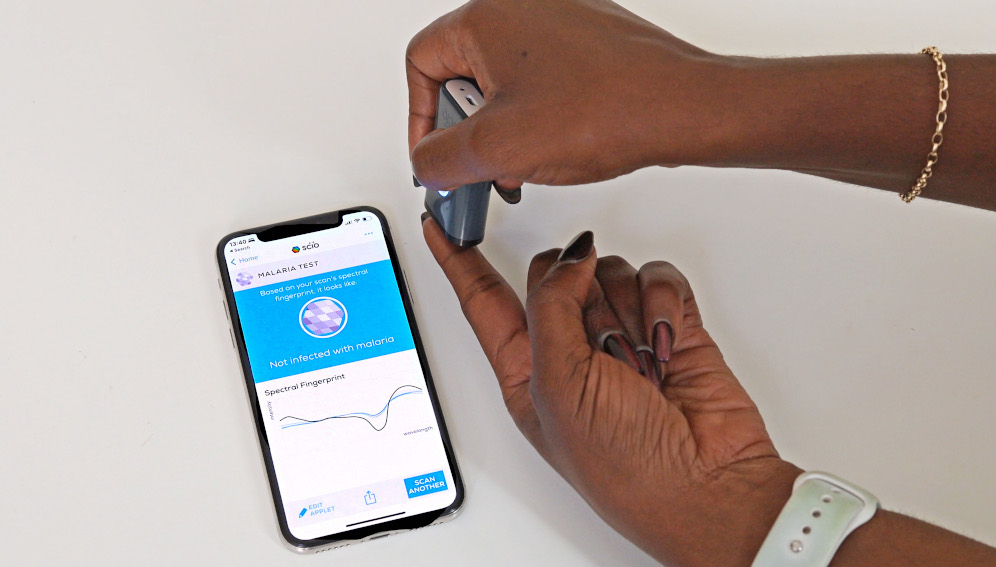
To help get back on track, researchers from Australia and Brazil have come up with a handheld, smartphone-operated, near-infrared spectrometer that shines infrared light for about five seconds on a person’s ears, arms, or fingers to detect changes in the blood caused by malaria.

They hope it could be used for the WHO-proposed universal screening that is a part of current malaria elimination strategies.

“If we can detect a large proportion of asymptomatic patients, they can receive treatment and prevent transmission to others, particularly children under the age of five years,” says Maggy Lord, lead author of the research, published 7 December in PNAS Nexus.

“By shining light on a body part, an infrared signature is detected through a phone or a computer,” Lord, a researcher at the University of Queensland’s School of Biological Sciences, tells SciDev.Net. “This infrared signature is a reflection of what is present in the bloodstream of a person. [As] malaria infects red blood cells causing both structural and chemical changes — these changes are what is observed in the reflected signature.”

Computer algorithms are then used to develop predictive algorithms that can differentiate malaria-infected people from the uninfected, giving results in real-time, she explains.

“These off-the-shelf spectrometers cost roughly US$2,500, but do not require sample processing procedures nor reagents to operate and therefore could easily be scaled up to scan an estimated 1,000 people per day per device,” adds Lord.

The tool is the outcome of a research collaboration between Australia’s University of Queensland and Brazil’s Instituto Oswaldo Cruz.

The technology could also help tackle other vector-borne diseases, such as Zika and dengue in asymptomatic people, who act as a reservoir for transmission by mosquitoes, says Lord.

“This was just proof of concept and with further funding, we will expand the study to other malaria endemic areas before we can recommend these devices for clinical use. We are extending our work with partners in Kenya and Tanzania,” she adds.

The WHO’s 2022 World Malaria Report stresses the need for investment in new tools, along with strengthening health systems and increasing funding. There were an estimated 619,000 deaths and 247 million cases of malaria globally in 2021. While African countries accounted for about 95 per cent of cases and 96 per cent of deaths, nine malaria-endemic countries in the South-East Asia region contributed to about two per cent of the malaria burden last year.

In 2021, more than three quarters of malaria cases in WHO’s South-East Asia region were concentrated in India with case increases also seen in Bangladesh, the Democratic People’s Republic of Korea and Indonesia. In WHO’s Western Pacific region, Papua New Guinea accounted for 87 per cent of all cases in 2021, followed by the Solomon Islands, Cambodia and the Philippines.

Malaria Consortium’s Senior Research Adviser Jane Achan says, “Sensitive diagnostics will play a key role in surveillance and early detection of outbreaks as malaria control efforts intensify and countries progress to elimination phases. As such, new and innovative diagnostic tools are urgently needed, especially in light of emerging threats to the effectiveness of some of the tools currently available.”

“Non-invasive malaria diagnostic tools are attractive as a rapid, reagent-free and affordable approach, but their sensitivity and specificity need to be confirmed in endemic settings and evidence gathered on how they can be integrated into healthcare practice universally,” Achan, who is not connected with the study, tells SciDev.Net.

Credit: SciDev.net

Smartphone-operated tool uses light beam to detect malaria Tech
Share. Facebook Twitter Pinterest LinkedIn WhatsApp Reddit Tumblr Email
Newsdesk
  • Website

Related Posts

Niger connects NUJ secretariat to 24hr broadband, targets 156 public offices

October 17, 2026

Tesla unveils flying roadster prototype

October 17, 2026

ESDIAC secures licence for Nigeria’s data market

October 16, 2026

Leave A Reply Cancel Reply

Niger connects NUJ secretariat to 24hr broadband, targets 156 public offices

October 17, 2026

NCF urges collective action on climate change

October 17, 2026

Pamilerin urges Lagos to improve flood control

October 17, 2026

Katsina health strike disrupts hospital services

October 17, 2026
About Us
About Us

ASHENEWS (AsheNewsDaily.com), published by PenPlus Online Media Publishers, is an independent online newspaper. We report development news, especially on Agriculture, Science, Health and Environment as they affect the under-reported rural and urban poor.

We also conduct investigations, especially in the areas of ASHE, as well as other general interests, including corruption, human rights, illicit financial flows, and politics.

Contact Info:
  • 1st floor, Dogon Daji House, No. 5, Maiduguri Road, Sokoto
  • +234(0)7031140009
  • ashenewsdaily@gmail.com
Facebook Twitter Instagram Pinterest
© 2026 All Rights Reserved. ASHENEWS Daily Designed & Managed By DeedsTech

Type above and press Enter to search. Press Esc to cancel.