

• Home
  • Agric
  • Sci & Tech
  • Health
  • Environment
  • Hausa News
  • More
    • Business/Banking & Finance
    • POLITICS
    • Entertainments & Sports
    • International
    • Investigation
    • Law & Human Rights
    • Africa
    • ACCOUNTABILITY/CORRUPTION
    • Hassan Gimba
    • Column
    • Prof. Jibrin Ibrahim
    • Prof. M.K. Othman
    • Defense/Security
    • Education
    • Energy/Electricity
    • Entertainment/Arts & Sports
    • Society and Lifestyle
    • Food & Agriculture
    • Health & Healthy Living
    • International News
    • Interviews
    • Investigation/Fact-Check
    • LAW & HUMAN RIGHTS
    • Oil & Gas/Mineral Resources
    • PRESS FREEDOM/JOURNALISM/PR
    • General News
    • Presidency
  • About Us
    • Contact Us
    • Board Of Advisory
    • Privacy Policy
    • Ethics Policy
    • Teamwork And Collaboration Policy
    • Fact-Checking Policy
    • Advertising
  • Media OutReach Newswire
    • Wire News
  • The Stories
Facebook Twitter Instagram
Trending
  • Nigeria begins enforcement of new identity law, phases out physical ID cards
  • FMLD urges Abia to establish more veterinary clinics
  • Kaduna ramps up rainy‑season health response, targets malaria and cholera outbreaks
  • i-CCARE urges men 45, above to get routine PSA prostate cancer test
  • IPI Nigeria secures release of journalist from police custody
  • Sokoto 2023 PDP guber candidate Umar Ubandoma defects to APC
  • Akwa Ibom flags off tsetse fly surveillance to protect livestock
  • Lagos saves ₦118bn in property, 1,900 lives from fires in 2025
Facebook Twitter Instagram YouTube
AsheNewsAsheNews
  • Home
  • Agric

    FMLD urges Abia to establish more veterinary clinics

    July 7, 2026

    Akwa Ibom flags off tsetse fly surveillance to protect livestock

    July 7, 2026

    Veterinarian urges dog vaccination to eliminate rabies in Oyo

    July 6, 2026

    Maritime expert urges coastal governors to adopt AU fisheries framework

    July 6, 2026

    Bauchi women reduce grocery bills through backyard farming

    July 6, 2026
  • Sci & Tech

    Nigeria begins enforcement of new identity law, phases out physical ID cards

    July 7, 2026

    Czech ambassador calls for investment in Nigeria’s youth innovation

    July 6, 2026

    China’s smart pet care market booms with AI innovations

    July 6, 2026

    UK-Nigeria tech hub launches NICE to strengthen innovation ecosystem

    July 6, 2026

    Zinox: Reliable power key to Nigeria’s data centre, AI ambition

    July 5, 2026
  • Health

    Kaduna ramps up rainy‑season health response, targets malaria and cholera outbreaks

    July 7, 2026

    i-CCARE urges men 45, above to get routine PSA prostate cancer test

    July 7, 2026

    Nigeria making major reforms in nutrition data, logistics systems

    July 6, 2026

    Tinubu calls for stronger ties with rotary international

    July 6, 2026

    Edo govt reunites deportee with family

    July 5, 2026
  • Environment

    IPI Nigeria secures release of journalist from police custody

    July 7, 2026

    Lagos saves ₦118bn in property, 1,900 lives from fires in 2025

    July 7, 2026

    FCTA clamps down on illegal motor parks in Utako, Banex

    July 6, 2026

    PEPSA intensifies drainage clearance to prevent Jos flooding

    July 6, 2026

    Dangote Cement targets 20% emissions cut, 80mtpa capacity by 2030

    July 6, 2026
  • Hausa News

    UNA signs MoU to launch air Bissau in Guinea-Bissau

    June 15, 2026

    Otti plans 250-room 5-star hotel in Umuahia

    April 11, 2026

    Anti-quackery task force seals 4 fake hospitals in Rivers

    August 29, 2025

    [BIDIYO] Yadda na lashe gasa ta duniya a fannin Ingilishi – Rukayya ‘yar shekara 17

    August 6, 2025

    A Saka Baki, A Sasanta Saɓani Tsakanin ‘Yanjarida Da Liman, Daga Muhammad Sajo

    May 21, 2025
  • More
    1. Business/Banking & Finance
    2. POLITICS
    3. Entertainments & Sports
    4. International
    5. Investigation
    6. Law & Human Rights
    7. Africa
    8. ACCOUNTABILITY/CORRUPTION
    9. Hassan Gimba
    10. Column
    11. Prof. Jibrin Ibrahim
    12. Prof. M.K. Othman
    13. Defense/Security
    14. Education
    15. Energy/Electricity
    16. Entertainment/Arts & Sports
    17. Society and Lifestyle
    18. Food & Agriculture
    19. Health & Healthy Living
    20. International News
    21. Interviews
    22. Investigation/Fact-Check
    23. LAW & HUMAN RIGHTS
    24. Oil & Gas/Mineral Resources
    25. PRESS FREEDOM/JOURNALISM/PR
    26. General News
    27. Presidency
    Featured
    Recent

    Nigeria begins enforcement of new identity law, phases out physical ID cards

    July 7, 2026

    FMLD urges Abia to establish more veterinary clinics

    July 7, 2026

    Kaduna ramps up rainy‑season health response, targets malaria and cholera outbreaks

    July 7, 2026
  • About Us
    1. Contact Us
    2. Board Of Advisory
    3. Privacy Policy
    4. Ethics Policy
    5. Teamwork And Collaboration Policy
    6. Fact-Checking Policy
    7. Advertising
    Featured
    Recent

    Nigeria begins enforcement of new identity law, phases out physical ID cards

    July 7, 2026

    FMLD urges Abia to establish more veterinary clinics

    July 7, 2026

    Kaduna ramps up rainy‑season health response, targets malaria and cholera outbreaks

    July 7, 2026
  • Media OutReach Newswire
    • Wire News
  • The Stories
AsheNewsAsheNews
Home»Food & Agriculture»Researchers grow a plant in nutrient-poor lunar debris, for first time ever
Food & Agriculture

Researchers grow a plant in nutrient-poor lunar debris, for first time ever

NewsdeskBy NewsdeskJune 18, 2022No Comments6 Mins Read
Share
Facebook Twitter LinkedIn Pinterest Email


This article or excerpt is included in the GLP’s daily curated selection of ideologically diverse news,

Opinion and analysis of biotechnology innovation. It is posted under Fair Use guidelines.

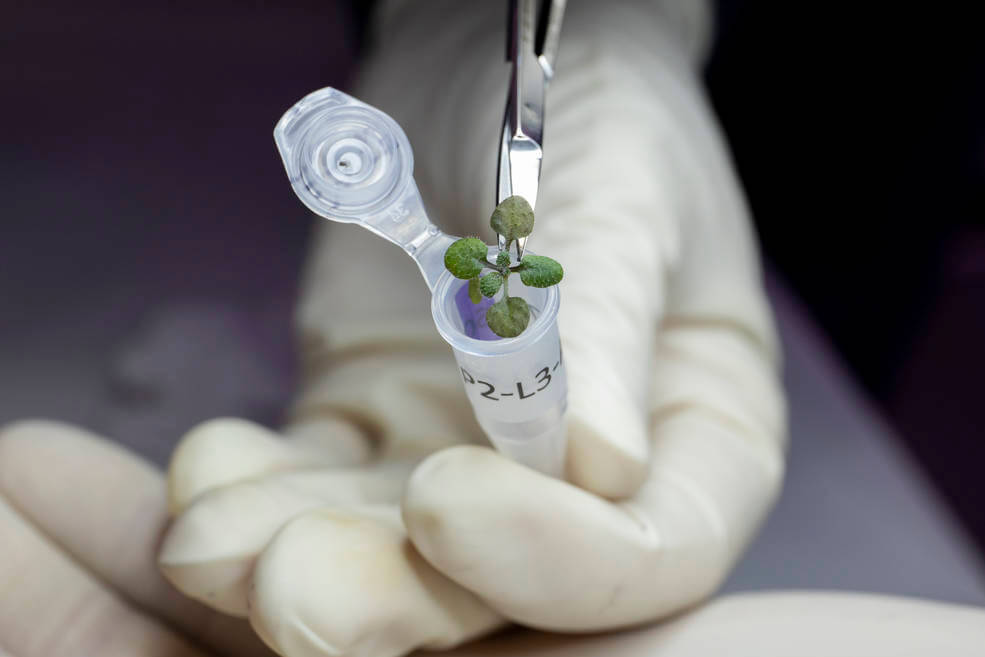
In the early days of the space age, the Apollo astronauts took part in a visionary plan: Bring samples of the lunar surface material, known as regolith, back to Earth where they could be studied with state-of-the-art equipment and saved for future research not yet imagined. Fifty years later, at the dawn of the Artemis era and the next astronaut return to the Moon, three of those samples have been used to successfully grow plants. For the first time ever, researchers have grown the hardy and well-studied Arabidopsis thaliana in the nutrient-poor lunar regolith.

“This research is critical to NASA’s long-term human exploration goals as we’ll need to use resources found on the Moon and Mars to develop food sources for future astronauts living and operating in deep space,” said NASA Administrator Bill Nelson. “This fundamental plant growth research is also a key example of how NASA is working to unlock agricultural innovations that could help us understand how plants might overcome stressful conditions in food-scarce areas here on Earth.”

Scientists at the University of Florida have made a breakthrough discovery — decades in the making — that could both enable space exploration and benefit humanity. “Here we are, 50 years later, completing experiments that were started back in the Apollo labs,” said Robert Ferl, a professor in the Horticultural Sciences department at the University of Florida, Gainesville, and a communicating author on a paper published on May 12, 2022, in Communications Biology. “We first asked the question of whether plants can grow in regolith. And second, how might that one day help humans have an extended stay on the Moon.”

The answer to the first question is a resounding yes. Plants can grow in lunar regolith. They were not as robust as plants grown in Earth soil, or even as those in the control group grown in a lunar simulant made from volcanic ash, but they did indeed grow. And by studying how the plants responded in the lunar samples, the team hopes to go on to answer the second question as well, paving the way for future astronauts to someday grow more nutrient-rich plants on the Moon and thrive in deep space.

To boldly go, we must boldly grow

“To explore further and to learn about the solar system we live in, we need to take advantage of what’s on the Moon, so we don’t have to take all of it with us,” said Jacob Bleacher, the Chief Exploration Scientist supporting NASA’s Artemis program at NASA Headquarters in Washington. Bleacher points out that this is also why NASA is sending robotic missions to the Moon’s South Pole where it’s believed there may be water that can be used by future astronauts. “What’s more, growing plants is the kind of thing we’ll study when we go. So, these studies on the ground lay the path to expand that research by the next humans on the Moon.”

Arabidopsis thaliana, native to Eurasia and Africa, is a relative of mustard greens and other cruciferous vegetables like broccoli, cauliflower, and Brussels sprouts. It also plays a key role for scientists: due to its small size and ease of growth, it is one of the most studied plants in the world, used as a model organism for research into all areas of plant biology. As such, scientists already know what its genes look like, how it behaves in different circumstances, even how it grows in space.

Working with teaspoon-sized samples

To grow the Arabidopsis, the team used samples collected on the Apollo 11, 12, and 17 missions, with only a gram of regolith allotted for each plant. The team added water and then seeds to the samples. They then put the trays into terrarium boxes in a clean room. A nutrient solution was added daily.

“After two days, they started to sprout!” said Anna-Lisa Paul, who is also a professor in Horticultural Sciences at the University of Florida, and who is first author on the paper. “Everything sprouted. I can’t tell you how astonished we were! Every plant – whether in a lunar sample or in a control – looked the same up until about day six.”

After day six, however, it was clear that the plants were not as robust as the control group plants growing in volcanic ash, and the plants were growing differently depending on which type of sample they were in. The plants grew more slowly and had stunted roots; additionally, some had stunted leaves and sported reddish pigmentation.

After 20 days, just before the plants started to flower, the team harvested the plants, ground them up, and studied the RNA. In a biological system, genes are decoded in multiple steps. First, the genes, or DNA, are transcribed into RNA.  Then the RNA is translated into a protein sequence. These proteins are responsible for carrying out many of the biological processes in a living organism.  Sequencing the RNA revealed the patterns of genes that were expressed, which showed that the plants were indeed under stress and had reacted the way researchers have seen Arabidopsis respond to growth in other harsh environments, such as when soil has too much salt or heavy metals.

Additionally, the plants reacted differently depending on which sample – each collected from different areas on the Moon – was used. Plants grown in the Apollo 11 samples were not as robust as the other two sets. Nonetheless, the plants did grow.

Sowing the seeds for future research

This research opens the door not only to someday growing plants in habitats on the Moon, but to a wide range of additional questions. Can understanding which genes plants need to adjust to growing in regolith help us understand how to reduce the stressful nature of lunar soil? Are materials from different areas of the Moon more conducive to growing plants than others? Could studying lunar regolith help us understand more about the Mars regolith and potentially growing plants in that material as well? All of these are questions that the team hopes to study next, in support of the future astronauts traveling to the Moon.

“Not only is it pleasing for us to have plants around us, especially as we venture to new destinations in space, but they could provide supplemental nutrition to our diets and enable future human exploration,” said Sharmila Bhattacharya, program scientist with NASA’s Biological and Physical Sciences (BPS) Division. “Plants are what enable us to be explorers.”

By geneticliteracyproject.com

geneticliteracyproject.com NASA nutrient-poor lunar debris
Share. Facebook Twitter Pinterest LinkedIn WhatsApp Reddit Tumblr Email
Newsdesk
  • Website

Related Posts

Nigeria begins enforcement of new identity law, phases out physical ID cards

July 7, 2026

FMLD urges Abia to establish more veterinary clinics

July 7, 2026

Sokoto 2023 PDP guber candidate Umar Ubandoma defects to APC

July 7, 2026

Leave A Reply Cancel Reply

Nigeria begins enforcement of new identity law, phases out physical ID cards

July 7, 2026

FMLD urges Abia to establish more veterinary clinics

July 7, 2026

Kaduna ramps up rainy‑season health response, targets malaria and cholera outbreaks

July 7, 2026

i-CCARE urges men 45, above to get routine PSA prostate cancer test

July 7, 2026
About Us
About Us

ASHENEWS (AsheNewsDaily.com), published by PenPlus Online Media Publishers, is an independent online newspaper. We report development news, especially on Agriculture, Science, Health and Environment as they affect the under-reported rural and urban poor.

We also conduct investigations, especially in the areas of ASHE, as well as other general interests, including corruption, human rights, illicit financial flows, and politics.

Contact Info:
  • 1st floor, Dogon Daji House, No. 5, Maiduguri Road, Sokoto
  • +234(0)7031140009
  • ashenewsdaily@gmail.com
Facebook Twitter Instagram Pinterest
© 2026 All Rights Reserved. ASHENEWS Daily Designed & Managed By DeedsTech

Type above and press Enter to search. Press Esc to cancel.