


The Attorney-General of the Federation and Minister of Justice, Mr Lateef Fagbemi, says human traffickers’ growing use of digital platforms is challenging Nigeria’s legal and institutional response.
Fagbemi stated this on Thursday in Abuja at the 2026 World Day Against Trafficking in Persons, marked annually on July 30.
Represented by Mrs Victoria Ojogbane, Director of Planning, Research and Statistics in the ministry, he said traffickers had shifted from physical methods to social media, encrypted platforms and fake recruitment websites.
He noted that Nigerian graduates were continuously lured with promises of overseas jobs in technology, digital marketing, cryptocurrency trading and telecommunications, only to be trapped in scam compounds.
Fagbemi said the trend required stronger enforcement of anti-trafficking and cybercrime laws, alongside improved digital evidence capacity and international cooperation.
He said the Trafficking in Persons (Prohibition) Enforcement and Administration Act, 2015, remained the foundation of Nigeria’s anti-trafficking framework, while the Cybercrimes Act complemented efforts by addressing online criminal activities.
The minister added that the Money Laundering (Prevention and Prohibition) Act, 2022, strengthened efforts to trace and confiscate proceeds of trafficking.
Fagbemi said Nigeria’s commitment to international anti-trafficking agreements had strengthened collaboration with regional and global partners.
He said the National Agency for the Prohibition of Trafficking in Persons (NAPTIP) had secured 839 convictions since inception, including 47 between January and July 2026.
According to him, 156 victims were rescued during the same period, while more than 300 Nigerians trafficked to Ghana and Côte d’Ivoire were repatriated in 2025.
He said NAPTIP’s Cyber Response Team had disrupted trafficking-linked scam centres. In addition, 46 suspected victims were intercepted at the Nnamdi Azikiwe International Airport, Abuja, while 120 others were rescued in Kano.
Fagbemi said NAPTIP had also validated the National Strategy for Trafficking in Persons and Violence Against Persons 2025–2027 to strengthen Nigeria’s response to emerging threats.
Citing the United Nations Office on Drugs and Crime, he said more than 300,000 people were trafficked annually into scam compounds in Southeast Asia, generating billions of dollars for criminal networks.
He noted that some Nigerian victims were among those trapped in Myanmar, Cambodia, Laos and the Philippines, where they were forced into online fraud and other cyber-related crimes.
The minister said legislation alone was insufficient, urging technology companies, telecommunications providers and financial institutions to support law enforcement through intelligence sharing and preservation of digital evidence.
He also called on parents, educators, religious and traditional leaders to educate young Nigerians on fake online job offers and fraudulent recruitment schemes.
Fagbemi urged the media to amplify survivors’ voices and sustain awareness of evolving trafficking methods.
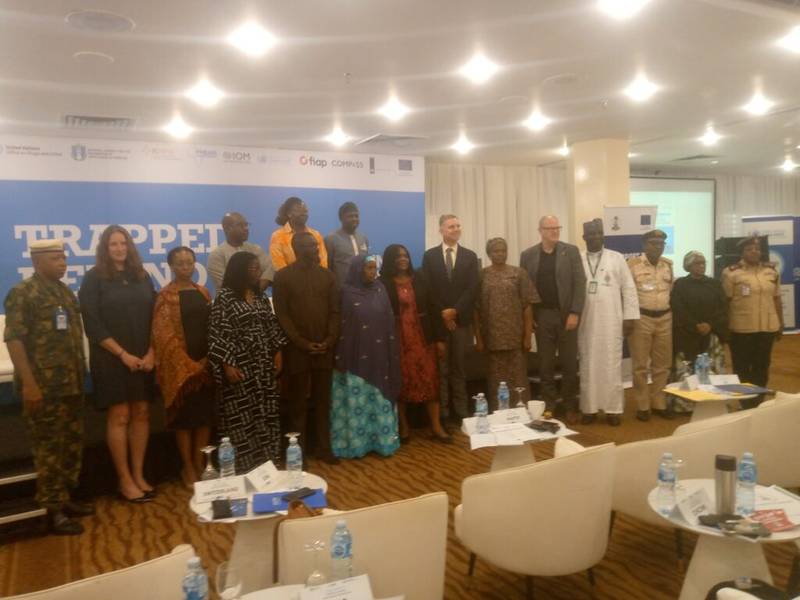
The event, attended by government agencies, civil society organisations and international partners, had the theme “Trapped Behind the Scam.”
