


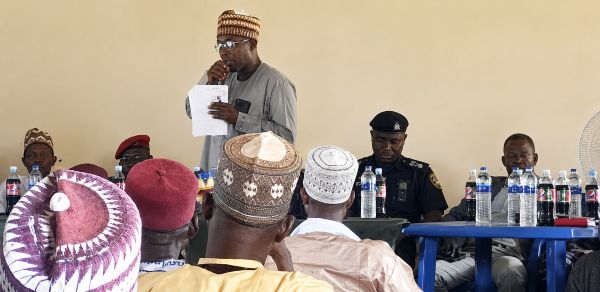
A high-level stakeholders’ meeting involving Fulani leaders, security agencies, farmers, traditional institutions and community representatives has been held in Oyo State to address insecurity, kidnapping, farmer-herder conflicts and the need to strengthen peaceful coexistence between Fulani communities and their host communities.
The meeting, convened by Fulani leadership in the state and hosted by the Chairman of Oyo West Local Government, brought together representatives of the Nigeria Police Force, Department of State Services (DSS), Nigeria Security and Civil Defence Corps (NSCDC), Amotekun Corps, farmers’ associations, traditional institutions, Miyetti Allah Cattle Breeders Association of Nigeria (MACBAN), and Fulani leaders from across Oyo State and the South-West.
The meeting commenced with prayers offered by a Muslim member of the Fulani community.
Among those represented at the gathering were Governor Seyi Makinde by Hakeem Salam; the Oyo West Local Government Chairman represented by Muyideen Adeyemi; the Alaafin of Oyo, Wahidi Ishola; representatives of the Oyo State Government; the Divisional Officer (DPO) of Afijio, Mojid Lawal, who represented the Oyo State Commissioner of Police and the Divisional Officer (DPO) of Oyo West, Aroloye Adesiji.
Others were representatives of the DSS; Oyo State Commandant of the NSCDC, Mr I.O. Olawuyi; Amotekun Corps; Ardo Fulani of Oyo State; National President of MACBAN, represented by A.B. Danmasani; Oyo State Chairman of MACBAN, Ibrahim Jiji; representative of the farmers council Chairman, Mr Oladeji Emmanuel; representative of the Sarki Fulani of Lagos, Farooq Gajo; Sarkin Fulani from across the state; Woman Leader of the South-West Fulani Council, Aminat Galadima; and the Chairman of Igboho, among others.
The Chairman of Oyo State MACBAN and convener of the meeting, Ibrahim Jiji, in his opening remarks, said the gathering was organised to draw the attention of the people of Oyo State to emerging security and Fulani challenges as well as to encourage collective responsibility in maintaining peace.
While acknowledging the commitment of the Oyo State Government to peace and security, he stressed that government alone could not guarantee peace without the cooperation of citizens. “We, the people, also have a responsibility to ensure peace,” he said.
Jiji noted that the meeting was particularly concerned with the persistent problem of kidnapping and the tendency to associate criminal activities with the entire Fulani community.
According to him, the Fulani community had been facing persecution in some parts of the state because of the perception that confronting one Fulani person would lead to the exposure of other suspected criminals.
He urged the government and members of the public to distinguish between law-abiding Fulani citizens and individuals involved in criminal activities.
“We are not criminals. We are not kidnappers. If we have a Fulani who is a criminal, we will not hide him. Likewise, if there is a criminal among our host Yoruba communities, they should not hide him. This is how to ensure peace,” he said.
The MACBAN chairman also raised concerns about the presence of what he described as foreign cattle rearers who had allegedly infiltrated some communities, urging the government and community leaders to take appropriate action.
He said the Fulani community was ready to assist the authorities by providing relevant information about suspicious individuals and activities.
The speaker also called for a solution to the challenges surrounding grazing, stressing that cattle rearers needed access to appropriate grazing areas to sustain their livestock.
He appealed to the government to ensure that Fulani communities, like other Nigerian citizens, benefited from the economic opportunities available in the country. “We are all citizens of Nigeria, and we should be able to benefit as others do,” he said.
Farmers and Fulani urged to work together
Speaking on behalf of the farming community, Secretary Oyi State Farmers Council, Kasali Kupah, described farmers and Fulani residents as neighbours who had historically lived peacefully together.
He said the Yoruba and Fulani communities in Oyo State had developed strong relationships over the years and should not allow conflicts to destroy the bonds between them.
“We and the Fulani in our land are together as brothers. Yoruba in Kano may not know what is happening here, but you Fulani in Oyo State are our neighbours. Together, we will make peace,” he said.
He appealed to farmers to avoid cultivating on established grazing routes, saying that farmers who encroached on such routes were sometimes assisted in removing their farms to prevent confrontation.
He added that farmers’ groups had sufficient personnel to support Fulani communities and other stakeholders in maintaining peaceful relations.
MACBAN calls for greater care for vulnerable Fulani
The National President of MACBAN, Baba Othman Ngelzarma, commended the cooperation between Fulani communities and their hosts in Oyo State, describing it as a model worthy of emulation.
Represented by A.B. Danmasani, the MACBAN president expressed concern over the increasing breakdown of social cohesion in some parts of Nigeria, where ethnic and communal tensions had created situations in which different groups turned against one another.
He also called on affluent members of the Fulani community to pay greater attention to the welfare of poor and vulnerable members of the community.
He urged traditional leaders, community heads and less privileged members of the society to cooperate with government and security agencies in the interest of peace.
Local government seeks greater involvement of traditional rulers
Representative of the Oyo West Local Government Chairman, Ambassador Muyideen Adeyemi, said there was a cordial relationship between Yoruba residents and Fulani communities in the local government.
He clarified that the meeting was not limited to Oyo West but was convened as part of a wider effort to promote peace and security across Oyo State.
Adeyemi, however, stressed the importance of involving traditional rulers in future engagements, noting that Obas and other traditional authorities were strategically positioned to communicate government and security messages to residents in rural communities.
He advised MACBAN leaders across the state’s local government areas to establish closer working relationships with their respective local government executive chairmen.
According to him, meetings aimed at promoting peace and resolving community disputes would be more effective when traditional rulers were fully involved.
He also urged relevant authorities to ensure that community leaders were accessible and available to listen to grievances from residents.
Farmers and Fulani are not enemies
The representative of the state farmers council chairman, Oladeji Emmanuel, said the relationship between farmers and Fulani should not be defined by hostility.
He argued that most disputes between the two groups were primarily economic and centred on competing interests over land, crops and livestock.
“Agbe (farmers) and Fulani are not enemies towards one another. The issues between them are economic—the properties between them,” he said.
He called for improved communication between farmers, Fulani leaders, traditional rulers and local government authorities.
According to Emmanuel, some traditional rulers and local government officials do not always respond promptly to complaints from farmers and Fulani communities.
He also raised concerns about the admission of strangers into communities by some traditional rulers without adequate consultation with either farmers or cattle rearers.
He called for a return to the traditional system of cooperation that previously existed between farmers and Fulani communities.
He warned that some individuals benefiting from conflicts between the two groups would not want them to come together in peace and urged farmers and herders to unite against those seeking to exploit communal tensions.
Oladeji Emmanuel also appealed to Fulani leaders to respond promptly whenever security agencies or community leaders request their assistance in resolving emerging disputes.
Police commends Fulani leadership
The DPO of Oyo West, Aroloye Adesiji, said his area of responsibility had witnessed relative peace between Fulani residents and their host communities, noting that farmers and Fulani cattle rearers were economically interconnected, stressing that both groups depended on activities carried out in rural areas.
He said there were instances where some farmers deliberately invited Fulani cattle rearers to allow their animals to graze on farms after harvesting, so their excreta would serve as manure that would fertilise crops to grow well.
Aroloye Adesiji, a Chief Superintendent of Police (CSP), commended the Sarki Fulani in Oyo West for maintaining communication with the police and promptly reporting the presence of unfamiliar Fulani individuals in the area.
He added that the Sarki also alerted the police when Yoruba residents allegedly brought unfamiliar Fulani individuals into rural communities.
Police warn against collective blame
Speaking on behalf of the Commissioner of Police, the Divisional Police Officer (DPO) in Afijio, CSP Mojid Lawal, commended the Fulani leadership for organising the meeting, describing it as consistent with the community-policing strategy being promoted by the police hierarchy.
He supported the call for traditional rulers to be actively involved in the peace initiative, noting that Obas and community leaders had the authority and influence to communicate directly with Baales and residents in rural communities.
He also acknowledged concerns over the tendency to blame all criminal activities on the Fulani people.
According to him, while the police sometimes arrest suspects who speak Fulfulde, investigations have also established cases where Yoruba individuals were responsible for crimes or had allegedly facilitated the entry of unfamiliar Fulani persons into communities for criminal purposes.
He therefore urged the public to avoid ethnic profiling and allow security agencies to conduct proper investigations before reaching conclusions.
The police representative also appealed to Fulani leaders to exercise greater vigilance over children sent out to herd cattle.
He noted that placing the responsibility of herding hundreds of cattle on very young children could create security and safety challenges.
He cited an incident in which a farmer was allegedly stabbed during a clash with a Fulani individual. According to him, the local Sarki Fulani immediately intervened, promised to produce the suspect and subsequently spent more than N1 million on the medical treatment of the injured farmer.
He said the incident demonstrated the importance of responsible community leadership and urged Fulani leaders to respond promptly whenever security agencies summoned them.
Another speaker at the meeting called on both farmers and cattle rearers to respect one another’s property.
He appealed to farmers to desist from poisoning cattle and urged both sides to avoid taking the law into their own hands.
He encouraged members of the public to report suspicious activities to security agencies promptly, stressing the importance of the principle: “When you see something, say something.”
DSS praises Oyo West local government boss
The representative of the DSS commended the Chairman of Oyo West Local Government for what he described as a significant investment in regular community engagement.
He particularly praised the local government’s weekly Wednesday meetings, which he said had contributed to maintaining communication between the authorities and residents.
He urged the Sarki Fulani of Oyo State to make attendance at such meetings a priority to strengthen cooperation between Fulani communities, government authorities and security agencies.
Amotekun calls for better security orientation
The representative of the Amotekun Corps and Acting Zonal Coordinator also called for measures to address the root causes of conflicts between farmers and herders.
She urged Fulani leaders to intensify security and safety education among their members, particularly those involved in cattle herding.
She stressed that Fulani people were Nigerian citizens and should not be collectively profiled as criminals because of the actions of individuals.
She called for greater collaboration between community leaders and security agencies to prevent criminal activities and resolve disputes before they escalate.
Sarki Fulani of Lagos calls for trust between security agencies and Fulani
Speaking on behalf of the Sarki Fulani of Lagos and Chairman Council of Fulani Chiefs South West, Farooq Gajo commended Fulani leaders in Oyo State, as well as the security agencies, for their efforts to promote peace.
He said the various contributions at the meeting demonstrated a shared desire for peaceful coexistence.
He emphasised that criminality had neither tribe nor religion and pledged the continued cooperation of the Fulani community with security agencies.
However, he explained that the reluctance of some Fulani herders to approach security agencies was partly caused by what he described as experiences of alleged discrimination and mistreatment.
He said some Fulani people viewed security personnel and certain members of host communities with suspicion because they feared they might not receive fair treatment if they reported themselves or their concerns.
According to him, the Fulani community would be more willing to cooperate with security agencies if they were assured of their safety and treated fairly.
He also argued that Fulani communities often lacked the media platforms and communication channels available to other groups, making it difficult for them to present their side of security-related disputes.
He therefore appealed to security agencies and other stakeholders to listen to Fulani communities and provide assurances that their rights and safety would be protected.
Call for sustained dialogue
The meeting ended with a broad consensus on the need for sustained dialogue, stronger collaboration between security agencies and community leaders, and greater involvement of traditional rulers in resolving farmer-herder disputes.
Participants stressed that neither farmers nor Fulani communities should be collectively blamed for crimes committed by individuals.
They called for timely reporting of suspicious activities, prompt intervention in emerging disputes, respect for the property of others, and greater cooperation between farmers, herders, traditional rulers, local government authorities and security agencies.
The stakeholders also agreed that regular engagements, such as the meeting, could help address misinformation, build trust and prevent local disputes from escalating into wider security crises.
The gathering ultimately underscored the shared responsibility of government, traditional institutions, security agencies, farmers, Fulani communities and other residents to protect lives and property and sustain peace across Oyo State.
Fulani woman raises alarm over attacks, alleged underreporting of violence against community in Oyo
A concerned Fulani woman, Aminat Idris, has called for a broader examination of the security challenges facing Fulani communities in Nigeria, arguing that the issues should not be viewed solely through the lens of farmer-herder conflicts.
Speaking at a stakeholders’ peace and security meeting involving Fulani leaders, security agencies, farmers and community representatives in Oyo State, Idris expressed concern over what she described as the vulnerability of Fulani communities and the lack of adequate platforms to amplify their grievances.
According to her, many Fulani people believe they have limited access to influential voices capable of defending their interests whenever they are victims of violence.
“No Fulani suffer like the Fulani tribe in Nigeria because they believe they have no helper or defender. We need to look at this problem beyond farmer-herder clashes,” she said.
Idris alleged that a Fulani settlement in Ago-Are, Oyo State, was attacked on Monday, July 20, 2026, resulting in the death of two members of the community, while another person was reportedly abducted.
She expressed disappointment that the incident had allegedly not received adequate public attention, particularly from the media.
“Yesterday, Monday, July 20, 2026, in Ago-Are, a Fulani settlement was attacked. Two Fulani were killed, while another was kidnapped. Nobody is helping us to speak out about these things. The media do not report all of these evils happening to us because they see us as nothing,” she alleged.
The Fulani woman also lamented what she described as the difficulties faced by members of the community in parts of Oyo State, particularly those living in rural areas.
She argued that some security challenges affecting Fulani communities could not be effectively addressed by local police officers or Fulani traditional leaders alone, especially when the alleged perpetrators were not members of the Fulani community.
Her comments added another dimension to discussions at the meeting, where participants had earlier called for an end to collective blame and ethnic profiling in the handling of security challenges.
The meeting, which brought together Fulani leaders, farmers, traditional institutions, local government officials and representatives of the Nigeria Police Force, Department of State Services (DSS), Nigeria Security and Civil Defence Corps (NSCDC) and Amotekun Corps, emphasised the need for all communities to work with security agencies in addressing criminality.
Idris’s intervention also highlighted the concerns of some Fulani residents who believe that incidents involving members of their community are not always given the same level of public attention as other security-related incidents.
She therefore called for a more balanced approach to reporting insecurity, urging the media, government and security agencies to ensure that victims of violence are treated equally, regardless of their ethnic or communal background.
Her remarks further reinforced calls made at the meeting for stronger communication between Fulani communities and security agencies, as well as the need for prompt reporting and investigation of attacks.
Participants at the gathering maintained that criminality should be treated as an individual act rather than an ethnic or religious identity, while urging all communities to cooperate with security agencies and avoid taking the law into their own hands.
The stakeholders also stressed the importance of building trust between communities and security agencies, saying that effective security could only be achieved when victims and witnesses felt safe enough to report crimes and when all allegations were investigated impartially.
