


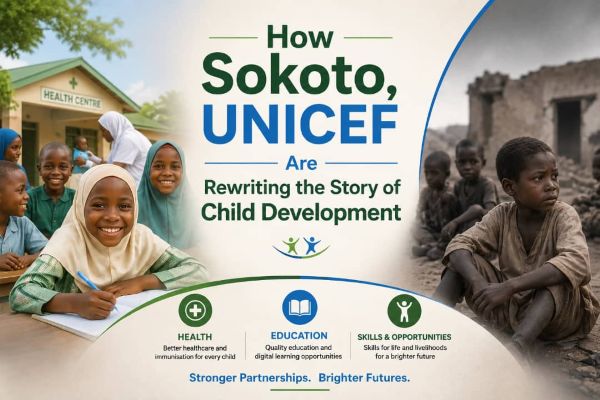
For many years, Sokoto State has featured prominently in discussions on child development in Nigeria. The challenges have been enormous, with high numbers of out-of-school children, low immunisation coverage, child malnutrition, maternal and infant mortality, poverty and, more recently, insecurity that has disrupted access to schools and healthcare facilities in some communities.
These realities have shaped the lives of thousands of children, limiting their chances of growing up healthy, educated and productive.
Today, however, a different story is gradually emerging. While the challenges remain, deliberate investments by the Sokoto State Government, complemented by the technical and financial support of the United Nations Children’s Fund (UNICEF), are beginning to change the narrative of child development in the state.
The recent visit of UNICEF Executive Director Catherine Russell, to Sokoto underscored the significance of this partnership. Rather than a ceremonial visit, it provided an opportunity to assess ongoing interventions aimed at improving the lives of children and to reaffirm a shared commitment to building a brighter future for the state’s youngest citizens.
Healthcare has become one of the strongest pillars of this collaboration. The recruitment of more than 1,500 nurses and midwives, alongside the engagement of 2,440 Community Health Extension Workers, has strengthened primary healthcare services, particularly in rural communities where access has traditionally been poor. Expanded routine immunisation, nutrition screening and maternal healthcare services are helping to reduce preventable diseases and improve child survival.
ALSO READ UNICEF urges stronger leadership, community action to tackle child health challenges
The fight against polio also remains a major priority. Nigeria’s certification as free of the wild poliovirus in 2020 demonstrated what sustained political commitment, community mobilisation and strong partnerships can achieve.
Maintaining those gains requires ensuring that every child receives life-saving vaccines and that disease surveillance remains effective. Sokoto’s continued commitment to these efforts is encouraging.
Education presents another important area of progress. For decades, thousands of children, particularly Almajiri and other out-of-school children, have struggled to access quality education. Recognising that education extends beyond the classroom, the state government, working with UNICEF, has expanded programmes that combine literacy, vocational training and life skills.
The establishment of the digital learning village in Sokoto, with support from UNICEF, reflects a growing recognition that today’s children require digital knowledge alongside conventional education. These centres are equipping young people with practical skills needed to participate in an increasingly technology-driven economy.
Equally significant are the state’s skills acquisition programmes. According to government figures, 2,720 Almajiri and out-of-school children have completed vocational training and received starter packs to establish small businesses or begin productive livelihoods. Such initiatives not only restore hope but also reduce vulnerability to poverty and social exclusion.
Nevertheless, much work remains. Insecurity continues to limit access to schools and healthcare services in some communities. Malnutrition, learning poverty and the large population of vulnerable children still demand sustained attention. But recent efforts by the state government and UNICEF to reverse the ugly trend of malnutrition are commendable. Progress must therefore be measured not only by the number of facilities constructed or personnel recruited but by tangible improvements in the lives of children and families.
The partnership between Sokoto State and UNICEF offers an important lesson: lasting development is achieved when political leadership is matched by technical expertise, community participation and consistent investment in people. Neither government nor development partners can succeed in isolation, but together they can build resilient systems that protect children and expand opportunities.
Ultimately, the success of these efforts will not be judged by official visits or policy announcements. It will be measured by healthier newborns, fully immunised children, classrooms filled with eager learners, young people equipped with employable skills and families whose hopes are renewed.
If the current momentum is sustained, Sokoto may well become a model of how strategic partnerships can transform child development. More importantly, it will demonstrate that investing in children is not simply a social responsibility; it is the most enduring investment any society can make in its future.
