


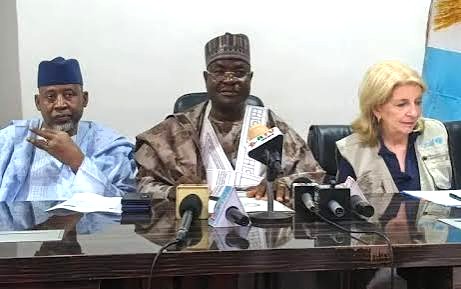
The Executive Director of the United Nations Children’s Fund (UNICEF), Catherine Russell, has called for sustained political leadership, stronger community engagement, and expanded partnerships to address Nigeria’s remaining child health challenges, particularly immunisation gaps.
Speaking during a courtesy visit to Sokoto State Governor Ahmed Aliyu on Friday, Russell said Nigeria’s certification as free of wild poliovirus in 2020 showed that complex public health challenges could be overcome through collective action.
She stressed the need to protect that achievement by ensuring every child receives routine immunisation, that missed children are reached, and disease surveillance remains robust.
Russell described Sokoto as a strategic state with one of Nigeria’s youngest populations and significant potential to drive the country’s human capital development.
She commended the state’s partnership with UNICEF after visiting a digital learning village and a primary healthcare centre, where she observed literacy and vocational training, routine immunisation and nutrition screening.
“What I saw today demonstrates what is possible when governments and partners work together,” she said.
According to her, Sokoto has the potential to become a national model for translating political commitment into measurable improvements in child health, education and skills development.
She reaffirmed UNICEF’s readiness to deepen its partnership with the state by strengthening public systems, improving service delivery and generating evidence to support better investments in children’s welfare.
Responding on behalf of Governor Aliyu, Deputy Governor Idris Muhammad Gobir thanked UNICEF for its continued support and for including Sokoto in Russell’s mission to Nigeria.
Gobir said the state government had prioritised maternal and child healthcare through free medical services, rehabilitation of health facilities and major investments in human resources for health.
He disclosed that the administration had recruited more than 1,500 nurses and midwives for rural health facilities and employed 2,440 community health extension workers to strengthen primary healthcare services across the state.
The deputy governor also highlighted ongoing investments in rural water supply, education and skills development, noting that the state had established 10 integrated Qur’anic schools and two child-friendly centres in partnership with UNICEF.
He added that 2,720 Almajiri and out-of-school children had graduated from state-supported skills acquisition programmes and received starter packs to support their livelihoods.
Gobir acknowledged UNICEF’s technical and financial assistance, particularly under the European Union-supported SARA programme implemented with UNFPA, saying the collaboration had strengthened efforts to reduce maternal, newborn and child mortality.
While reaffirming the state’s commitment to improving education and healthcare, he noted that insecurity continued to threaten schools and health facilities in parts of Sokoto and appealed to UNICEF for additional support in rebuilding critical infrastructure.
