


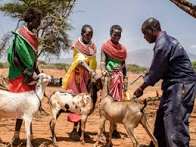
The Federal Government has reaffirmed its commitment to eradicating the deadly Peste des Petits Ruminants (PPR), a viral disease affecting sheep and goats, to protect livelihoods, strengthen the livestock sector, and support food security.
The Permanent Secretary of the Federal Ministry of Livestock Development, Dr Chinyere Akujobi, made this known on Thursday in Abuja at a workshop to review and align the National Strategic Plan for the Control and Eradication of PPR in Nigeria.
The workshop was organised by the Pan-African Secretariat for the Eradication of PPR (PAPS), funded by the European Union, in collaboration with the Federal Ministry of Livestock Development.
Akujobi said small ruminants remain the primary economic safety net for millions of households, making their protection central to the government’s agricultural transformation agenda.
She described PPR as one of the most economically devastating transboundary animal diseases affecting sheep and goats across Africa, Asia, and parts of the Middle East.
According to her, the disease continues to threaten livelihoods, reduce household incomes, and constrain the growth of the livestock sector.
Akujobi noted that Nigeria’s large small-ruminant population and its extensive transboundary trade with Niger, Benin, Cameroon, and Chad make the country’s efforts critical to the success of the livestock economy across West Africa.
She said effective control of the disease would reduce poverty, strengthen the resilience of rural communities, improve livestock productivity, and expand trade opportunities.
“This immense economic reality demands that our administrative and financial investments are guided by a modern, robust strategic framework,” she said.
Akujobi said the establishment of the Federal Ministry of Livestock Development underscores the Federal Government’s commitment to positioning the livestock sector as a key driver of food security, economic diversification, employment generation, and rural development.
She reaffirmed Nigeria’s commitment to the global target, led by the Food and Agriculture Organisation (FAO) and the World Organisation for Animal Health (WOAH), to eradicate PPR by 2030.
According to her, Nigeria has implemented disease surveillance, laboratory strengthening, outbreak investigations, targeted vaccination campaigns, stakeholder engagement, and capacity-building programmes to reduce the burden of PPR.
The interventions have also strengthened disease reporting and response systems.
Akujobi, however, noted that changes in livestock production systems, increasing animal movements, evolving disease patterns, and advances in disease control strategies require periodic reviews of the national strategy.
She said the workshop would provide an opportunity to assess progress, identify gaps, incorporate emerging priorities, and align Nigeria’s strategy with current regional and global frameworks.
“We recognise that disease eradication must be supported by strong surveillance systems, efficient reporting mechanisms, effective laboratory networks, adequate resource mobilisation, stakeholder ownership and sustained political commitment,” she said.
