



Introduction: Across the drylands and savannah landscapes of Nigeria, millions of Neem trees stand as one of the country’s most overlooked economic assets. For decades, Neem (Azadirachta indica) has been valued primarily for its medicinal, environmental and agricultural benefits, particularly among rural communities that have relied on the tree for traditional healthcare, shade and natural pest control (National Research Council, 1992). However, as global markets increasingly shift toward sustainable agriculture, green manufacturing, natural products and climate-smart solutions, Neem is emerging as a strategic bioeconomy resource with significant commercial potential (FAO, 2023; UNEP, 2023).
Around the world, demand for biological pesticides, organic fertilizers, natural cosmetic ingredients and plant-based wellness products continues to grow as consumers, governments and industries seek environmentally responsible alternatives to conventional products (OECD, 2023; Grand View Research, 2024). Yet despite possessing extensive Neem resources, Nigeria has not fully developed the industrial value chains required to transform this natural asset into a driver of economic growth, employment generation and export diversification.
This article argues that Neem should no longer be viewed merely as a medicinal tree. Rather, it should be recognized as a strategic industrial resource capable of supporting sustainable agriculture, green industrialization, climate resilience and rural economic transformation. By investing in collection systems, processing infrastructure, product innovation and market development, Nigeria has an opportunity to build one of Africa’s most competitive bioeconomy industries.
Why Neem Matters in the Global Bioeconomy
The global economy is undergoing a gradual transition from dependence on fossil-based and synthetic products toward biological and renewable alternatives. This transformation, commonly referred to as the bioeconomy, encompasses industries that utilize biological resources to produce food, energy, industrial materials, pharmaceuticals, chemicals and consumer products (OECD, 2023).
Several global trends are accelerating this transition.
First, growing concerns regarding environmental degradation and climate change are encouraging governments and industries to adopt more sustainable production systems (UNEP, 2023). Second, increasing awareness of food safety and pesticide residues is driving demand for biological crop protection products and organic agricultural inputs (FAO, 2023). Third, consumers are increasingly seeking natural ingredients in cosmetics, personal care products and wellness formulations (Grand View Research, 2024).
Neem is uniquely positioned within this emerging landscape because it supports multiple industries simultaneously. The tree produces seeds, oil, leaves, bark and other derivatives that can be utilized in agriculture, pharmaceuticals, cosmetics, veterinary products and environmental restoration programmes (National Research Council, 1992).
One of Neem’s most significant advantages is its role in sustainable agriculture. Research indicates that compounds such as azadirachtin possess insecticidal properties that support biological crop protection and integrated pest management systems (Isman, 2020). As global agricultural systems seek alternatives to conventional synthetic pesticides, demand for Neem-based formulations is expected to continue expanding.
Beyond agriculture, Neem has become increasingly relevant within the natural cosmetics industry. Manufacturers are incorporating Neem oil and extracts into soaps, shampoos, lotions and skin care products as part of the broader movement toward plant-based ingredients (Grand View Research, 2024).
Neem also contributes to environmental sustainability through land restoration, drought resilience and carbon sequestration. These characteristics align strongly with emerging climate finance mechanisms and nature-based solutions programmes supported by governments and development finance institutions worldwide (UNEP, 2023).
Taken together, these trends suggest that Neem is not simply an agricultural commodity. It is a strategic bioeconomy resource positioned at the intersection of climate resilience, sustainable agriculture, industrial innovation and green growth.
Nigeria’s Neem Advantage
Nigeria possesses several advantages that position it to become a leading Neem processing and commercialization hub in Africa.
The most important advantage is resource availability. Neem trees are widely distributed across northern and central Nigeria, particularly within the Sudan and Sahel ecological zones where climatic conditions favor their growth (FAO, 2020). States such as Kano, Kaduna, Katsina, Jigawa, Sokoto, Kebbi, Bauchi and Yobe contain substantial Neem populations, many of which remain commercially underutilized.
Unlike many agricultural industries that require significant investment in cultivation, much of Nigeria’s Neem resource base already exists. Every year, large quantities of Neem fruits and seeds are produced naturally, yet a significant proportion remains uncollected and unused (RMRDC, 2018). This creates an opportunity to develop value chains around an existing resource rather than establishing entirely new production systems.
Nigeria’s large agricultural economy further strengthens its competitive position. Agriculture remains one of the country’s most important economic sectors, creating substantial domestic demand for crop protection products, soil fertility solutions and sustainable agricultural inputs (Federal Ministry of Agriculture and Food Security, 2024). Neem-based products can serve these markets while reducing dependence on imported alternatives.
The country’s manufacturing potential also provides an important advantage. Existing industrial infrastructure can support the processing of Neem into oils, biopesticides, fertilizers, cosmetic ingredients and other value-added products. As Nigeria continues to pursue industrialization and import substitution strategies, Neem processing aligns closely with national development objectives (UNIDO, 2023).
Furthermore, Nigeria’s strategic location provides access to regional markets through the African Continental Free Trade Area (AfCFTA), creating opportunities for exports to neighbouring countries and broader African markets (African Union, 2024).
Taken together, these factors position Nigeria as one of the countries best placed to lead the development of a competitive Neem industry on the African continent.
Market Opportunities Across the Value Chain
The economic potential of Neem lies in its ability to generate value across multiple industries and market segments. Unlike many commodities that produce a single primary output, Neem supports a diversified value chain with numerous commercial applications (National Research Council, 1992).
The value chain begins with seed collection and aggregation. Organized procurement systems can create employment opportunities for rural communities, women groups and youth enterprises while ensuring a reliable supply of raw materials for processors (World Bank, 2022).
The next stage involves oil extraction. Neem oil serves as a foundational industrial ingredient used in agriculture, cosmetics, pharmaceuticals and veterinary products. The development of local oil extraction facilities can significantly increase value retention within Nigeria while reducing reliance on imported ingredients.
One of the fastest-growing opportunities lies within the biopesticide industry. Global demand for biological crop protection products is increasing due to concerns regarding pesticide resistance, food safety and environmental sustainability (OECD, 2023). Neem-based products can serve domestic agricultural markets while also targeting export opportunities.
The cosmetic and personal care industry represents another high-value segment. Neem oil and extracts are increasingly incorporated into beauty and wellness products as consumers seek natural alternatives. Local manufacturing of Neem-based cosmetic products offers opportunities for import substitution, SME development and export growth (Grand View Research, 2024).
The pharmaceutical and nutraceutical sectors also present opportunities for product development and commercialization. While all health-related products must comply with regulatory requirements and scientific validation standards, growing interest in botanical ingredients is creating new markets for plant-based formulations (WHO, 2023).
In addition, Neem cake, the residue remaining after oil extraction, can be processed into organic fertilizers and soil conditioners. This creates a circular economy model that maximizes resource utilization and generates additional revenue streams for processors.
Emerging climate finance and environmental markets provide yet another layer of opportunity. Neem’s role in land restoration, agroforestry and climate adaptation may attract support from sustainability-focused investors, restoration funds and impact finance institutions (UNEP, 2023).
The diversity of these market opportunities is one of Neem’s greatest strengths. By serving multiple industries simultaneously, the Neem economy reduces market concentration risks while creating pathways for industrial diversification, rural development and sustainable economic growth.
Agriculture and Biopesticides: The Largest Commercial Opportunity
Among all Neem-derived products, biopesticides represent perhaps the most significant commercial opportunity within the global Neem economy. Growing concerns regarding pesticide resistance, environmental degradation, biodiversity loss and food safety have accelerated demand for biological crop protection products worldwide (FAO, 2023; OECD, 2023).
Neem contains several biologically active compounds, most notably azadirachtin, which has been widely studied for its insecticidal properties and potential applications in integrated pest management systems (Isman, 2020). Unlike many conventional synthetic pesticides that rely primarily on direct toxicity, Neem-based products can interfere with insect feeding, reproduction and development, making them valuable tools in sustainable agriculture.
The global biopesticide market has experienced steady growth over the past decade as governments and consumers seek safer alternatives to conventional agrochemicals (OECD, 2023). This trend is particularly relevant in export-oriented agriculture, where increasingly stringent residue regulations are influencing production practices and market access requirements.
For Nigeria, the implications are significant. Agriculture remains one of the country’s largest economic sectors, employing millions of people and contributing substantially to national food security (Federal Ministry of Agriculture and Food Security, 2024). Crops such as maize, rice, cowpea, vegetables, cotton and sesame could potentially benefit from locally produced Neem-based crop protection products.
The development of a domestic Neem biopesticide industry offers multiple advantages. It can reduce dependence on imported agrochemicals, stimulate local manufacturing, create employment opportunities and support the country’s transition toward climate-smart agriculture. Furthermore, growing demand across West Africa presents opportunities for regional exports under the African Continental Free Trade Area (African Union, 2024).
To realize this potential, investment will be required in formulation technologies, product registration, quality assurance systems, farmer awareness programmes and distribution networks. However, given global trends toward sustainable agriculture, Neem-based crop protection products are likely to remain one of the most promising segments of the Neem economy for years to come.
Cosmetics, Pharmaceuticals and Industrial Uses
One of Neem’s greatest economic strengths is its versatility. Beyond agriculture, Neem supports a broad range of industrial applications spanning cosmetics, personal care products, pharmaceuticals, veterinary products and industrial manufacturing (National Research Council, 1992).
The global cosmetics industry is increasingly embracing natural ingredients as consumers become more conscious of product composition and environmental sustainability. Neem oil is now incorporated into soaps, shampoos, body lotions, facial cleansers, hair treatments and skin care products in various international markets (Grand View Research, 2024).
This trend presents an important opportunity for Nigeria’s manufacturing sector. Rather than exporting raw Neem materials, local companies can capture greater value through processing, branding and product development. The production of Neem-based cosmetics could contribute to import substitution while supporting the growth of small and medium-sized enterprises.
The pharmaceutical and wellness sectors also offer considerable opportunities. Although many traditional medicinal applications of Neem require further scientific validation, research has documented various biological properties associated with Neem compounds, leading to growing interest in pharmaceutical ingredients, botanical extracts and wellness products (Subapriya & Nagini, 2005).
Potential commercial products include:
Herbal teas
Botanical extracts
Oral care products
Nutraceutical ingredients
Wellness formulations
Success within these markets will depend on rigorous quality standards, scientific evidence, regulatory compliance and consumer trust. Institutions such as NAFDAC play a critical role in ensuring product safety and market credibility (NAFDAC, 2024).
Industrial applications extend even further. Neem derivatives can be incorporated into animal health products, veterinary formulations and environmentally friendly manufacturing processes. This diversity of applications significantly reduces market concentration risks and enhances the long-term attractiveness of the Neem economy.
Climate Finance and Environmental Markets
As climate change intensifies and environmental sustainability becomes a global priority, Neem is gaining attention not only as a commercial resource but also as a strategic environmental asset (UNEP, 2023).
One of Neem’s most important characteristics is its resilience. The species thrives in drought-prone regions, tolerates poor soils and survives under harsh climatic conditions that challenge many other tree species (FAO, 2020). These attributes make Neem particularly valuable within dryland ecosystems and climate adaptation programmes.
Across northern Nigeria and the wider Sahel region, Neem has long been used in afforestation initiatives, shelterbelts, land restoration projects and desertification control programmes. Its deep root system and ability to stabilize degraded landscapes contribute to environmental restoration and improved ecosystem resilience (World Agroforestry Centre, 2022).
The emergence of climate finance presents new opportunities for Neem-based investments. Development finance institutions, climate funds and impact investors are increasingly supporting projects that deliver measurable environmental and social benefits (African Development Bank, 2024).
Potential opportunities include:
Afforestation projects
Agroforestry systems
Landscape restoration programmes
Climate adaptation initiatives
Nature-based solutions projects
Neem also contributes to carbon sequestration through biomass accumulation and long-term carbon storage. While carbon credit revenues should not be viewed as the primary investment rationale, they may provide supplementary benefits within larger restoration and sustainability projects (World Bank, 2024).
Importantly, Neem aligns strongly with Environmental, Social and Governance (ESG) investment principles. Projects involving Neem can support biodiversity conservation, sustainable agriculture, rural employment and climate resilience simultaneously. These characteristics enhance the attractiveness of the sector to institutional investors increasingly focused on sustainability outcomes.
Challenges and Constraints to Industry Development
Despite its considerable potential, Nigeria’s Neem economy faces several challenges that must be addressed before the sector can achieve large-scale commercial success.
The first challenge is the absence of comprehensive resource data. While Neem is widely distributed across the country, reliable estimates of tree populations, seed production volumes and commercial availability remain limited (RMRDC, 2018). This uncertainty can discourage investors seeking accurate information before committing capital.
A second challenge relates to weak aggregation systems. Large volumes of Neem fruits and seeds remain uncollected each year due to the absence of organized procurement networks. Without reliable raw material supply chains, processing facilities may struggle to operate efficiently.
Processing infrastructure also remains underdeveloped. Nigeria currently has limited industrial capacity for Neem oil extraction, biopesticide formulation and large-scale product manufacturing. Significant investment will be required to establish competitive processing industries capable of meeting domestic and international quality standards.
Market awareness presents another constraint. Many policymakers, investors and entrepreneurs remain unfamiliar with the full commercial potential of Neem beyond its traditional medicinal uses. This limits investment flows and slows industry development.
Regulatory and certification challenges also require attention. Products intended for agriculture, cosmetics or health-related applications must comply with increasingly stringent quality, safety and traceability requirements. Meeting these standards can be costly, particularly for small enterprises.
Finally, research commercialization remains weak. Although Nigerian institutions have conducted important studies on Neem applications, relatively few innovations have successfully transitioned from laboratories to commercial markets (RMRDC, 2018).
Addressing these constraints will require coordinated action involving government agencies, research institutions, private investors, development partners and industry stakeholders. However, the experience of other successful tree-based industries demonstrates that these challenges are manageable when supported by appropriate policies, investment and market development strategies.
Strategic Recommendations: Building a Competitive Neem Economy in Nigeria
The development of a commercially viable Neem economy will require deliberate action from government institutions, investors, research organizations, development partners and private sector actors. While Nigeria possesses a substantial Neem resource base, resource availability alone will not generate economic value. Competitive industries emerge when resources are supported by efficient value chains, investment, innovation and market development (World Bank, 2022).
Conduct a National Neem Resource Assessment
One of the most significant constraints facing the sector is the absence of reliable data regarding Neem tree populations, seed availability and production potential. A nationwide resource assessment should be undertaken to establish the size, distribution and economic value of Nigeria’s Neem resources (RMRDC, 2018).
Reliable data would improve investor confidence, support policy planning and facilitate project development.
Develop Organized Seed Collection and Aggregation Systems
Large quantities of Neem fruits and seeds are currently wasted across Nigeria each year. Organized collection systems should be established through cooperatives, community enterprises and private sector partnerships.
Experience from the shea and gum arabic industries demonstrates that structured aggregation systems can generate employment while ensuring consistent raw material supply for processors (World Bank, 2022).
Promote Industrial Processing and Value Addition
Nigeria should prioritize value addition rather than raw material trading. Incentives should encourage investment in:
Neem oil extraction
Biopesticide production
Organic fertilizer manufacturing
Cosmetic ingredient processing
Botanical extract production
Countries that process biological resources locally capture significantly greater economic value than those that export raw materials (UNIDO, 2023).
Strengthen Research-Industry Collaboration
Several Nigerian institutions have conducted research on Neem applications, yet commercialization remains limited. Stronger partnerships between universities, research institutes and private companies would accelerate product development and innovation (RMRDC, 2018).
Priority areas should include biopesticide formulation, cosmetic ingredients, veterinary products, nutraceutical development and quality standardization.
Establish Neem Processing Clusters
Cluster development can improve efficiency and competitiveness. High-potential states such as Kano, Kaduna, Katsina, Jigawa and Sokoto could serve as hubs for processing and manufacturing activities.
Industrial clusters can support shared infrastructure, reduced logistics costs, knowledge transfer and economies of scale.
Position Neem within Climate Finance and Green Growth Strategies
Neem contributes to land restoration, climate adaptation and sustainable agriculture. These characteristics make it suitable for climate finance initiatives and nature-based solutions programmes (UNEP, 2023).
Government and private sector actors should explore opportunities within carbon finance, restoration funds, ESG investment vehicles, green bonds and blended finance mechanisms.
Develop Export-Oriented Quality Standards
International markets increasingly demand traceability, certification and quality assurance. Nigeria should strengthen standards for Neem products through collaboration among regulatory agencies, industry associations and exporters.
Improved quality systems would enhance competitiveness in regional and global markets.
Promote Private Sector Investment
The Neem economy should be recognized as a strategic investment opportunity within Nigeria’s broader industrialization agenda.
Investment promotion efforts should target agribusiness investors, impact investors, climate funds, development finance institutions and manufacturing companies. Public-private partnerships could accelerate commercialization while reducing investment risks.
The Future of Nigeria’s Neem Economy: A 2035 Outlook
The future of Nigeria’s Neem economy will depend largely on whether the country continues to view Neem as a traditional resource or deliberately develops it as a strategic industrial commodity. Global demand for sustainable agricultural inputs, natural ingredients and climate-smart solutions is expected to continue growing over the coming decade (FAO, 2023; OECD, 2023).
Under a business-as-usual scenario, Neem will likely remain underutilized, with most seeds continuing to be wasted and limited value addition occurring within the country. However, under a coordinated commercialization strategy, the sector could evolve into a significant contributor to rural development, industrial growth and export diversification.
A mature Neem economy could support thousands of jobs across collection, aggregation, processing, manufacturing, logistics and export services. Rural communities could benefit from new income opportunities, while local industries could reduce dependence on imported agricultural and industrial inputs.
Furthermore, the sector could contribute to national objectives related to climate adaptation, sustainable agriculture, environmental restoration and economic diversification.
The experiences of countries such as India demonstrate that Neem can evolve from a largely traditional resource into a commercially important industrial commodity when supported by research, investment and market development (National Research Council, 1992).
For Nigeria, the opportunity is not simply to participate in the global Neem market but to position itself as Africa’s leading centre for Neem processing, innovation and trade.
Conclusion
For generations, Neem has been recognized throughout Nigeria and many parts of Africa for its medicinal, agricultural and environmental value. Yet despite its widespread presence and diverse applications, the tree remains one of the continent’s most underdeveloped economic resources.
The global transition toward sustainability, biological products and climate-smart development is creating unprecedented opportunities for resources such as Neem. Demand for biopesticides, organic fertilizers, natural cosmetic ingredients and environmentally responsible industrial products continues to expand, providing favorable conditions for sector growth (FAO, 2023; UNEP, 2023).
Nigeria possesses many of the ingredients required to build a successful Neem industry. The country has an extensive resource base, a large agricultural sector, growing manufacturing capacity and access to regional markets through AfCFTA (African Union, 2024).
However, natural resource abundance alone is insufficient. The development of a competitive Neem economy will require investment in collection systems, processing infrastructure, product innovation, quality assurance and market development. Stronger collaboration among government institutions, researchers, investors and private sector actors will also be essential.
If these foundations are established, Neem could become far more than a traditional medicinal tree. It could emerge as a strategic driver of sustainable agriculture, green industrialization, climate resilience, rural employment and export diversification.
At a time when governments, businesses and investors are searching for opportunities that combine profitability with sustainability, Nigeria’s Neem advantage offers a compelling pathway toward inclusive and environmentally responsible economic growth.
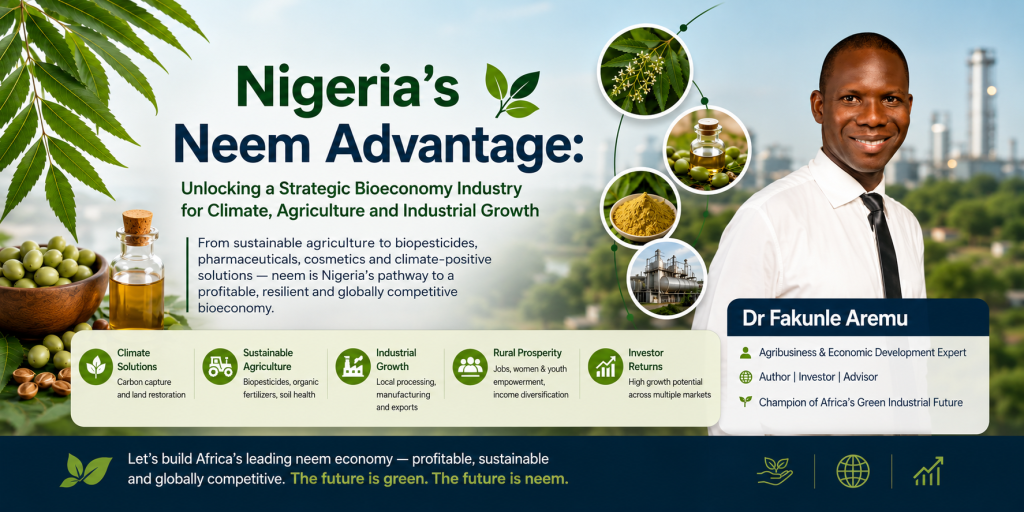
Dr. Fakunle Aremu is an agribusiness, investment and economic development expert with extensive experience in value chain development, trade and investment facilitation, climate-smart agriculture and private sector engagement across Africa. He advises governments, development partners and investors on unlocking sustainable growth opportunities in agriculture, renewable energy and emerging bioeconomy sectors, with a strong focus on industrialization, job creation and inclusive economic transformation. He can be reached via Call/W: +2348063284833; fakunle2014@gmail.com
