


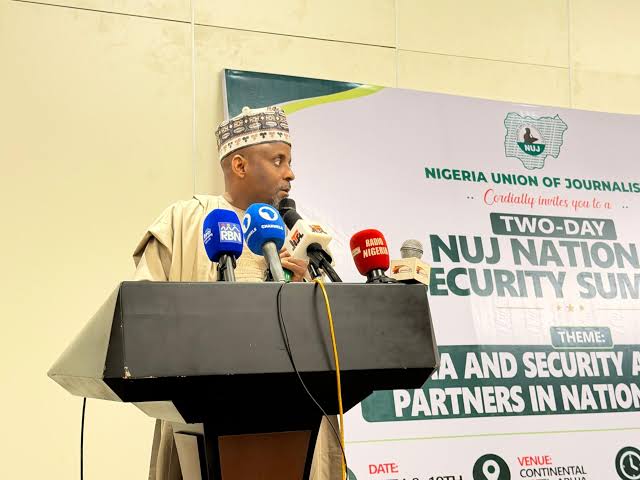
The Nigeria Union of Journalists (NUJ) has identified unregulated foreign access to Nigeria’s media space as a key factor fueling the country’s security challenges.
Alhassan Yahaya-Abdullahi, NUJ’s National President, made this statement on Friday in Abuja during the second day of the National Security Summit organized by the union in collaboration with the Department of State Services (DSS).
The summit, themed “Media and Security Agencies as Partners in Nation Building,” brought together journalists, security experts, and former military spokespersons to explore ways to strengthen collaboration in addressing Nigeria’s security issues.
Abdullahi urged journalists to prioritize national security and development in their reporting, emphasizing the media’s responsibility to safeguard the country’s interests.
He expressed concern over the growing presence of foreign actors in Nigeria’s media landscape, calling for clear regulations and closer monitoring due to potential security implications.
The NUJ president also linked Nigeria’s security challenges to malnutrition, describing it as an often-overlooked issue with serious social consequences.
“Many may wonder why malnutrition is discussed at a security summit, but it’s a critical problem. Nigeria ranks among the most affected countries worldwide. Children suffering from malnutrition often experience stunted growth and impaired cognitive development, which threaten the country’s future productivity and stability,” he said.
He emphasized the need for stronger collaboration between journalists and security agencies to shape security narratives and promote national unity.
In his presentation, Mr. Musikilu Mojeed, President of the International Press Institute (IPI), advocated for dialogue and institutional mechanisms to resolve disputes between the media and government agencies.
Mojeed cited an example where a disagreement between the DSS and the Lagos State House of Assembly was resolved through engagement and clarification, avoiding coercion or arrests.
He noted that while security agencies are responsible for protecting the nation and the media for informing the public, disagreements are inevitable and should be addressed through structured, regular engagement before crises develop.
Retired Maj.-Gen. Chris Olukolade, a former Director of Defence Information, highlighted the importance of dialogue, recalling a military operation where newspaper delivery vehicles were searched based on intelligence reports.
Although the exercise caused delays and drew public criticism, the issue was resolved within a day through discreet discussions between the military and media stakeholders.
Similarly, Retired Commodore Kabir Aliyu, a former Director of Naval Information, described the media as a strategic partner and “force multiplier” in national security efforts.
He warned that excluding journalists from critical discussions could undermine efforts to contain security threats, stressing that effective communication is essential for managing sensitive issues.
Former NUJ President Mr. Chris Isiguzo urged journalists to exercise caution in reporting security matters, warning that terrorist groups often exploit media coverage for propaganda and operational purposes.
It was reported that former NUJ Presidents Chris Isiguzo, Abdulwaheed Odusile, and Lanre Ogundipe attended the summit.
Also present were former leaders of the Nigeria Association of Women Journalists (NAWOJ) and its National Chairperson, Aisha Kwaya-Bura.
