


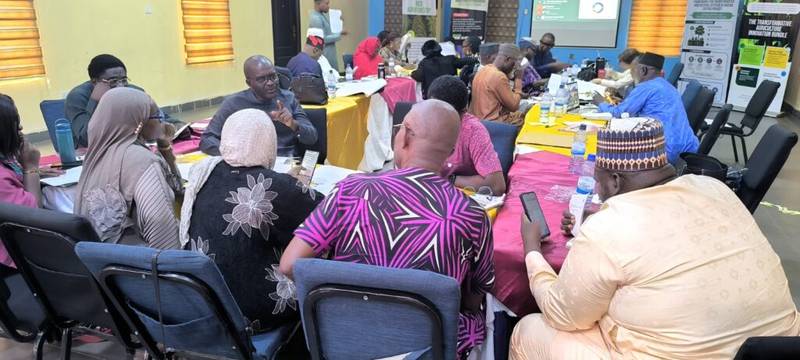
The Sasakawa Africa Association (SAA), a non-governmental organization (NGO), has trained farmers, researchers, policymakers, and extension personnel on agroforestry finance to prepare them for opportunities in the emerging carbon economy.
The two-day capacity-building workshop, funded by the German Corporation for International Cooperation (GIZ), started Thursday in Keffi, Nasarawa State, with participants from Nasarawa, Benue, Cross River, and Kano states.
The workshop was organized by SAA under the GIZ-supported Strengthening Institutional Frameworks for Transformative Agricultural Systems in Nigeria (SIFTAS) project.
This initiative aims to raise awareness and build technical capacity on carbon credits, carbon markets, and agroforestry-based climate solutions, while promoting regenerative and climate-resilient agricultural practices nationwide.
Dr. Bidemi Ajibola, SIFTAS Project Manager, stated that the goal was to expose stakeholders to emerging opportunities in carbon finance and prepare them for participation in the growing carbon market ecosystem.
He highlighted that the workshop, themed “Carbon Credits, Carbon Markets, and Opportunities in Agroforestry Systems,” focused on carbon finance opportunities in cassava, potato, and rice agroforestry systems.
“Nigeria is making progress toward establishing a national carbon market framework, creating new investment opportunities in climate-smart agriculture and agroforestry.
As part of SIFTAS, which promotes crop-specific agroforestry systems, we found it important to expose stakeholders to carbon market opportunities,” he said.
Ajibola added that similar workshops had been held earlier—one in Ibadan, Oyo State, on June 3–4 focused on cassava, and another in Jos, Plateau State, on June 10–11 on potato agroforestry. The Keffi workshop centered on rice agroforestry systems.
Ms. Rose Ritter, Technical Advisor with the Sustainable Agricultural Systems and Policies (AgSys) project, reaffirmed Germany’s commitment to supporting Nigeria and other countries in climate change mitigation through emissions reduction and adaptation.
She disclosed that Germany provided €11.8 billion in international climate finance in 2024, much of it invested in agriculture and land use, given smallholder farmers’ vulnerability to climate change.
Ritter also noted that through the ClimA Project, GIZ is helping Nigeria establish a national agricultural carbon registry to monitor and verify carbon projects nationwide.
Nasarawa State Commissioner for Agriculture, Mr. Tanko Tunga, described the workshop as timely, given climate change’s devastating effects on smallholder farmers, who produce about 80% of Nigeria’s food.
He said the state government is committed to transforming agriculture under the Nasarawa Economic Development Strategy (NEDS).
Tunga reaffirmed the state’s willingness to collaborate with organizations addressing climate issues and praised President Bola Tinubu’s approval of the National Carbon Market Framework.
He stated that this framework would support Nigeria’s climate commitments while fostering sustainable economic growth and green investments.
Prof. Ibrahim Haruna of Nasarawa State University, Keffi, emphasized agroforestry as a vital strategy to counter climate change impacts on agriculture.
“The only way to survive is to adapt to climate change, and agroforestry is one of the best solutions. I commend GIZ and Sasakawa for sponsoring this initiative,” he said.
The workshop included technical presentations, policy dialogues, interactive sessions, and practical exercises on agroforestry systems, carbon sequestration, financing mechanisms, credit generation, and developing bankable agroforestry carbon projects.
Stakeholders also contributed inputs to strengthen the carbon markets and credits component of the SIFTAS agroforestry training curriculum.
