


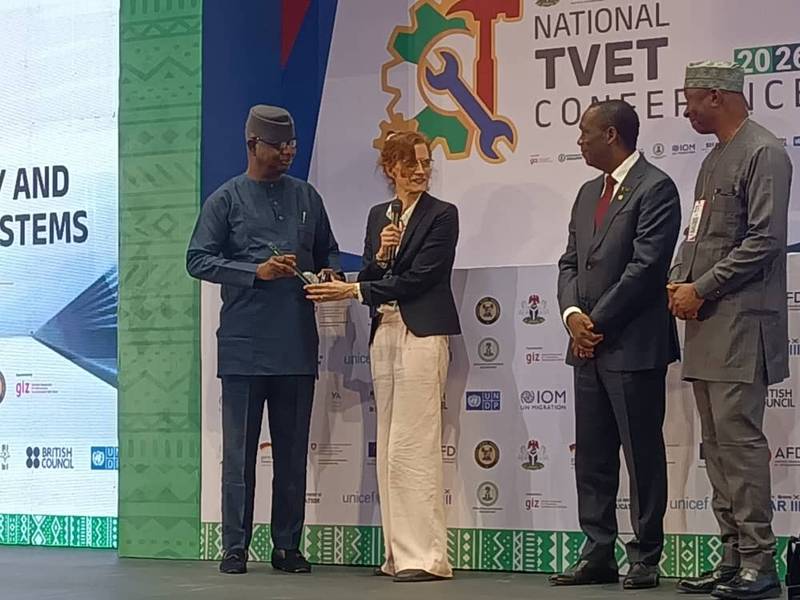
The Nigerian Association of Chambers of Commerce, Industry, Mines, and Agriculture (NACCIMA) has received the Outstanding Private Sector Technical and Vocational Education and Training (TVET) Partner Award 2026.
The award was presented in recognition of NACCIMA’s contributions to promoting industry-led skills development and strengthening collaboration between the private sector and training institutions.
A statement from the association on Tuesday said the award was accepted on its behalf by the Director-General, Mr. Sola Obadimu, during the conference held from June 8 to 10 in Lagos.
The conference was organized by the Federal Ministry of Education in collaboration with the Lagos State Government through the Lagos State Technical and Vocational Education Board (LASTVEB).
Its theme was “Harnessing TVET as a Pathway to Employment: Building a System for Employability, Inclusion, and Green Growth in Nigeria.”
According to the statement, the award reflects NACCIMA’s sustained efforts to promote demand-driven technical and vocational education frameworks that meet labor market needs.
“The award recognizes NACCIMA’s ongoing commitment to advancing industry-led skills development and strengthening linkages between the private sector and training institutions.
“It also aligns with efforts to promote demand-driven technical and vocational education frameworks responsive to evolving labor market needs in Nigeria.”
The association has continued supporting initiatives to bridge skills gaps, improve youth employability, and foster enterprise development.
It reaffirmed its commitment to deepen collaboration with relevant stakeholders to strengthen Nigeria’s TVET ecosystem.
”This will ensure skills development remains aligned with industry requirements and national development priorities,” the statement noted.
The conference brought together stakeholders from government, industry, academia, and development partners to explore strategies for enhancing technical and vocational education as a driver of economic growth and competitiveness.
It was supported by development partners including the French Government, the Agence Française de Développement (AFD), the German Government through GIZ-SKYE, the European Union, and ECOWAS.
Other supporting partners included the Skills Initiative for Africa (SIFA), the Swiss Government, and UNESCO.
