


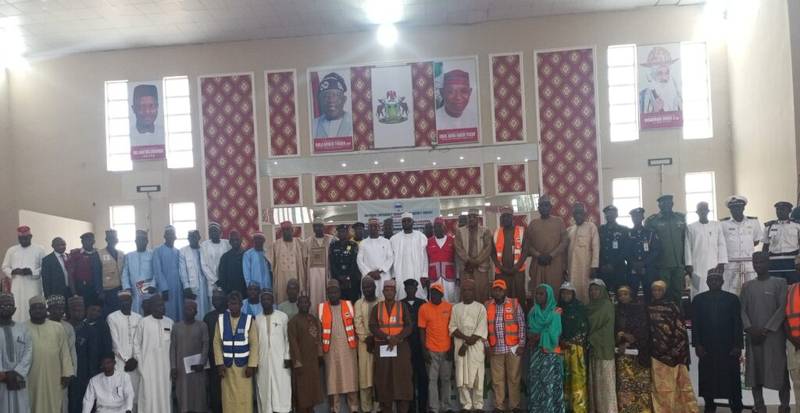
The National Emergency Management Agency (NEMA) announced that 178 vulnerable communities in 28 local government areas of Kano State face a moderate risk of flooding.
NEMA Director-General Mrs. Zubaida Umar disclosed this on Tuesday in Kano during a stakeholders’ engagement and the launch of the 2026 National Preparedness and Response Campaign (NPRC) on flood disaster and related hazards.
Held at the Coronation Hall, Government House, Kano, the campaign, themed “Strengthening Disaster Risk Governance for a Resilient Nigeria,” aims to bolster disaster preparedness, raise public awareness, and promote coordinated actions to protect lives, livelihoods, and infrastructure during the 2026 rainy season.
Umar, represented by NEMA Northwest Zonal Director Aliyu Shehu-Kafindangi, said forecasts from NiMet and NIHSA indicated that parts of Kano are vulnerable to flooding and associated hazards.
“Our risk assessment identified 28 local government areas in Kano as being at moderate flood risk, with 178 communities needing special attention and preparedness measures,” she said.
The affected areas include Ajingi, Bagwai, Bebeji, Bichi, Bunkure, Dala, Dawakin Kudu, Dawakin Tofa, Fagge, Gabasawa, Garun Malam, Gaya, Gwale, Kabo, Karaye, Kiru, Kunchi, Ghari, Kura, Madobi, Rano, Rimin Gado, Sumaila, Takai, Tofa, Tudun Wada, Ungogo, and Warawa.
Umar added that NEMA has developed the 2026 Climate-Related Risk Management, Preparedness, and Mitigation Framework, focusing on strengthening local emergency response, conducting simulations, disseminating early warnings, pre-positioning relief supplies, assessing infrastructure vulnerabilities, and enhancing stakeholder coordination.
“Preparedness is far less costly than response. All stakeholders must take ownership of disaster risk reduction efforts,” she emphasized.
She urged residents in flood-prone areas to remain vigilant and follow evacuation advisories when necessary.
“Through collective action, coordination, and community participation, we can significantly reduce the impact of flooding and climate hazards,” Umar stated.
Governor Abba Kabir-Yusuf, represented by Dr. Dahiru Muhammad-Hashim, reaffirmed the state’s commitment to flood control, environmental protection, and climate resilience.
He highlighted measures for the 2026 season, including drainage clearance, distributing tools to community groups, removing illegal structures blocking waterways, and planting 10 million trees.
The governor emphasized that early warning systems are vital for protecting lives and urged stakeholders to ensure climate and flood information reaches vulnerable communities in local languages.
“Disaster risk reduction is a shared responsibility that requires collective ownership and action,” he said.
Isyaku Abdullahi-Kubarachi, Executive Secretary of Kano State Emergency Management Agency (SEMA), called for ongoing collaboration among stakeholders to boost awareness, sanitation, and proactive disaster management.
He commended NEMA and other partners for their support in strengthening disaster preparedness in Kano.
A NiMet representative, Mr. Abubakar Sani-Yahaya, underscored the importance of accurate weather information in building resilience, protecting lives, and supporting economic growth.
He urged stakeholders to effectively disseminate climate data to grassroots communities to enhance preparedness and reduce risks.
Participants included representatives from federal and state agencies, traditional and religious leaders, security agencies, the Nigeria Red Cross Society, NEMA, SEMA, and development partners.
