


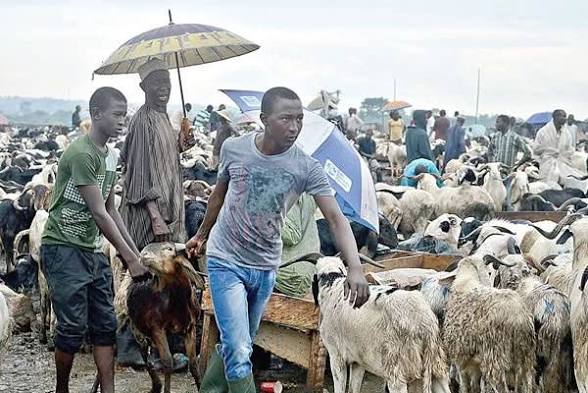
Prices of rams in major animal markets in Kebbi have risen sharply days before the Eid-el-Kabir festival.
A survey conducted by reporters at Birnin Kebbi Kara Market and Ambursa International Market showed a 50% increase in ram prices compared to Eid-el-Kabir 2025.
Speaking to Ashenews, Yahusa Aliyu, Treasurer of the Animal Traders Association at Kara Market, Birnin Kebbi, attributed the hike to banditry, high transportation costs, and rising animal feed prices.
“The feed we bought for N8,000 is now N24,000. Leaves that cost N500 per measure now go for N2,500.
Many people are afraid to rear animals because bandits steal livestock, and many villages where cattle and rams come from are unsafe. High transportation costs have also forced sellers to raise prices,” he said.
Aliyu explained that rams previously sold for N150,000, N170,000, and N250,000, but now go for N250,000, N300,000, and N350,000 depending on size.
He added that goats, which used to sell for N35,000 and N50,000, are now N70,000 and N120,000 respectively.
He also noted that some customers are hesitant to buy because they lack storage space, saying many regular buyers are waiting for salaries or leave grants before purchasing rams.
“I appeal to the government to pay workers so civil servants can buy. If salaries are paid before Sallah, many people will come here to buy animals.”
Regarding credit sales, the treasurer said, “We offer credit to trusted, regular customers.”
At Ambursa International Market along the Argungu-Sokoto road, livestock agent Abdullahi Gwandu said livestock rustling and high fuel costs are driving prices up.
“Transport from Birnin Kebbi to Ambursa that used to cost N200 per ram is now N700. From Kalgo, it’s N2,000 instead of N1,000.
Drivers charged N200 to carry a ram and N3,000 for a cow before; now it’s double. It’s not our fault; it’s the outcome of government policies,” he said.
He added that rams costing N120,000, N170,000, and N200,000 now sell for N180,000, N240,000, and N300,000 or more, depending on breed and size.
Another dealer, Mohammad Augie, linked the price increase to banditry in the Northwest.
“Many breeders have lost herds to terrorists, which has severely impacted animal production. People in villages have stopped rearing livestock out of fear,” he said.
He called on governments at all levels to intensify efforts against bandits, noting that ending insecurity would encourage many to return to animal rearing.
