


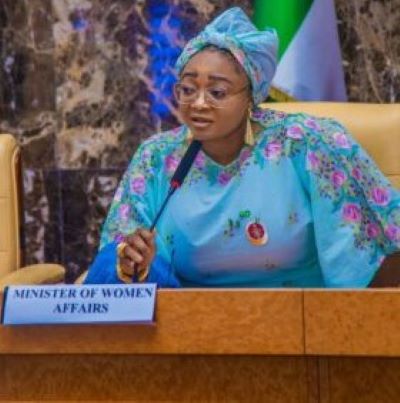
The Minister of Women Affairs, Hajiya Imaan Sulaiman-Ibrahim, has called for stronger coordination and inclusive systems to amplify voices of women and girls with disabilities.
She made the call on Tuesday in Abuja at a joint symposium for special needs groups commemorating the 2026 International Women’s Day, convened by UN Women.
The symposium theme was “Rights, justice, action for women and girls with special needs in Nigeria: Exploring strategies for acceleration and sustainable development.”
Represented by Princess Jumai Idonije, the minister urged commitment to building a Nigeria where no woman is invisible, no right denied, and every girl empowered with dignity.
“We gathered not just to celebrate, but to give voice to those often unseen, present yet uncounted, resilient yet unheard within our systems,” she said.
She described women and girls with disabilities as facing barriers of access, perception, and opportunity, stressing that their rights are often overlooked despite global commitments to gender equality.
The minister referenced outcomes of the Commission on the Status of Women session in New York, where countries reaffirmed commitment to inclusive policies addressing multiple and intersecting forms of discrimination.
She stressed the need to move beyond commitments to implementation, ensuring national frameworks translate into tangible improvements in the lives of women and girls with disabilities.
Sulaiman-Ibrahim emphasised that policies and programmes must be deliberately inclusive and responsive, noting that the Renewed Hope Agenda provides a framework to address existing gaps.
Dr Doris Uzoka-Anite, Minister of State for Budget and Economic Planning, said vulnerability results from systems that fail to protect, include, and invest in marginalised populations.
Speaking on “Equity without exception,” she said the Federal Government would soon launch the National Development Plan 2026–2030, aimed at building a one trillion-dollar economy.
She noted that the plan is anchored on inclusivity, ensuring no group is left behind, especially women and girls with disabilities facing structural and economic disadvantages.
Uzoka-Anite added that Nigeria has shifted from expenditure-based budgeting to investment-driven planning, aligning public finance with long-term development priorities and inclusive economic growth.
She reaffirmed government’s commitment to ensuring inclusive development and pledged continued efforts to carry all citizens along in national planning and implementation processes.
In her opening remarks, Ms Beatrice Eyong, UN Women Country Representative to Nigeria, said the symposium focused on five vulnerable groups facing multiple forms of discrimination.
These include women and girls living with HIV, those with disabilities, elderly women, young women and girls, and internally displaced women and girls.
Eyong noted that these groups often exist at intersections of vulnerability and are most likely to be left behind if policies fail to address layered inequalities.
She stressed that policies must reflect women’s lived realities, while health and social systems must be accessible and inclusive to meet the needs of all groups.
“Our responses must be inclusive and targeted, ensuring those facing multiple disadvantages are reached first and not left behind in development efforts,” she said.
