


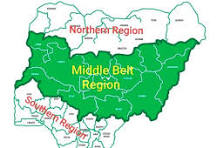
It has become imperative to respond decisively to a mischievous and intellectually dishonest article circulating under the headline, “The Manufactured Middle Belt: The Untold History, Foreign Backing and the Agenda to Fracture Northern Nigeria,” authored under the pseudonym Safyan Umar Yahaya. Far from being a work of history and of social concern, the piece is an alarmist pamphlet, animated by fear and bigotry, not facts, all aimed at delegitimising the rising social and political consciousness of the Middle Belt.
The anxiety beneath the essay is unmistakable. For over a century, certain ruling blocs have exploited the Middle Belt economically, subordinated it politically, and tried to diminish it culturally. Today, as the people of the region reclaims its history, pride and asserts its unity, anger and blackmail are the responses of the losers.
The central claim, that the Middle Belt is a recent political fabrication without historical roots, is not merely false; it is a deliberate distortion built on colonial convenience and selective amnesia.
What the Middle Belt actually is
The Middle Belt refers to the vast geographical and cultural zone inhabited by indigenous ethnic nationalities of the former Northern Region, now spanning 19 Northern states and the Federal Capital Territory, who were never conquered or were never largely ruled by the Sokoto Caliphate or the Kanem-Borno Empire before British colonisation.
ALSO READ Middle Belt Journalists Forum commends Tinubu for signing NCDC bill into law
Put plainly, the Middle Belt consists of the autochthonous peoples of Northern Nigeria who are neither Hausa, Fulani, nor Kanuri, and who historically existed outside the authority of Islamic caliphates, notwithstanding some pockets of Emirate enclaves among it. This is not opinion; it is an established historical fact.
Long before colonial rule, the Middle Belt was home to sovereign empires, kingdoms, chiefdoms, and complex stateless societies whose political systems predated the 19th-century jihads by centuries. Among the most prominent was the Kwararafa Confederacy, centred in the Gongola – Benue Valley. Between the 18th and 19th centuries, Kwararafa repeatedly defeated and humiliated Hausa city-states such as Kano and Zaria and even challenged Kanem-Borno, long before Usman dan Fodio’s jihad of 1804.
Other well-documented polities include the Igala Kingdom, Jukun states, Nupe Kingdom, and countless Tiv, Idoma, Gbagyi, Birom, Angas, Lelna, Bwatye, Eggon, and Goemai societies among hundreds of others – each with distinct political traditions, land tenure systems, and military histories. They had a common solidarity hinged on wading off Islamisation and genocidal slave raids.
Colonial conquest and forced subordination
The author inadvertently exposes his argument’s weakness when he ignores a crucial colonial reality: the British conquered the Muslim emirates with relative ease, largely by co-opting existing centralized hierarchies. In contrast, Middle Belt societies resisted British conquest fiercely.
British colonial records, by administrators such as Frederick Lugard and C.L. Temple, document prolonged military campaigns, punitive expeditions, and scorched-earth tactics used against Middle Belt communities from the early 1900s to the 1920s. This resistance is precisely why the British imposed Indirect Rule by force, subordinating Middle Belt peoples to Fulani and Kanuri emirs they had never known, accepted, or recognized. That imposition, not foreign conspiracy, is the historical root of Middle Belt political consciousness.
The colonial fallacy of “nonexistence”
The article’s reliance on colonial maps and constitutions to argue that the Middle Belt did not exist before the 1940s is intellectually indefensible. Colonial documents recognized what served imperial administration, not indigenous reality. By that logic, countless African nations and identities would vanish simply because Europeans failed, or refused, to acknowledge them.
Even then, the claim is factually weak. The term “Middle Belt” appears descriptively in colonial correspondence as early as the first decade of the 20th century, used by administrators and missionaries to describe the non-emirate central zone of Northern Nigeria. The British deliberately refused to create a Middle Belt Region, not because it lacked coherence, but because doing so would weaken the numerical and political dominance of the Hausa-Fulani-Kanuri oligarchy that sustained Indirect Rule. The agitation for recognition, therefore, predates independence; it merely became organized in the 1950s.
The UMBC and the myth of foreign manipulation
The United Middle Belt Congress (UMBC) under Joseph Sarwuan Tarka did not invent the Middle Belt identity. It articulated long-standing grievances: land dispossession, political exclusion, cultural suppression, forced labour, and religious discrimination. To dismiss UMBC as a tool of missionaries or foreign interests is not only false but insulting. Middle Belt people and leaders were among the most educated and politically sophisticated Nigerians of their generation, many trained in Britain and elite Nigerian institutions well before independence. They required no NGO or missionary to understand the injustice they lived with daily.
The historical record, petitions against Native Authority abuses, resistance to emirate taxation, land struggles, and demands for self-rule, is open to anyone willing to read honestly.
The contemporary moment
Today’s Middle Belt movement is neither separatist nor violent. It is a demand for recognition, equity, and freedom from an imposed Arewa identity that neither reflects its history nor aligns with its values. The Middle Belt does not deny the existence of Northern Nigeria; it rejects the falsehood that Northern Nigeria is synonymous with the Middle Belt. What has long been marketed as “Northern unity” has, in truth, been a forced political marriage, sustained by coercion rather than consent. Increasingly, the Middle Belt is stating what history has always known: this union was never voluntary! If language must be blunt, then so be it. This relationship has often resembled political rape, and the survivors have finally found their voice.
2027 and the panic of declining hegemony
The fear driving this revisionist essay is understandable. The once-boasted “monolithic Northern voting bloc” is fracturing. Demographics, political awareness, and historical truth are converging. For the first time, Nigeria’s political establishment is confronting an uncomfortable reality: the Middle Belt is the decisive factor in national politics.
The Middle Belt, religion and the collapse of old myths
A recurring propaganda tactic is to label the Middle Belt a “Bible Belt,” as though its political awakening is a sectarian religious project. This claim is demonstrably false. The Middle Belt has always been religiously plural, home to Christians, Muslims, and adherents of African traditional religions for centuries. Even institutionally, the Middle Belt Forum (MBF) disproves this caricature: its Board of Trustees and National Working Committee include Muslims, reflecting the region’s inclusive ethos. While it is true that the Middle Belt today is predominantly Christian, largely due to historical resistance to jihadist conquest and the voluntary embrace of Christianity, the majority faith does not translate into religious extremism. The Middle Belt struggle is not about imposing religion; it is about ending political subjugation, cultural erasure, and systemic inequality. Reducing this legitimate quest to sectarianism is not analysis but propaganda.
Demise of the Hausa/Fulani amalgam
Equally misleading is the continued use of the term “Hausa-Fulani” as though it remains a coherent political or cultural bloc. Increasingly, Hausa intellectuals and opinion leaders reject this forced amalgam, insisting that there is Hausa land and there is the Middle Belt, but no natural or “Arewa” identity. The very terms “Northern Nigeria” and “Arewa” now irritate many enlightened Hausa voices who recognize them as tools historically used to sustain Fulani political dominance and economic exploitation. Recent events have further exposed this fracture: widespread violence by Fulani bandits against Hausa rural communities has shattered the illusion of a shared destiny. For decades, the Hausa masses were mobilized as demographic instruments against Middle Belt minorities; today, they are confronting the reality that they, too, have borne the costs of an unjust hierarchy. What is unfolding is not a Middle Belt conspiracy, but the collapse of an artificial political fiction. History, not agitation, has caught up with it.
Dr: Pogu Bitrus is the President of the Middle Belt Forum (MBF) and hails from Chibok, Southern Borno.
