


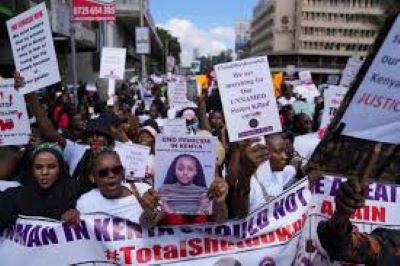
A sobering report recently released by the UN Women and the UN Office on Drugs and Crime (UNODC) reveals that in 2023, 140 women died daily in alleged femicide.
According to the report, no fewer than 140 women and girls die every day allegedly at the hands of either their partners or close relatives.
Femicide, the killing of women and girls, is a pressing social and health issue globally. It is one of the violence against women and girls under-reported.
This means that one woman is killed every 10 minutes.
That is why in the UN report, released on the 25th anniversary of the International Day for the Elimination of Violence Against Women, sheds light on the global crisis of femicide and calls for urgent action.
UN Secretary-General, António Guterres in his message for the Day, said “the epidemic of violence against women and girls shames humanity.”
“The world must heed this call. We need urgent action for justice and accountability and support for advocacy,” said the UN report.
The report coincides with the start of the annual 16 Days of Activism campaign, which runs from November 25 to December 10.
This year, the UNITE campaign is drawing attention to the alarming escalation of violence against women under the theme: “Every 10 minutes, a woman is killed. #NoExcuse. UNITE to End Violence against Women”.
The report said that femicide transcended borders, socioeconomic statuses, and cultures, but its severity varied regionally.
It said that Africa recorded the highest rates of intimate partner and family-related femicides, with 21,700 women killed in 2023, followed by the Americas and Oceania.
In Europe and the Americas, most victims were killed by their intimate partners, comprising 64 per cent and 58 per cent of cases, respectively.
In contrast, women in Africa and Asia were more likely to be killed by family members than by partners, reflecting varied cultural and social dynamics responsible for this discrimination.
The reports described femicide, or the killing of women, in Nigeria, as a pervasive issue often perpetuated by patriarchal norms and societal expectations.
The UN report’s findings also underscored the need for urgent action to address this issue.
In Nigeria, domestic violence is a significant contributor to femicide.
A study found that 31 per cent of women were reported to be experiencing physical, emotional, or sexual violence in their marriages.
Furthermore, the 2008 Demographic and Health Survey revealed that over 30.5 per cent of married women experienced domestic violence.
In spite the alarming numbers, lack of consistent and comprehensive data remains a significant challenge to addressing the menace.
The survey indicated a sharp rise in femicide cases in Nigeria, with 52 reported cases between July 2023 and June 2024.
Unfortunately, no official data is available to aid proper and effective prosecution of culprits.
It is this lacuna of dearth of data juxtaposed against the increased rate of femicide cases that made experts describe the menace as a pandemic, requiring urgent action to halt the worrisome societal malaise.
These experts identified that such factors including challenges of underreporting by victims and their families, fear of stigma or retaliation, the lack of dedicated resources for tracking and investigating these cases as well as lack of legal instruments, further complicate the issue of femicide.
Corroborating this, Samuel Keshinro, a Pathologist with the Nigeria Police, who confirmed increased cases of femicide across Nigeria, however, noted that “Unfortunately, police have no accurate data to address femicide cases nationwide currently.”
Keshinro, an Assistant Commissioner of Police, and the only Force Pathologist in the country, made the stark revelation in an interview in Lagos.
Yet, Sima Bahous, UN Women Executive Director, said “Violence against women and girls is not inevitable—it is preventable”.
Aderonke Atoyebi, the Executive Director of Fame Foundation, a gender-bias Non-Governmental Organisation (NGO), lamented that the girl child, young women, young female adults had become endangered species in Nigeria.
“The situation of femicide is now critical as the Federal Government has recorded 27,698 SGBV cases in the last three years in Nigeria. At least five female murder cases recorded from different states this year were highlighted, some of the cases got justice while some didn’t get till date.
“Femicide has become a pandemic and a state of emergency needs to be declared on this often-overlooked issue. Victim blaming must end. Femicide, or the killing of women and girls, is a pressing social and health issue in Nigeria that deserves attention and discussion. The victims ranged in age from four to 60 years old, and the perpetrators are often intimate partners, family members, or strangers,” she said.
Isioma Faustina Odita, an Education and Gender Equality Advocate with DOHS Cares Foundation, however, noted that the lack of proper documentation of femicide among other variety of factors, had contributed to the societal idleness on the matter.
“Challenges such as underreporting by victims and their families, fear of stigma or retaliation, and the lack of dedicated resources for tracking and investigating these cases further complicate the issue of femicide,” Odita said.
Odita catalogued several cases to include the Sept.4, 2024, gruesome murder of Christianah Idowu, a 300-level student of the Federal University of Agriculture, Abeokuta (FUNAAB), by one Ayomide Adeleye, after allegedly raping her.
“From the brutal killing of Iniobong Umoren to the tragic murder of 18-year-old Barakat Bello, and beyond, the mania is fast becoming too familiar,” she said.
On the challenge of addressing femicide cases, Odita said there was the urgent need for a review of the legal framework.
“Currently, in Nigeria, there is no specific legislation outlawing femicidal murders. Although the Violence Against Persons Prohibition (VAPP) Act and Lagos State’s Domestic Violence Law 2007 aim to protect individuals from violence, they do not explicitly define femicide or outline its consequences.
“As a result, femicide cases in the country often go unpunished or are prosecuted under less severe charges, perpetuating a culture of impunity and leaving victims’ families without justice. This legal gap highlights the need for targeted legislation that addresses the unique nature of femicide and holds perpetrators accountable.
“Pushed by this realisation, in April 2024, the team at the DOHS Cares Foundation drafted and submitted a 17-page bill that criminalises femicide to the Lagos State House of Assembly and the National House of Assembly.”
According to her, the initiative of the proposed goes beyond the current domestic violence laws, covering additional areas and nuances that differentiate femicidal killings from murder.
“It proposes to classify the crime as separate and stemming from gender-motivated circumstances. Additionally, the said bill covers provisions for attempted cases of femicide.
“What the initiative aims to realise is to bring to light the distinctive motivations behind these killings—often related to societal expectations of women— and that it demands a distinct classification.
“Crimes such as the murder of sex workers by men, which often go underreported or misclassified, exemplify this problem. In many cases, these women are found dumped in forests or roadsides, and their deaths are brushed off as ritual killings, she added.
Similarly, the Police Pathologist disclosed that the police authority had given approval for his department to partner with Australian-based Bluebird Philanthropist Foundation and the University of Lagos, to research more on femicide data in Lagos State.
According to him, result of the project will be ready within a year.
” I am a director of the research project sponsored by Bluebird Foundation; the project is on gender violence against women and girls, that is also called femicide. It will be measuring gender-related killings of women and girls (femicide) in Lagos state.
“The project, which is merely on public health, on the death of women, will focus on recommendations for data systems improvements, advocacy and action. The project will also look into the gender inequality on women and girls. This is because women and girls are always the victims of gender-based violence,” he said.
Stakeholders also unanimously agreed that there should be increased public awareness of the femicide epidemic in the country.
They opined that this could be achieved through awareness campaigns and community engagements on the disturbing trend.
Bohous, in agreement with the stakeholders’ submission said: “As this year’s 16 Days of Activism Campaign begins, we must act now to protect women’s lives’’.
The UN Women and UNODC also stressed the need for systematic data collection as part of a broader strategy to address violence against women.
According to world bodies, accurate and transparent data is essential to inform policy, track progress, and ensure governments remain accountable for their commitments to gender equality.
This is also as the world approaches the 30th anniversary of the Beijing Declaration and Platform for Action in 2025, coupled with the fast-approaching five-year deadline to achieve the Sustainable Development Goals (SDGs), especially Goal 5 on gender equality, the report serves as a call to action.”
NANFeatures
