


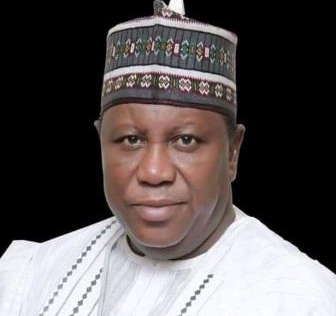
Abdulkadir Junaid is a professor of Veterinary Public Health and currently the commissioner for Animal Health and Fisheries in Sokoto state. In an exclusive interview with ASHENEWS, Prof. Junaid speaks about how the state government has given priority to animal production. EXCERPTS:
How is Sokoto government preparing livestock farmers for enhanced animal and milk production?
Well, let me start by saying that we have for long known our traditional mode of animal husbandry and livestock production in Sokoto state in particular and Northern part of Nigeria in general. This is mainly practiced under extensive system and it is not like a commercialized system. Many of our people do it as part of interest and some for just little businesses. Now, what we do is to, first of all, mobilize our people through enlightenment and education; to inform them on taking livestock production fully as a business, and the way and form of improving the businesses is through modern technologies. We have observed that even the feeding pattern of animals is not done under a balanced system – that is a balanced ratio. High content of carbohydrates is the main source of feed for our animals and they often go for grazing even inside Sokoto. They go in the morning and come back in the evening. So, what we did is to ensure that we have some components of these new methods of livestock production, one of which is pastoral development. Pasture development involves planting of different brands of legumes, grasses and other components of feed production. For instance, we use planted sorghum, soya beans, and several other plants that we intend to use across the state.
With this, we also established a feed mill which will now be used in packaging these mills after harvest. We then mix them with other things needed for a balanced diet for healthy animal growth. This is to ensure that we package it and sell it to the farmers at subsidized rates. This will further stimulate faster growth and development for the animals so that the farmers can get back their money quickly. For instance, they will fatten their bulls for three months and they will get profit. So, this is what we intend to pursue and the farmers have welcomed the idea. Then we have established cluster farms which is a new model of farming. These cluster farms have been provided with new exotic breeds of animals. These genetic breeds will improve our own local breeds. Our own local breed, called Sokoto Gudali, is one of the best in the country. Unfortunately, you cannot compare it with foreign breeds because these foreign breeds produce more milk and produce animals greater in weight than our local breeds. So, what we do is to cross breed our own local breeds with the exotic ones. We purchased Jersey cattle, Holstein cattle, Red Sea heifer and so on. These are usually used for meat and milk production and from what we have, we are lucky to have succeeded because I will say all the female animals we have purchased have given birth. Most of them have given birth up to three times and the cross breed have now grown.
Interestingly, most of the farmers have told us that they have high yield of milk production and the weight of their animals is superb. Previously, they just produced about one to three and maximum of four litres from Sokoto Gudali Cattle but now they produce about ten to thirty litres per day. This goes to show that there is massive improvement in what they are doing. In terms of meat, you will realize that our own local breed can produce only about 150 to 350 kilogram per animal weight but from the new cross breed of animals, you will now have between 500 to 5000kg. That again shows a massive improvement in terms of meat production. So, if a farmer for instance sells a litre of milk at N300, that is to be so conservative because conservative is up to N500 or more, you will realize that if he has 10 animals, he will have about N9000 daily which translates to N180,000 per month and about N2.1 million in a year. Now, this shows that a farmer will have lots of resources both to feed the animals and also generate more employment opportunities. Similarly, in terms of beef production, an animal that is weighed 500kg could sell for up to N500,000 or even up to N1 million because most of these farmers that we give these animals to now sell younger ones even at the rate of N1 million depending on the age.
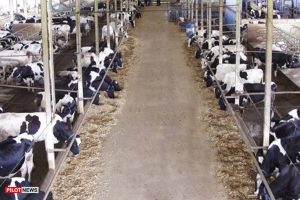
Now, you can see that there is more economic income for the farmers and the economy has been diversified and increased in terms of production. However, we observed that we have distributed animals to those that cannot afford it even though government gave subsidy at 50%. We have brought in the new technologies, including artificial insemination and embryo transfer.
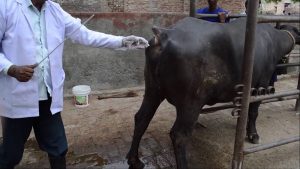
Artificial insemination
For artificial insemination, we implant siemens of these breeds – the exotic breeds into our own local breeds which will then produce a more potentially better genetic breed than our own local breeds at a lesser cost than when you say you have to purchase a live animal. This is done freely. Similarly, we harvest the embryo and then plant it into the uterus. This takes place when the animals would have started acclimatizing with the environment since while they are within the womb of our own local breed. This means they will be more resistant to the weather, and they will be more resistant to diseases.
We have met with leaders of the herdsmen (Miyetti Allah) in all the local government areas and all herdsmen have welcomed the idea. The demand we have now for people that are interested in artificial insemination and embryo transfer is so high that we may need to increase funding for that. This is because they have seen what has happened with the live animals and they know that in no distant future, there is likelihood that we will produce more of these breeds across the state.
We have resuscitated and rehabilitated our own dairy unit which had been comatose for over 40 years. We have put new equipment and started producing yoghurt from the milk of those cluster farmers that we gave these animals. And for pastoralists that are not lucky to sell their milk, we buy it from them and process it. The dairy has the capacity of producing or processing 500 litres of milk daily and we have the intention of improving it. Also, you cannot do artificial insemination without liquid nitrogen, which is a gas that is used in conserving the siemens and the embryo, including bacteria and viruses and other scientific things that you really need. So, we decided to commence the production of liquid nitrogen. This is found in very few places in Nigeria – you will find just two or three where this liquid nitrogen is produced. The essence is to make sure that the siemens that we have will be conserved and we are now in the process of also trying to see that we start producing our own siemens. We are technically good enough to commercialize the process by selling to our sister states. A litre of liquid nitrogen is sold at between N1,500 to N2,500 depending on the location. We are able to produce 4,000 litres daily and by the time we now make it commercial, you will see that it will bring some revenue to the state. Similarly, we have no problem in terms of siemens production and embryo. These are the processes we have come across which are new modern methods and are welcomed by our own people within the state. You know, when you have a new process at times, it takes time for people to understand. That is why we started with a pilot of cluster farms and people have seen the successes achieved and that is why they accepted it.
With striking desertification, the production of animal feeds is a challenge. How are you tackling this challenge?
In our own ministry, we have what we call range department or range which is concerned with this production. We collaborate with technical experts in the ministry of agriculture and are in the process of developing an irrigation system. The irrigation system in Rabah was a pilot system that we started and it has already been fixed. But due to security problems, we had to abandon it and with the technical personnel that we have, we now moved to Dogon Daji and they have given us their report on how we can develop the technology that we will be able to produce throughout the year. We will have to create dams, boreholes and this water reticulation system where we will be pumping these places with water so that the little water that the plants needs is the one that will be dropping in a form of modern system.
In fact, we are able to harvest the product of the raining season with modern equipment – the best you can find in Nigeria because it was obtained from a reputable company and its products are really good even confirmed by experts that came from the federal government of Nigeria. Remember that this is what will make the pasture production easier. The intention is that we have 19 grazing reserves and we also intend to go into ranching. We dedicate ourselves into all these programs and, apart from that, we will also to be able to fight desertification.
Let’s talk about animal biotechnology. How will that benefit farmers in Sokoto state?
We are already sensitising our farmers about modern techniques in terms of animal production and this usually is aimed at improving low potential of our genetic breeds. As I have said, we are starting gradually in introducing certain aspects of the technology because when we started producing these sheep that almost resembled the same parent, there was crisis in the world, especially from religious perspective. But what we always do is to be a bit careful not to create scenarios whereby people will think it is against Islam or any religion. The new technologies that we have started introducing now involves this artificial insemination and embryo transfer, which is a new technique that people are used to. The rest are certain technologies that are more developed in the world. For instance, you can even take a skin of animal, craft it and make another animal or harvest it in the laboratory.
What is the quantity of milk you buy from farmers for processing at the moment?
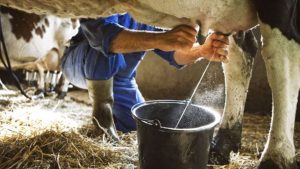
For now, we have not calculated but we buy whatever they sell to us. Most of the farmers have also started producing yoghurt themselves. They sell the quantity they feel they can because they know that they have to pay 50% of the cost of animals given to them by the government. So, if they give us the milk we record what they have given. If they produce 30 litres for instance, and they are willing to give us the 30 litres, we collect and record that and at the end of the day, we will quantify what we have taken from each of them. We are now on a pilot scheme and trying to get NAFDAC registration. We have produced and even consumed most and are satisfied. We have a lab where we do our testing but we want to make sure that we follow the whole procedure before we now know that this is the actual thing that we need to do.
For the pilot scheme, what is the total number of farmers you are working?
We have 30 cluster farms and then any other farmer that produces milk and would want to sell to us, we collect. But we do the testing to ensure that the milk produced by the farmers is free from diseases and fit for consumption.
