


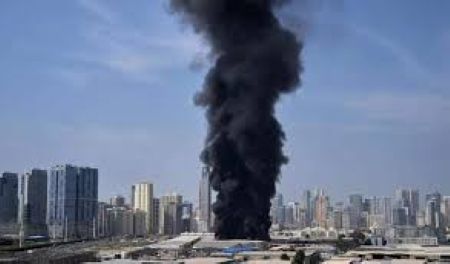
Iranian drones struck the United States Embassy in Riyadh on Tuesday, widening the regional fallout from the escalating conflict between Iran, the United States and Israel.
The attack came four days after coordinated US and Israeli strikes reportedly killed Iran’s Supreme Leader, Ali Khamenei, triggering open hostilities across the Middle East.
AFP correspondents in the Saudi capital reported visible smoke damage to sections of the embassy building. Saudi security forces cordoned off the diplomatic quarter, mounted heavy patrols and blocked several roads leading to the US mission.
Saudi authorities said air defences intercepted eight drones over two cities, including Riyadh. However, two reportedly breached defences and struck the embassy compound, causing a fire.
US orders its citizens to leave the Middle East
Amid the growing security threat, the US State Department urged Americans to “DEPART NOW” from countries and territories across the Middle East, citing serious safety risks.
In Washington, US President Donald Trump warned the conflict could continue “for weeks or months,” adding that the United States had the capacity to sustain prolonged operations.
Speaking at the White House and in separate media interviews, Trump said he would not rule out deploying US ground troops to Iran “if necessary.” He also vowed that Iran would “find out soon” how Washington plans to respond to the Riyadh embassy strike.
The US president outlined the objectives of the military campaign as degrading Iran’s missile systems, naval capabilities and nuclear programme, as well as curbing its support for armed groups across the region. He did not explicitly call for regime change in Tehran.
US Secretary of State Marco Rubio said Washington acted pre-emptively after assessing that Iran would retaliate against US forces if Israel launched strikes.
According to Rubio, US intervention followed intelligence that Israel was preparing to attack Iranian targets and that Tehran was poised to respond against American assets in the region.
Iran’s Foreign Minister, Seyed Abbas Araghchi, rejected that account, stating there had been “no so-called Iranian threat” and accusing Washington of entering “a war of choice on behalf of Israel.”
Israel expands operations in Lebanon
The conflict has also intensified along Israel’s northern front. Defence Minister Israel Katz said Israeli forces were authorised to seize additional strategic positions in southern Lebanon to prevent attacks on border communities.
Hezbollah claimed responsibility for missile strikes on three Israeli bases, saying the action was in support of Iran. A Lebanese military source confirmed troop redeployments in the south following Israeli bombardments.
Oil markets react as Gulf infrastructure targeted
Iranian strikes also targeted oil and gas infrastructure across parts of the Gulf, including the Omani port city of Duqm. In the United Arab Emirates, authorities in Fujairah reported that debris from intercepted drones ignited a fire at an oil facility.
As European markets opened, benchmark Brent crude prices rose sharply amid fears of disruption to shipping through the Strait of Hormuz.
A senior commander of Iran’s Revolutionary Guards threatened to block maritime traffic through the vital chokepoint, heightening concerns about global energy supplies.
Casualties mount
According to US Central Command, six American military personnel have been killed since the conflict began.
Iranian state media reported hundreds of casualties, including civilians. The US-based Human Rights Activists News Agency (HRANA) said at least 101 people were killed inside Iran by the third day of fighting, including 85 civilians and 11 military personnel. Independent verification of casualty figures remains difficult.
In Tehran, AFP reporters observed residents preparing to flee the capital amid overnight explosions and fighter jet overflights.
The conflict marks one of the most confrontations between Iran and the United States in recent history, raising fears of a prolonged regional war with far-reaching geopolitical and economic consequences.
AFP
