


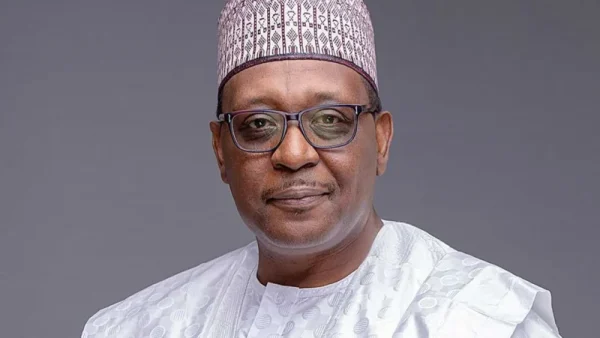
The Coordinating Minister of Health and Social Welfare, Prof. Mohammed Pate, says the health challenges identified in Nigeria’s Country Health System and Services Profiles (CHSSP) report are surmountable.
Pate, represented by Dr. Kamil Shoretire, Director of Health Planning, Research and Statistics at the ministry, stated this on Wednesday in Abuja during the official unveiling of Nigeria’s CHSSP report.
Nigeria’s CHSSP is the first edition of the African Health Observatory Platform on Health Systems and Policies (AHOP)—a comprehensive review of African countries’ health systems and services.
The report was published by the Health Policy Research Group, University of Nigeria, Nsukka, which serves as Nigeria’s National Centre for AHOP.
Pate said addressing the challenges outlined in the report requires collective effort from multiple stakeholders. He added that the Nigeria Health Sector Renewal Investment Initiative (NHSRII), introduced by President Bola Tinubu’s administration, was designed to tackle those gaps.
According to him, the NHSRII provides a unified roadmap for transforming Nigeria’s health system through improved governance, reduced financial barriers, and systematic capacity building.
He noted that the Federal Government is addressing issues such as low public health spending, overdependence on private healthcare, and high out-of-pocket expenditure through sector-wide reforms.
“We launched the Sector-Wide Approach (SWAp) in August 2024 with a $1.2 billion investment.
“The SWAp initiative ensures that all stakeholders—government, development partners, civil society, and the private sector—work under a single unified strategy of One Plan, One Budget, One Conversation, One Monitoring and Evaluation, and One Report.
“This coordination is essential to maximize efficiency and impact,” Pate said.
He disclosed that in pursuit of Universal Health Coverage (UHC) by 2030, the government has increased enrollment in the National Health Insurance Scheme (NHIS) from 16.7 million to over 19.4 million people within the past year.
The minister added that government is strengthening primary healthcare through the Basic Health Care Provision Fund (BHCPF), disbursing ₦80 billion in 2024 and planning to increase it to ₦298.42 billion in 2025.
“Through the Presidential Initiative for Unlocking the Healthcare Value Chain, we have developed a $5 billion project pipeline and attracted $2 billion in foreign investments,” he said.
In his remarks, Prof. Obinna Onwujekwe, Director of Nigeria’s National Centre for AHOP and Coordinator of the Health Policy Research Group, said the CHSSP provides evidence-based data for informed policy-making in the health sector.
He explained that the report assessed Nigeria’s health system performance and service delivery against African benchmarks to guide effective policy actions.
According to the CHSSP, Nigeria’s health system currently performs at 45 per cent—below the African regional average of 56 per cent.
The report revealed that while access to, demand for, and quality of health services have improved over the past decade, they remain insufficient to achieve universal health coverage by 2030.
Despite the progress, Nigeria’s essential health service coverage remains 1.7 per cent below the African average.
The report further stated that private health providers deliver about 70 per cent of all health services, even though they represent only 35 per cent of health facilities nationwide.
It added that about 80 per cent of Nigeria’s health infrastructure is dysfunctional, hindering service delivery and causing an estimated $1 billion annual loss to outbound health tourism.
The CHSSP also highlighted that out-of-pocket expenditure accounts for 75 per cent of total health spending, while only one in ten Nigerians has access to health insurance or any form of risk-pooling scheme.
