


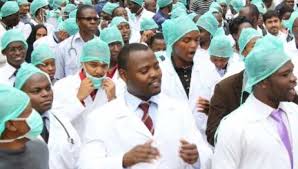
The Joint Health Sector Unions (JOHESU) at the University of Ilorin Teaching Hospital (UITH) on Tuesday staged a peaceful protest over the Federal Government’s failure to address their demands.
The protest followed an emergency congress held by the union. Members of JOHESU, which represents health workers across federal health facilities in Nigeria, have been on an indefinite strike since November 14, 2025. Following the strike, the Federal Ministry of Health and Social Welfare reportedly directed the stoppage of salaries for union members.
Mr Oyelowo Olufemi, JOHESU-UITH Chairman, told reporters that the Federal Government had been insensitive to the plight of health workers.
Olufemi said the government signed a Memorandum of Understanding with JOHESU in 2009, committing to adjustments and recognition under the two salary structures: the Consolidated Medical Salary Structure (CONMESS) and the Consolidated Health Salary Structure (CONHESS).
He noted that while CONMESS had been adjusted for physicians in 2014, 2017, and 2018, JOHESU members under CONHESS had yet to receive similar adjustments.
“That is the backbone of our strike. We are demanding that the government adjust CONHESS as well. We are appealing to the Federal Government to intervene and do what is right for the health sector,” Olufemi said.
Also speaking, Mr Saka Abdullahi, Chairman of the Senior Staff Association of Universities, Teaching Hospitals, Research Institutes, and Associated Institutions (SSAUTHRAI), alleged that UITH management had been intimidating staff.
He explained that the management was citing a circular from the Federal Ministry of Health to tell the union that members do not have the right to picket or stop work. Abdullahi said the “No work, No Pay” policy was being used to coerce staff into working despite the ongoing strike.
“No work, no pay is not new to us, but using force to compel members to work is what we are resisting. The Federal Government has ignored JOHESU’s demands for the past 12 years. This is the 13th year of agitation. The National Association of Resident Doctors (NARD) had nine demands, almost all of which were met. Our flagship demand—CONHESS adjustment—remains unmet,” he said.
Abdullahi also highlighted that members’ salaries were insufficient, particularly due to the removal of subsidies and high transportation costs.
Responding to the allegations of intimidation, Mr Abiodun Fagbemi, Acting Head of Corporate Affairs at UITH, said the management was aware that the strike was national, not local.
“There is nobody forced to appear at the hospital to work,” Fagbemi said.
During the protest, union members carried placards with inscriptions such as “No Compliance, No Compromise,” “Health Sector Can’t Work Without JOHESU,” and “Federal Government Should Stop Discrimination in Health Sector.”
