


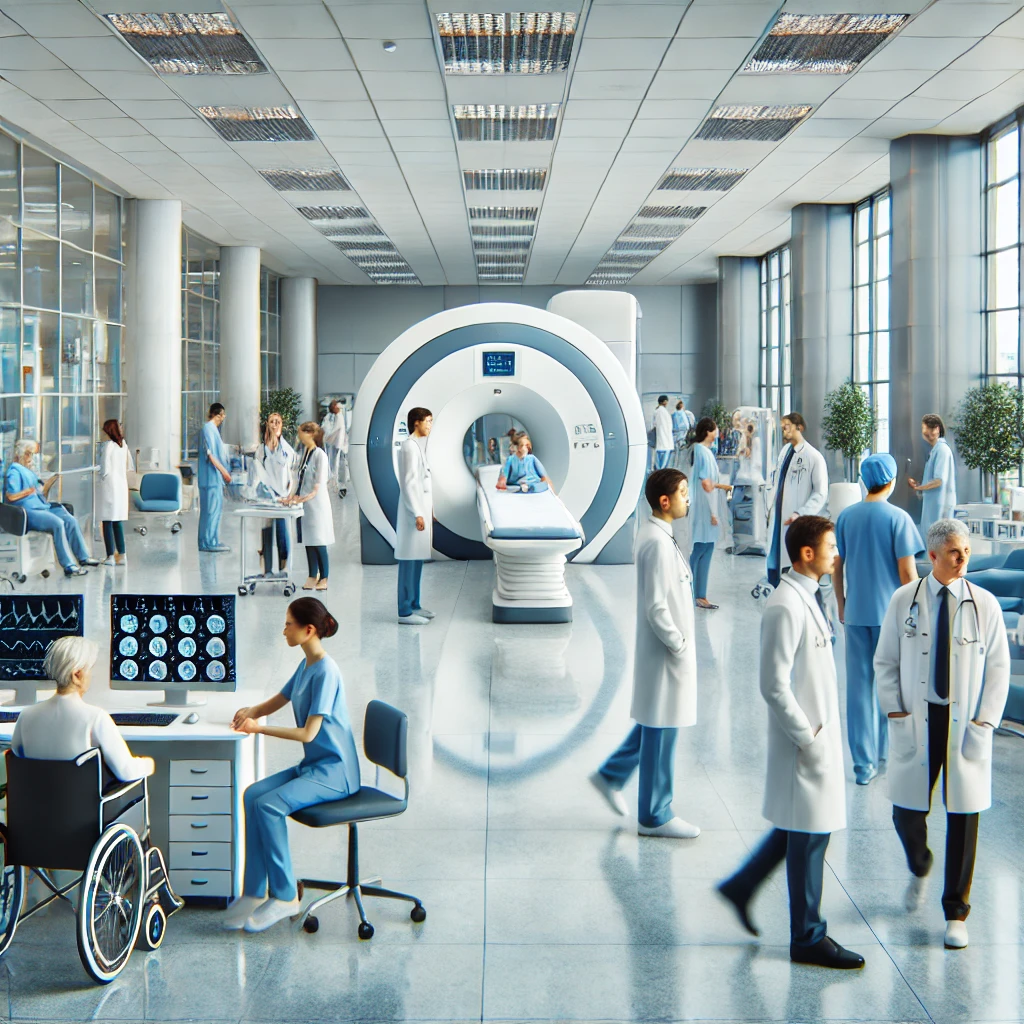
Walking into a typical primary healthcare centre in Nigeria, one is often confronted by overworked health workers juggling long queues, limited diagnostic tools and incomplete patient records.
By contrast, in better-equipped facilities, digital platforms powered by Artificial Intelligence (AI) can already analyse symptoms, flag high-risk cases and support clinical decisions within seconds.
This stark disparity captures Nigeria’s evolving relationship with AI in healthcare—a space marked by high expectations, but also deep concerns about readiness, regulation and public trust.
Health experts say AI has moved beyond the realm of distant innovation to become a practical tool for healthcare delivery in Nigeria.
Its relevance is growing as the country faces an overstretched workforce, a rising disease burden and mounting pressure to achieve Universal Health Coverage (UHC).
In recent months, initiatives such as the launch of AI-enabled healthcare platforms and renewed policy conversations have brought the debate into sharper focus.
While proponents argue that AI could help Nigeria overcome long-standing structural weaknesses, critics warn that weak data systems, poor infrastructure and regulatory gaps may limit its impact or even cause harm.
Speaking in Abuja at the inauguration of the Koyo Navigate App, an AI-enabled healthcare service platform, the Speaker of the House of Representatives, Mr Tajudeen Abbas, described AI as a potential equaliser in a health system marked by inequality.
ALSO READ Lab scientist urges tougher laws to combat quackery
“AI-driven services are not just technological upgrades; they are pathways to better health outcomes, dignity and independence,” Abbas said.
He noted that globally, AI had proved effective in accelerating diagnostics, supporting early intervention and enabling more personalised care.
Beyond political endorsements, health technology experts say AI is already transforming healthcare delivery worldwide, offering lessons Nigeria could adapt to its own context.
At the Afrihealth Conferences and Exhibitions in Abuja, Dr Kunle Kakanfo, founder of Artificial Intelligence for Social Impact Development (AI4SID), said Nigeria must harness AI to strengthen its fragile health system.
“We are seeing AI used in clinical decision support, with chatbots helping people identify basic symptoms and supporting healthcare workers to determine which conditions require urgent attention,” Kakanfo said.
According to him, AI is also facilitating task-shifting, predictive disease surveillance and more efficient resource planning.
“Given the inefficiencies within our healthcare system, AI can serve as a leapfrog innovation to fast-track efficiency,” he added.
For others, the appeal of AI lies primarily in its ability to stretch Nigeria’s limited human resources.
Mr Abdulhamid Yahaya, Deputy Director for Global Health Informatics at eHealth Africa, said Nigeria’s low doctor-to-patient ratio made technology indispensable.
“Nigeria is severely overburdened. Community health workers operate with limited tools and resources, yet the patient load is among the highest,” he said.
“So how do you scale? Use AI technology. It helps you to take a simple, effective use case and replicate it thousands or millions of times.”
Similarly, Dr Francis Ohanyido, Director-General of the West African Institute of Public Health, outlined AI as a transformative technology that could redefine work and healthcare delivery if properly understood and managed.
“AI will not take people’s jobs; those who refuse to adapt will lose theirs. AI is here to stay and must be seen as a partner, not a threat,” Ohanyido warned.
He added that a growing AI ecosystem could become a major driver of economic recovery and talent retention if harnessed through innovation, partnerships and sound regulatory frameworks.
“The African AI industry could generate between 13 and 18 billion dollars by 2030.
“If implemented well, Nigeria could lead this growth, attract investment and curb healthcare workforce migration.”
Despite this optimism, concerns remain substantial.
At the global level, the World Health Organisation (WHO) has warned that although the use of AI in healthcare is accelerating, legal and ethical safeguards are lagging.
In a report titled Artificial Intelligence Is Reshaping Health Systems: State of Readiness across the WHO European Region, the organisation noted that AI is already helping doctors detect diseases earlier, reduce administrative burdens and improve patient communication.
However, it cautioned that weak regulation could widen inequities rather than close them.
“While the technology is reshaping how care is delivered, data interpreted and resources allocated, without clear strategies, data privacy protections, legal guardrails and investment in AI literacy, we risk deepening inequities,” said Dr Hans Kluge, WHO Regional Director for Europe.
The WHO observed that although many countries recognise AI’s transformative potential, only a few have developed dedicated national strategies, with legal uncertainty and financial constraints remaining major barriers to adoption.
These concerns resonate locally.
Dr Kemisola Agbaoye, Director of Programmes at Nigeria Health Watch, said Nigeria still faces major gaps in data quality, infrastructure, skills and public trust.
“Data is foundational. You cannot build a realistic AI healthcare system without reliable data,” she said.
She also pointed to trust deficits at the community level.
“When communities are told that healthcare workers will rely on AI tools, a great deal of trust-building is required.”
Nevertheless, she acknowledged gradual progress.
“A lot is happening. Are we ready for AI in healthcare? Not yet, but we are moving in that direction,” she said.
In response, the Federal Government says steps are being taken to address these challenges.
Dr Leke Ojewale, Senior Technical Adviser to the Coordinating Minister of Health and Social Welfare on Digital Health, stated that the Nigerian Digital Health Architecture (NDHA) is being developed to ensure that AI tools operate within a unified and secure system.
“We are building the NDHA to ensure that all AI tools in health plug into a single, interoperable framework,” Ojewale said.
He explained that the architecture would be anchored on national registries and a Health Information Exchange to support secure data sharing and responsible AI deployment.
On the legislative front, the National Assembly has also pledged support for digital health innovation.
The Senate President, Sen. Godswill Akpabio, said lawmakers were committed to advancing legislation that supports telemedicine, electronic health records and the use of AI for diagnosis and surveillance.
“We will advance legislation that supports digital innovation, telemedicine, electronic records and AI-driven diagnosis and surveillance,” he said.
“We must build a digital backbone that connects every primary health centre to every tertiary hospital, ensuring continuity of care, transparency and accountability.”
He stressed that innovation was no longer optional.
“We cannot build a 21st-century nation with 19th-century tools. Innovation is not an accessory; it is our lifeline.”
Even so, experts agree on a critical caveat: AI must complement and not replace human judgement.
Aligning with this view, the Nigeria Medical Association (NMA), Kwara Chapter, said the use of AI in medicine should enhance human intelligence rather than substitute it.
The chapter’s chairman, Prof. Abdulrahman Afolabi, said no algorithm could replicate the compassion, moral reasoning and trust that define the physician-patient relationship.
“Physicians must be active participants in shaping this transformation, not passive observers.
“We must ensure that technology serves humanity, not the other way around,” he said.
Without technology, analysts warn, Nigeria may struggle to meet its UHC targets. With it, the country has an opportunity to improve diagnostics, surveillance and access to care at scale.
For now, the conversation continues, balancing optimism with caution.
Policymakers, health workers and citizens are weighing how best to harness artificial intelligence to strengthen healthcare delivery while protecting patients, data and public trust.
NANFeatures
