


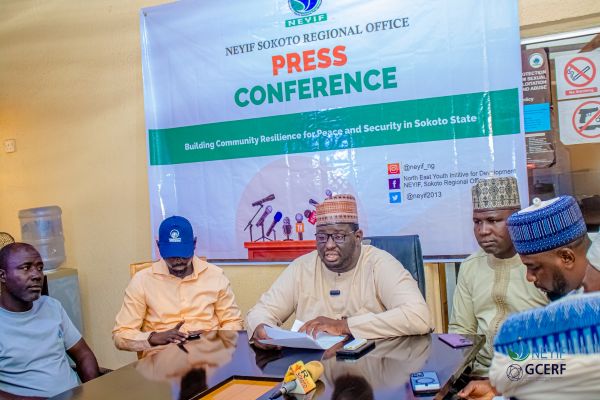
The North East Youth Initiative for Development (NEYIF) has called on state and local governments in North-West Nigeria to formally integrate community-based peace structures into government systems and budgets as part of efforts to deepen peacebuilding, conflict prevention, and social resilience.
The call was made by NEYIF’s Executive Director, Dauda Muhammad Gombe, during a press conference in which the organisation presented its Third Quarter 2025 achievements covering July to September.
Gombe stated that the period marked a strategic shift from isolated community interventions to coordinated state and regional engagement models, designed to strengthen institutional ownership, accountability, and sustainability.
According to him, NEYIF recorded significant progress in capacity building, regional coordination, policy engagement, and institutional strengthening across several North-West states, reaffirming the organisation’s belief that lasting peace depends on empowered local actors and functional institutions rather than stand-alone projects.
During the quarter, NEYIF implemented organisational development and mentorship workshops in Sokoto, Kebbi, Jigawa, and Zamfara States, targeting youth-led organisations, women groups, educators, and grassroots peace actors. He noted that learning outcomes improved significantly, reflecting increased competence and confidence among participants.
In addition, a five-day Training of Trainers programme was conducted to strengthen the capacity of government and community actors in disaster preparedness, early warning systems, first aid, and coordinated emergency response, addressing the overlapping challenges of insecurity, climate risks, and social vulnerability.
At the regional level, Gombe said NEYIF supported the North-West Regional Summit on Preventing and Countering Violent Extremism (PCVE) held in Kaduna, which helped align State PCVE Action Plans with Nigeria’s National Action Plan. The summit, he added, laid the groundwork for a regional coordination platform to improve collaboration and information sharing among states.
At the state level, NEYIF intensified advocacy and policy engagement with the Sokoto State House of Assembly and relevant ministries, strengthening partnerships around youth inclusion, gender equity, humanitarian coordination, and community-based conflict resolution frameworks.
Community monitoring and mentoring visits in Sokoto State, according to NEYIF, confirmed strong local ownership of peace initiatives, with functional peace committees, improved engagement with security agencies, and livelihood-focused interventions contributing to enhanced social cohesion and reduced vulnerability.
Internally, the organisation invested in staff development through targeted capacity-building workshops to reinforce planning, advocacy, teamwork, and adaptive programming.
Gombe said that overall, NEYIF strengthened government and community capacity for preventing violent extremism, disaster preparedness, and resilience; elevated youth and women as leaders rather than beneficiaries; enhanced regional coordination and policy alignment; and built platforms capable of sustaining impact beyond donor funding.
As part of its recommendations, NEYIF urged governments to improve coordination among ministries, emergency agencies, and security actors, fast-track legislation such as Alternative Dispute Resolution (ADR) frameworks, ensure continuous inclusion of youth and women in policymaking, and support the establishment of a North-West Regional PCVE Coordination Platform.
The organisation also called on communities to strengthen peace committees, prioritise livelihoods and skills development, and sustain community-led early warning mechanisms, while urging civil society organisations to align grassroots interventions with government frameworks and strengthen regional networks for collective impact.
NEYIF reported that its Q3 2025 interventions directly reached hundreds of youth leaders, women peace actors, government officials, traditional and religious leaders, civil society organisations, and media practitioners, with over 2,000 community members reached indirectly across parts of Sokoto State.
Gombe said as NEYIF enters the final quarter of 2025, the organisation remains committed to building a secure, resilient, and people-driven North-West Nigeria through stronger partnerships and inclusive peacebuilding systems.
