


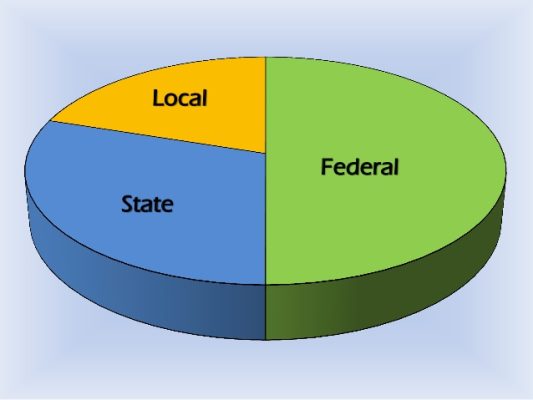
Nigeria’s three tiers of government shared a total of ₦9.62 trillion from the Federation Account Allocation Committee (FAAC) over August–October 2025, but monthly allocations declined steadily, signalling renewed fiscal pressure.
Data from the National Bureau of Statistics (NBS) shows FAAC disbursements fell from ₦3.64 trillion (August revenue) to ₦3.05 trillion (September revenue), before dropping further to ₦2.93 trillion (October revenue).
Who got what (Aug–Oct 2025)
- Federal Government: ₦2.28trn
- 36 States: ₦2.13trn
- 774 Local Governments: ₦1.56trn
August revenue: ₦3.64trn strong start
FAAC opened the period on a strong note, with the Federal Government receiving ₦810.05bn, states ₦709.83bn, and local governments ₦522.23bn.
VAT-supported allocations, especially to states and LGs, while oil-producing states benefited from ₦183.01bn in 13% derivation and other oil-related refunds. However, heavy deductions—including ₦851.17bn transferred to the Non-Oil Excess Account—tempered the gains.
September revenue: allocations fall to ₦3.05trn
By October 2025, FAAC disbursement declined to ₦3.05trn. States overtook the Federal Government, receiving ₦727.17bn, compared with ₦711.31bn for the FG. LGs received ₦529.95bn.
Stronger VAT boosted subnational allocations, but liquidity tightened as ₦700bn was again moved to the Non-Oil Excess Account, alongside rising collection costs.
October revenue: FAAC drops to ₦2.93trn
FAAC fell further in November 2025, with just ₦2.93trn shared—the lowest in the period.
The Federal Government led with ₦758.41bn, followed by states (₦689.12bn) and LGs (₦505.80bn). VAT weakened across all tiers, increasing pressure on subnational finances.
Why allocations are shrinking
FAAC inflows declined as oil revenues weakened, driven by lower production, underperformance in the upstream sector and reduced oil taxes. At the same time, VAT and other non-oil revenues softened, reflecting slowing economic activity.
The trend underscores Nigeria’s fiscal vulnerability and reinforces calls for revenue diversification and stronger domestic revenue mobilisation.
