


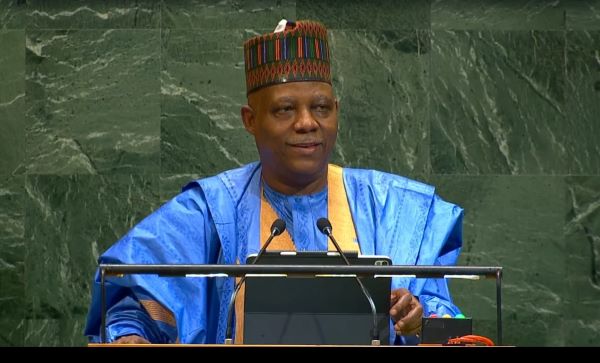
Vice President Kashim Shettima has pledged the Federal Government’s continued support for Nigerian farmers under the auspices of the All Farmers Association of Nigeria (AFAN), saying that when farmers thrive, the nation thrives.
Shettima gave the assurance at the closing ceremony of the three-day General Assembly of Farmers (GAF) meeting, themed “Empowering Farmers, Fostering Collaboration,” held in Abuja.
Speaking on behalf of the Vice President, the Senior Special Assistant to the President on Public Health, Dr. Uju Rochas-Anwukah, said the Nutrition 774 Initiative places farmers at the centre of Nigeria’s fight against malnutrition.
She described agriculture as not only an economic policy but also a strategy for security, peace, and national healing, adding that under the Renewed Hope Agenda, agriculture occupies a central position in the country’s recovery efforts.
According to her, Nigeria cannot fix its nutrition challenges without fixing food systems, and food systems cannot be fixed without farmers, stressing that farmers must not be treated as an afterthought.
She noted that the Nutrition 774 Initiative aligns agriculture, health, education, and livelihoods, emphasizing that nutrition begins on farms, not in hospitals.
Rochas-Anwukah added that the Office of the Vice President was ready to partner with AFAN to ensure farmers succeed, families prosper, and the nation grows.
She further stated that the fundamentals of life—food, shelter, and clothing—originate from the soil, adding that no nation industrialises without first securing its agricultural foundation.
Also speaking, the Minister of Defence, Gen. Christopher Musa (rtd), acknowledged the significant security challenges facing farmers and assured them of the Federal Government’s commitment to improving safety in farming communities.
Musa urged farmers to promptly report security threats, stressing that protecting farmers is critical to national food production and food security.
Earlier, AFAN President, Dr. Farouk Mudi, highlighted the effects of climate change, rising input costs, and insecurity on agricultural productivity.
Mudi said delayed rainfall, flooding, and high fertilizer prices were adversely affecting farming activities, noting that stronger policies and increased investment were required to safeguard the future of agriculture in Nigeria.
He stated that erratic rainfall patterns and the disappearance of harmattan had led to delayed rains and flash floods, destroying over 500,000 hectares of rice and maize farms nationwide.
Mudi added that the rising cost of fertilizer and agrochemicals had made farming increasingly unaffordable for many farmers.
He also described Nigeria’s livestock sector as being in crisis, despite the country’s large livestock population, attributing the situation to insecurity and persistent conflicts.
According to him, AFAN recorded the loss of over 10,000 lives and about N500 billion worth of property due to farmer-herder clashes in the last 10 years, while more than three million cattle were lost to rustling and unplanned migration.
Mudi said the association strongly supports the National Livestock Transformation Plan, which aims to promote modern ranching and enable farmers to cultivate their land without fear.
He added that Nigeria spends billions of dollars annually on food imports such as wheat, sugar, and fish—resources that could otherwise support local farmers.
He noted that agriculture was once central to Nigeria’s education system and rural economy, but declining emphasis on practical agriculture, combined with insecurity and climate challenges, has weakened local food production and discouraged youth participation in the sector.
