


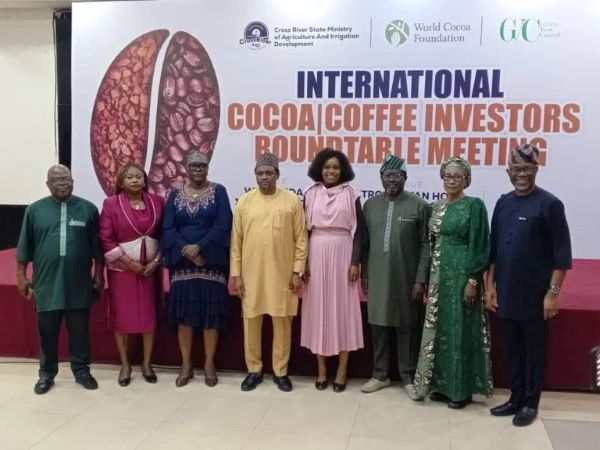
The Cross River State Government, on Thursday in Calabar, hosted a Cocoa and Coffee Investors Roundtable to promote value addition in the production of cocoa and coffee.
The event, which brought together stakeholders from the agriculture, environment, and finance sectors, also featured the unveiling of a seven-year Strategic Development Plan for Cocoa, Coffee, and Oil Palm (2025–2032).
Speaking at the event, the Commissioner for Agriculture, Mr. Johnson Ebokpo, said the state was no longer comfortable with supplying raw, undervalued cocoa and coffee beans.
“The roundtable provided a platform to present our strategic vision, anchored on value addition and inclusive growth,” he said. “It also introduced a clear Public-Private Partnership (PPP) framework.”
He added: “We are transitioning from just production to processing; from exporting raw materials to creating premium products and jobs here at home. We are building a proudly African ecosystem rooted in production, processing, and branding—driven by partnerships that unlock innovation, investment, and inclusion.”
Ebokpo disclosed that the state would establish six new cocoa estates as part of its seven-year strategic plan. He also revealed plans to pilot the cultivation of both Arabica and Robusta coffee in ecologically suitable areas of the state.
Declaring the event open, the wife of the governor, Mrs. Eyoanwan Otu, represented by her Special Adviser on Gender Mainstreaming, Dr. Iyang Asibong, emphasised her commitment to supporting women in agriculture. She commended ongoing developments in the cocoa sector and expressed hope that women in the state would lead in the coffee value chain.
Also speaking, Dr. Coffie Mawuli, Country Director of the World Cocoa Foundation (WCF) in Ghana and Nigeria, highlighted the launch of a deforestation-free cocoa initiative in response to sustainability challenges in Nigeria.
“This approach aims to grow the sector without compromising Nigeria’s natural resources, while cultivating with an eye on the future,” he said.
Mawuli listed key investment opportunities in the state’s cocoa sector, including:
- Local processing and value addition
- Traceability and digital technology platforms
- Ecosystem services and carbon markets
In his remarks, Mr. Hassan Usman, President of the National Coffee and Tea Association of Nigeria (NACOFTAN), said Cross River’s ambitious plan for cocoa and coffee would yield significant economic returns.
“At the peak of cultivation, you can get up to 2.5 tons of coffee per hectare, and during full harvest, up to 3.5 tons,” he said, adding that a ton of coffee currently sells for up to ₦9 million.
