

• Home
  • Agric
  • Sci & Tech
  • Health
  • Environment
  • Hausa News
  • More
    • Business/Banking & Finance
    • Politics/Elections
    • Entertainments & Sports
    • International
    • Investigation
    • Law & Human Rights
    • Africa
    • ACCOUNTABILITY/CORRUPTION
    • Hassan Gimba
    • Column
    • Prof. Jibrin Ibrahim
    • Prof. M.K. Othman
    • Defense/Security
    • Education
    • Energy/Electricity
    • Entertainment/Arts & Sports
    • Society and Lifestyle
    • Food & Agriculture
    • Health & Healthy Living
    • International News
    • Interviews
    • Investigation/Fact-Check
    • Judiciary/Legislature/Law & Human Rights
    • Oil & Gas/Mineral Resources
    • Press Freedom/Media/PR/Journalism
    • General News
    • Presidency
  • About Us
    • Contact Us
    • Board Of Advisory
    • Privacy Policy
    • Ethics Policy
    • Teamwork And Collaboration Policy
    • Fact-Checking Policy
    • Advertising
  • Media OutReach Newswire
    • Wire News
  • The Stories
Facebook Twitter Instagram
Trending
  • Senate confirms Oyewole as Supreme Court justice
  • DSS arraigns Malami, son on 5-count terrorism financing, firearms charges
  • NECO: 86.26% score 5 credits and above as body releases 2025 SSCE external results
  • Hayo secures A2P monetisation deal with Niger Republic’s Zamani telecom
  • Northwest University Sokoto: One year of measured transformation
  • US targets 79 Nigerians on “worst-of-the-worst” criminal deportation [LIST]
  • Naira opens February stronger at N1,384.5/$, narrows gap with parallel market
  • Expert urges businesses to strengthen cyber security to curb rising threats
Facebook Twitter Instagram YouTube
AsheNewsAsheNews
  • Home
  • Agric

    Middlemen, weak market structures blamed for rising food prices in Nigeria

    February 3, 2026

    L-PRES engages Sokoto stakeholders on livestock development priorities

    February 3, 2026

    ICRISAT, FAO back farmer-led pigeonpea seed enterprises in Mozambique

    February 2, 2026

    How Corteva Agriscience is boosting South Africa’s farming system

    January 31, 2026

    AI-driven project targets climate resilient crops for farmers in Africa

    January 31, 2026
  • Sci & Tech

    Hayo secures A2P monetisation deal with Niger Republic’s Zamani telecom

    February 3, 2026

    Expert urges businesses to strengthen cyber security to curb rising threats

    February 3, 2026

    Public sector technicians trained on ethical AI data compliance in Abuja

    February 3, 2026

    NOTAP takes IP regularization campaign to universities nationwide

    February 2, 2026

    Google launches WAXAL to amplify African voices in AI

    February 2, 2026
  • Health

    FTH Lokoja launches prostate cancer support group to improve patient care

    February 3, 2026

    Community pharmacists urge federal govt to make antivenom free nationwide

    February 3, 2026

    Neimeth Pharmaceuticals records N1.49bn pre-tax profit

    February 3, 2026

    FG warns of rising health risks from greenhouse gas emissions in Nigeria

    February 2, 2026

    Pate warns global health gains fragile amid overlapping global crises

    February 2, 2026
  • Environment

    FG warns of rising health risks from greenhouse gas emissions in Nigeria

    February 2, 2026

    EHCON reaffirms commitment to national emergency response on GHG health impacts

    February 2, 2026

    LAWMA seizes waste carts, arrests suspect in Lagos

    February 2, 2026

    Abia govt approves new climate change policy, prioritises disability inclusion

    January 31, 2026

    LAWMA arrests cart pushers for illegal dumping on Lagos–Badagry expressway

    January 31, 2026
  • Hausa News

    Anti-quackery task force seals 4 fake hospitals in Rivers

    August 29, 2025

    [BIDIYO] Yadda na lashe gasa ta duniya a fannin Ingilishi – Rukayya ‘yar shekara 17

    August 6, 2025

    A Saka Baki, A Sasanta Saɓani Tsakanin ‘Yanjarida Da Liman, Daga Muhammad Sajo

    May 21, 2025

    Dan majalisa ya raba kayan miliyoyi a Funtuwa da Dandume

    March 18, 2025

    [VIDIYO] Fassarar mafalki akan aikin Hajji

    January 6, 2025
  • More
    1. Business/Banking & Finance
    2. Politics/Elections
    3. Entertainments & Sports
    4. International
    5. Investigation
    6. Law & Human Rights
    7. Africa
    8. ACCOUNTABILITY/CORRUPTION
    9. Hassan Gimba
    10. Column
    11. Prof. Jibrin Ibrahim
    12. Prof. M.K. Othman
    13. Defense/Security
    14. Education
    15. Energy/Electricity
    16. Entertainment/Arts & Sports
    17. Society and Lifestyle
    18. Food & Agriculture
    19. Health & Healthy Living
    20. International News
    21. Interviews
    22. Investigation/Fact-Check
    23. Judiciary/Legislature/Law & Human Rights
    24. Oil & Gas/Mineral Resources
    25. Press Freedom/Media/PR/Journalism
    26. General News
    27. Presidency
    Featured
    Recent

    Senate confirms Oyewole as Supreme Court justice

    February 3, 2026

    DSS arraigns Malami, son on 5-count terrorism financing, firearms charges

    February 3, 2026

    NECO: 86.26% score 5 credits and above as body releases 2025 SSCE external results

    February 3, 2026
  • About Us
    1. Contact Us
    2. Board Of Advisory
    3. Privacy Policy
    4. Ethics Policy
    5. Teamwork And Collaboration Policy
    6. Fact-Checking Policy
    7. Advertising
    Featured
    Recent

    Senate confirms Oyewole as Supreme Court justice

    February 3, 2026

    DSS arraigns Malami, son on 5-count terrorism financing, firearms charges

    February 3, 2026

    NECO: 86.26% score 5 credits and above as body releases 2025 SSCE external results

    February 3, 2026
  • Media OutReach Newswire
    • Wire News
  • The Stories
AsheNewsAsheNews
Home»Food & Agriculture»China’s food security policies jeopardise apples, pears supply
Food & Agriculture

China’s food security policies jeopardise apples, pears supply

Abdoulaye KayBy Abdoulaye KayMay 15, 2024Updated:May 15, 2024No Comments5 Mins Read
Share
Facebook Twitter LinkedIn Pinterest Email

Companies of all sizes around the world, from multinationals down to local grocers, are concerned about supply chain security. China is the world’s biggest producer of apples and pears, but government policies have disincentivised growth.

Insight Focus

  • China is the world’s largest apple and pear producer by far.
  • But domestic food security policies could jeopardise the future of orchards.
  • Could the Southern Hemisphere fill in some of the production gaps?

Additionally, other major Northern Hemisphere suppliers such as Italy and Spain have faced production losses due due to adverse weather, diseases and low yields.
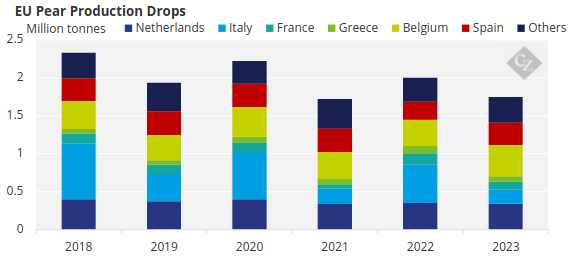
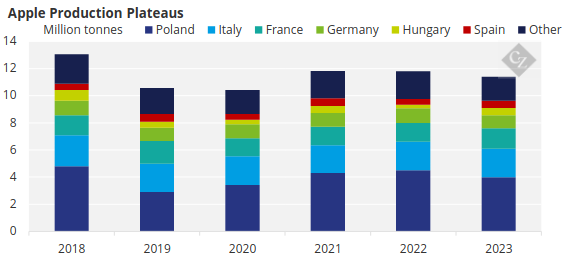
 

Source: USDA 

Can global apple and pear supply remain stable amid this backdrop?

ALSO READ Food Security: UN inaugurates 2024 plan for Northeast

China’s Orchards Clash with Crops

Both apples and pears are native to Asia, so it is no surprise that China remains the world’s largest producer. In fact, China produces about 55% of apples globally and 78% of the world’s pears. 
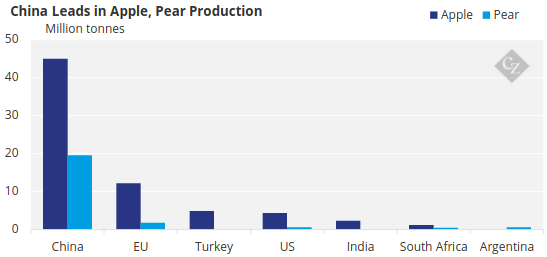
Source: USDA

However, despite being the world’s largest apple and pear producer, China is allocating less land to orchards and more to staple crops. It is well known that the Chinese government has placed a massive emphasis on food security to feed its growing population, and as a result, has imposed very strict policies regarding farmland use.

According to a USDA analysis on stone fruit production in China, orchards that produce fruit on viable farmland are being gradually phased out in return for compensation for farmers. The government wants to instead promote the growth of wheat, rice, corn, cotton, oilseeds, sugar, vegetables and forages on this land.

The government has stopped short of removing orchards that are already in full production. The USDA report also states that many of the fruit orchards in western China are located on “orchard land” or “forest land,” which is not appropriate for crop cultivation. While there will likely be a reduction in orchard on potential farmland, there could also be a move towards hillier areas in western China from current locations in central and north China. 
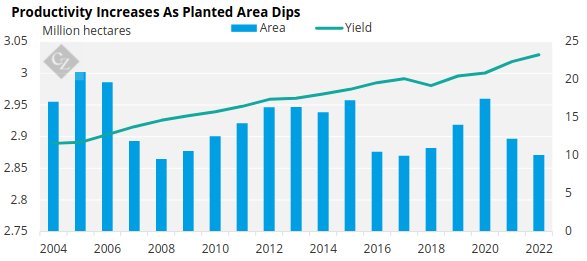
Source: NSBC 

As the world’s major producer of apples and pears, any disruption to Chinese orchards is likely to have an impact on global supply chains, especially since apple and pear demand has remained stable. 
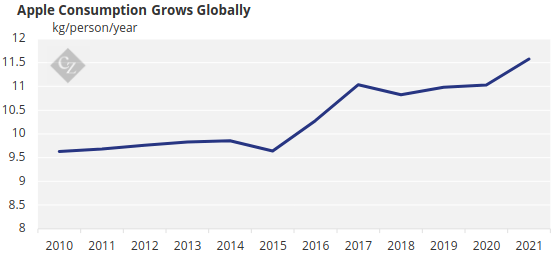
Source: FAOSTAT

And around 20% of China’s apple crop is currently represented by high-density plantings featuring dwarf trees. These high density plantings have been found to erode soil quality and exacerbate water shortages, particularly in very high production areas such as the Loess Plateau.

Can Southern Hemisphere Pick Up Slack?

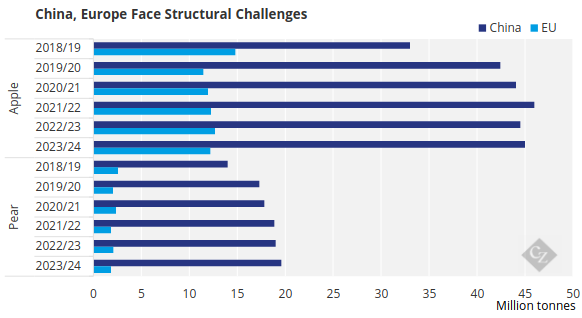
Considering Chinese apple production is now plateauing after decades of growth and EU production is dropping, apple processors around the globe have start to consider other producing regions and are looking to the Southern Hemisphere.
 

Source: USDA

In general, the Southern Hemisphere’s crop is expected to grow over 1% year over year to bring it up to 4.8 million tonnes. South Africa leads the region with 1.4 million tonnes of apple production, followed by Brazil at 1.1 million tonnes. Production in Chile is expected to be close to 1 million tonnes, but this represents an 8.3% reduction from last year. 

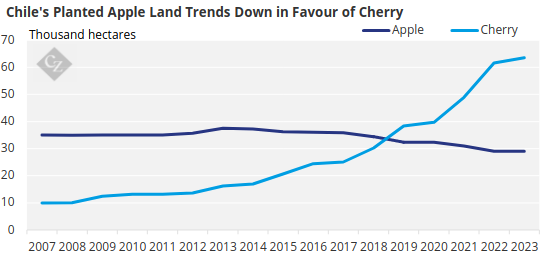
In a very similar situation as China, planted apple area has declined this year in Chile. But unlike in China, this is a consequence of the low apple returns to farmers, which has forced them to change their crop to other fruits with higher profitability such as cherries or apricot. 
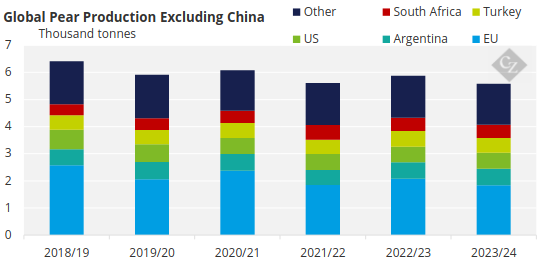
The situation for pears worldwide is not very different from apples. However, although pears face the same structural challenges in China and the EU, South Hemisphere projections do not look as good as for apple.

After China and the EU, Argentina is the third largest pear producer in the world. China and Argentina harvest their pears at different times of the year. If strategically managed, this can guarantee a fresh product and ensure security of supply. 
Source: USDA

But Argentina is expected to produce 6% less than last year, with 614,000 tonnes in 2024/25. Despite the good crop, weather conditions affected the flowering and delayed the harvesting to March. There is also a smaller planted area due to urbanization, shortage of growers and the continued higher production costs resulting in low revenue from the fruit.

Meanwhile, South Africa continues investing in the development of orchards and reliability of power and water resources, showing slow but steady production growth over the last 10 years. This has represented a pear orchard expansion of 1% per year. This year is expected to be the same and combined with better weather conditions than last year, there should be a growth of 3.4%, meaning a total production of 567,334 tonnes. 

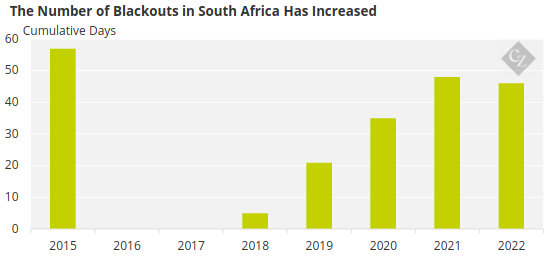
However, South Africa continues to struggle with challenges related to national utility company Eskom, which has experienced increasing numbers of blackouts, impacting the agricultural and industrial sectors.
Source: Czapp

Apples China Food security Pea
Share. Facebook Twitter Pinterest LinkedIn WhatsApp Reddit Tumblr Email
Abdoulaye Kay
  • Website

Related Posts

US targets 79 Nigerians on “worst-of-the-worst” criminal deportation [LIST]

February 3, 2026

Middlemen, weak market structures blamed for rising food prices in Nigeria

February 3, 2026

L-PRES engages Sokoto stakeholders on livestock development priorities

February 3, 2026

Leave A Reply Cancel Reply

Senate confirms Oyewole as Supreme Court justice

February 3, 2026

DSS arraigns Malami, son on 5-count terrorism financing, firearms charges

February 3, 2026

NECO: 86.26% score 5 credits and above as body releases 2025 SSCE external results

February 3, 2026

Hayo secures A2P monetisation deal with Niger Republic’s Zamani telecom

February 3, 2026
About Us
About Us

ASHENEWS (AsheNewsDaily.com), published by PenPlus Online Media Publishers, is an independent online newspaper. We report development news, especially on Agriculture, Science, Health and Environment as they affect the under-reported rural and urban poor.

We also conduct investigations, especially in the areas of ASHE, as well as other general interests, including corruption, human rights, illicit financial flows, and politics.

Contact Info:
  • 1st floor, Dogon Daji House, No. 5, Maiduguri Road, Sokoto
  • +234(0)7031140009
  • ashenewsdaily@gmail.com
Facebook Twitter Instagram Pinterest
© 2026 All Rights Reserved. ASHENEWS Daily Designed & Managed By DeedsTech

Type above and press Enter to search. Press Esc to cancel.