


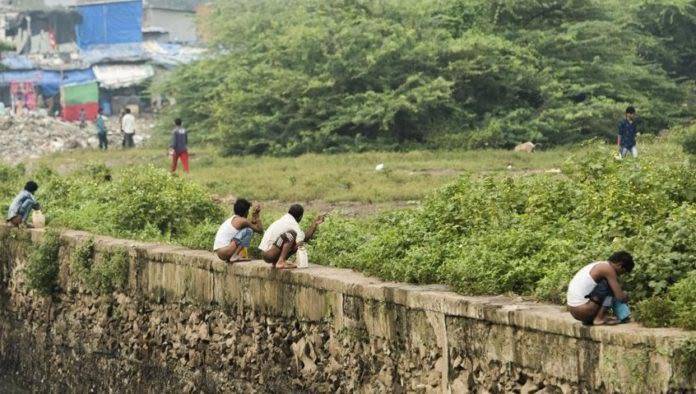
Traders and buyers at the Odo Olowu Warehouse Market in Lagos have decried persistent open defecation along the Oshodi-Mile 2 Expressway near Cele Bus Stop, describing it as a health risk and an embarrassment to the state.
The traders, who spoke with reporters in Lagos, said the situation has created an unpleasant environment for business and daily activities.
Human waste is visible along the highway shoulder and around the footbridge leading to the busy market, exposing traders, commuters, and motorists to foul odour and unsanitary conditions.
Mrs. Michelle Agbo, a reseller of fairly used kitchen appliances, said visiting the market has become increasingly unpleasant because of the sanitation problem.
“I like buying my goods here because the prices are competitive, but I dread crossing the road to enter the market. Everywhere is messy, and it’s not a good image for Lagos. I often take alternative routes just to avoid the area,” she said.
Agbo blamed the situation on people who sleep around the corridor and use the area as an open toilet.
Mrs. Adebayo, a fish trader, said rainfall worsened the problem.
“Whenever it rains, the smell becomes unbearable. It reaches our stalls and makes customers uncomfortable. Some people leave without buying anything,” she said.
Ngozi, a second-hand clothes trader, said traders are paying a heavy price for the poor sanitation conditions.
“We spend the whole day breathing in the offensive odour. It affects our comfort and raises health concerns. Customers are turned off, and many hurry away because of the smell,” she said.
She added that the situation has made her consider relocating her business despite the opportunities in the area.
Mr. Nnomso Ajaegbu, another trader, said the stench is usually strongest during hot afternoons.
“Customers complain often, and some leave without making purchases,” he said.
Malaika Wandu, a household appliances trader, described the situation as embarrassing.
“We sell products here daily, yet people defecate openly nearby. It leaves visitors with a poor impression of the environment,” she said.
Sandra Mahmoud, a food vendor, expressed fears about health risks.
“When it rains, the waste is washed into nearby drains. We worry about contamination since people eat and trade around here every day,” she said.
Some residents blamed the problem on the lack of accessible public toilets, despite the large number of passersby.
Abu, a commercial driver, called for more affordable sanitation facilities.
“We need clean, affordable public toilets. People shouldn’t have to choose between paying to use a toilet and relieving themselves in the open,” he said.
Another trader, Okechukwu, urged authorities to act urgently.
“This is a major gateway into Lagos. The government should provide adequate facilities and ensure they are properly maintained,” he said.
Nigeria aims to achieve an open defecation-free status by 2030, and Lagos State has pledged to eliminate the practice through improved sanitation infrastructure and public awareness campaigns.
However, at Odo Olowu Warehouse Market, traders say the visible human waste beneath the footbridge remains a daily reminder of the gap between sanitation goals and realities.
They insist that providing adequate toilet facilities, public education, and regular maintenance are essential to restoring dignity and cleanliness to one of Lagos’ busiest commercial corridors.
