


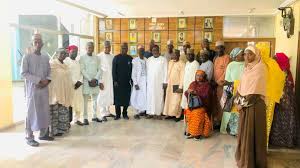
The Kano Coalition for Climate Action and Inclusive Governance (KACIG) has urged the Kano State House of Assembly to prioritize climate resilience in the 2026 Appropriation Bill.
The Head of KACIG, Mr Safiyanu Bichi, made the call on Monday during a public hearing on the budget while presenting the coalition’s position paper.
Bichi noted that Kano, with a population of over 20 million, remains one of the most climate-vulnerable states in the Sahel region.
“Continued underfunding of climate-related interventions can threaten livelihoods, critical infrastructure, and long-term development in the state,” he said.
He presented the coalition’s analysis of budget performance between 2022 and 2025, highlighting that the real value of the state budget declined by about 20 per cent in dollar terms, despite nominal growth from ₦241 billion in 2022 to ₦696 billion in 2025.
“The analysis shows that capital budget execution averaged 23 per cent during the period, dropping to 19.9 per cent in 2025. KACIG also reports a steady decline in climate-related allocations, from 13.9 per cent in 2023 to 6.5 per cent in 2025,” he said.
Bichi further noted that the Ministry of Environment executed only 26.7 per cent of its ₦12.5 billion allocation in 2025, while funding for agriculture fell sharply from ₦36 billion in 2023 to ₦0.2 billion in 2024.
He expressed concern that spending on non-critical items such as ceremonies, media engagements, office renovations, and symbolic purchases increased, while funding for climate-critical projects continued to shrink.
He cited cuts in erosion control funding for the Baban Gwari drainage from ₦2.6 billion to ₦514 million, preventive erosion works from ₦1.1 billion to ₦500 million, and ₦210 million allocated for tree planting across the three senatorial districts. He also described the ₦800 million earmarked for drainage construction under the Ministry of Environment and Climate Change as inadequate.
Bichi warned that persistent underfunding of climate resilience could worsen economic losses from flooding, erosion, and drought, while heightening environmental stress, migration, unemployment, and insecurity.
He highlighted that every one naira invested in climate resilience could save between four and seven naira in future losses.
The KACIG head therefore urged the assembly to increase capital allocations to climate-critical ministries, departments, and agencies, including the Ministry of Environment and Climate Change, WECCMA, the Ministry of Water Resources, REMASAB, and KNAP’s afforestation project.
He also called for the protection and expansion of funding for erosion control, drainage systems, water treatment, afforestation, renewable energy, climate-smart agriculture, and waste management.
Bichi urged lawmakers to align the 2026 budget with the Kano State Climate Change Policy to secure a climate-resilient future for the state.
