


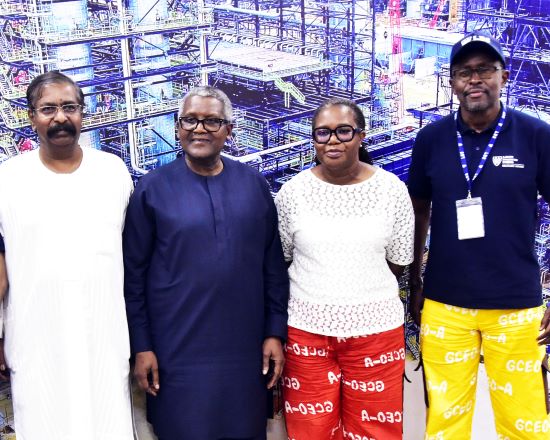
President/Chief Executive of Dangote Industries Limited, Aliko Dangote, has called on African entrepreneurs, business leaders, and wealthy individuals to invest in the development of the continent.
Speaking while hosting participants of the Global CEO Africa Programme—a partnership between Lagos Business School and Strathmore Business School, Nairobi—after a tour of the Dangote Petroleum Refinery & Petrochemicals in Ibeju-Lekki, Lagos, Dangote emphasized that Africa has the potential to grow and compete globally if given the right investments.
He asserted that the continent needs bold and transformative projects to address long-standing challenges. Citing the successful completion of the world’s largest single-train refinery, the Dangote Petroleum Refinery, he said such achievements can be replicated across sectors to drive economic growth.
Reflecting on the skepticism the project initially faced, Dangote noted that despite numerous obstacles, the group remained steadfast in its commitment.
“There will always be challenges. In fact, life without challenges isn’t exciting. You just hope for the kind of challenges you can overcome—not the ones that overwhelm you,” he remarked.
He added that completing the refinery had emboldened the group to pursue even more ambitious goals:
“Now that we’ve built this refinery, we believe we can do anything. We aim to make our fertiliser company the largest in the world—and we’ve set ourselves a 40-month timeline.”
Dangote highlighted Africa’s abundance of human and natural resources, stressing that business leaders are in a privileged position to harness these assets to create jobs for the continent’s growing population. He maintained that development cannot be left to governments alone, urging the private sector to demonstrate confidence by investing within the continent.
“We, as Africans, must stop taking our money abroad. We should invest it here to build our countries and the continent. I don’t take my money out of Africa. If we don’t show confidence in our own economies and leadership, foreign investors certainly won’t. After all, we know our leaders better than anyone else,” he said.
Dangote also argued that while many African nations have achieved political independence, they remain economically dependent. He referenced Dubai and Singapore—which were at par with some African countries in the 1970s—as examples of nations that surged ahead through deliberate policy choices and partnerships with visionary entrepreneurs.
He expressed concern over the mismatch between Africa’s rapid population growth and limited job opportunities, calling for a strong banking sector, robust manufacturing base, and thriving agriculture sector as essential drivers of development.
The business magnate also stressed the importance of intra-African connectivity, revealing that it is currently cheaper to import goods from Spain than to transport cement clinker from Nigeria to Ghana.
Acknowledging issues such as policy inconsistency and infrastructural challenges, Dangote urged the visiting CEOs not to be discouraged but to remain ambitious and gain deep knowledge of their industries.
“If you think small, you don’t grow. If you think big, you grow. It’s better to try and fail than never to try at all,” he advised the 24 CEOs from six African countries.
Patrick Akinwuntan, Academic Director of the Global CEO Africa Programme at Lagos Business School and former Managing Director of Ecobank Nigeria, said the programme aims to inspire Africa’s future business leaders.
He explained that the programme comprises three modules, with participants spending a week each in Nairobi (Kenya), Lagos (Nigeria), and New Haven (USA).
“The goal is to nurture business leaders who see Africa as a single market—one without borders—focused on the continent’s vast potential. The refinery is a powerful symbol that vision goes beyond mere sight,” he said.
Dr. Caesar Mwangi, Executive Dean of Strathmore Business School, echoed these sentiments, stating that the Dangote Refinery is living proof that Africans must dream big, think big, and act boldly.
“This refinery is the world’s largest single-train refinery. It’s proof that we must act. If the Dangote Group can achieve this, then so can others across the continent.”
He added that each CEO should take the inspiration back home to initiate impactful projects that will uplift Africa and create opportunities for its youth.
Professor Olayinka David-West, Dean of Lagos Business School, said the visit aligns with the school’s mission to develop leaders capable of addressing Africa’s complex social and institutional challenges.
She described Dangote as a visionary leader who mobilizes resources to confront critical issues, noting that the refinery’s ripple effects extend beyond petroleum production to national well-being and regional integration.
“This facility is pivotal. It serves as a practical tool to implement frameworks like the African Continental Free Trade Area (AfCFTA). Though one project, its effects will be felt across multiple sectors,” she said.
Dr. Rabiu Olowo, CEO of Nigeria’s Financial Reporting Council and a programme participant, said the visit reignited the need for bold, courageous thinking in driving sustainable national development.
Other notable visiting CEOs included Segun Aina, global banking leader; Nancy Njau, Managing Director of Family Bank, Nairobi; Emmanuel Wakili, Executive Director and CFO for Cameroon, CEMAC and CESA Region at Ecobank; and Ibukun Oyedeji, former President of the CFA Society Nigeria, among others.
