


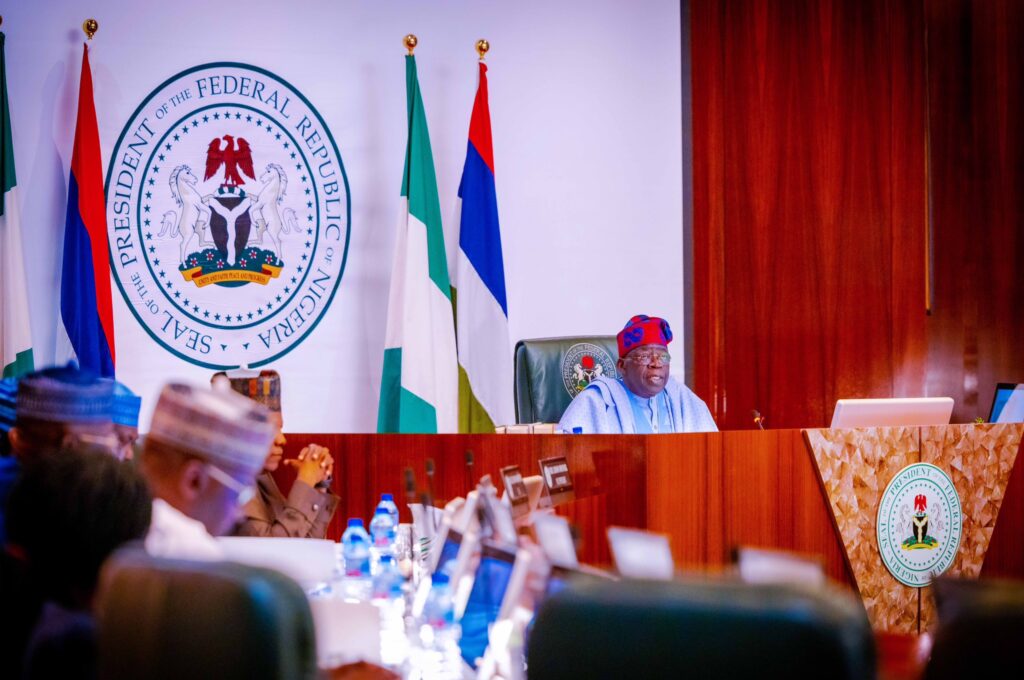
Some stakeholders have commended President Bola Tinubu for the recently inaugurated Presidential Committee on Fiscal Policy and Tax Reforms, chaired by Mr Taiwo Oyedele.
While inaugurating the committee on Monday, Tinubu, said that it was a demonstration of his administration’s commitment to breaking the cycle of over reliance on borrowing to fund public expenditure.
He charged the committee to improve the country’s revenue profile and business environment as the Federal Government moves to increase the country’s tax-to-Gross Domestic Product (GDP) ratio to 18 percent within three years.
The president had directed the committee not to fail to achieve its one-year mandate, which was divided into three main areas of fiscal governance, tax reforms, and growth facilitation.
He also directed all government Ministries, Departments and Agencies (MDAs) to cooperate fully with the committee toward achieving their mandate.
“Our aim is to transform the tax system to support sustainable development while achieving a minimum of 18 percent tax-to-GDP ratio within the next three years.
“Without revenue, government cannot provide adequate social services to the people it is entrusted to serve.
“The committee in the first instance is expected to deliver a schedule of quick reforms that can be implemented within thirty days.
“Critical reform measures should be recommended within six months, and full implementation will take place within one calendar year,” he said.
A research organisation, Pol Eco Analytics, commended the president for taking steps to introduce needed changes in Nigeria’s tax reform.
A statement by the senior researcher, Pol Eco Analytics, Mr Adefolarin Olamilekan, said the committee would find a lasting solution to the excesses of more than 62 government agencies.
Olamilekan said that it would also resolve confusion over MDAs’ mandates on tax remittance to government.
“This is a patriotic policy stand Nigerians must commend.
“This is a laudable move to tackle problems of disarticulated tax regime, and official negligence that worsened the case of tax evasion and non-compliance in Nigeria,” he said.
An economist, Dr Tope Fasua, said that it was good for the government to optimise revenue generation to cut down on borrowings.
Fasua advised that every state should take concrete steps to improve revenue generation for the economy to grow sustainably.
He urged the private sector to always cooperate with the government in its revenue drive rather than antagonise such initiatives.
“The private sector kicks anytime government proposes a tax increase, no matter how insignificant. It has turned itself into an enemy of government,” he said.
According to him, the Nigerian government will also need to get its expenditure priorities right.
“We have a debt problem, we have a revenue problem and we have an expenditure problem.
“Although debt-to-GDP ratio is not high compared to other countries, Nigeria needs to start spending wisely and generating more revenues,” he said.
Dr Ayo Abina, the chairman of AACS, an international consulting and investment company, said rather than continued borrowing, Nigeria could generate enough to fund government’s expenditure.
“Nigeria can earn additional 53 billion dollars by raising the tax-to-GDP ratio to 15 per cent without raising taxes, and save four billion dollars by tackling oil theft,” he said in a publication.
The International Monetary Fund (IMF) had also waded in, urging the Federal Government to take steps to increase the country’s revenue base.
Ari Aisen, Resident Representative, IMF Nigeria Office, during a recent virtual forum on the Nigerian debt situation, advised the government to drastically reduce dependence on borrowing to fund expenditure.
According to Aisen, to resolve the debt issues of Nigeria, the country needs to concentrate on its revenue and expenditure.
He said that the debt situation had deteriorated because the Federal Government spent more than it was actually getting in revenues.
“How do you reduce the spending needs of the government? That should be the question.
“It is really about fiscal discipline. People should not permanently spend beyond what they generate in revenue because it becomes unsustainable,” he said.
Aisen said that the critical thing to do was for countries to rely more on their own revenue to finance their own expenditure.
“That is the autonomy and the independence that we would like to see our member countries rely on,” he said.
Vahyala Kwaga, an analyst at BudgIT, a Nigerian company that provides social advocacy using technology, urged Nigerians to also beam their searchlights on the state governors and their fiscal behaviour.
“The federal system allows the centre to provide monies for the states.
“The question is, how prudent are these monies expended when they are given to the states?
“The transparency and accountability problem we have in the use of funds is extremely problematic at the level of the states,” he said.
As the Federal government takes steps to boost the country’s revenue base through tax and other fiscal reforms, Nigerians expect that borrowing will soon cease to be a primary source of funding for the country’s budgets.
Nigeria’s public debt stock as at Dec. 31, 2022 stood at N46.25 trillion equivalent to (103.11 billion dollars).
According to the Debt Management Office (DMO), the public debt stock of the country consists of the domestic and external debts of the Federal Government of Nigeria and the sub-national governments.
The DMO, which is the Federal Government’s agency established to coordinate the management of national debts also recognised the dire need for government to reduce its dependence on borrowing by generating more revenues.
Its Director-General, Patience Oniha said that Nigeria had operated deficit budgets for many decades, which made borrowing from local and external sources imperative.
“The financing of the deficits through borrowing from local and external sources is the principal reason for the growth in debt stock and debt servicing.
“One way to reduce budget deficits is to grow revenues, the other way is to prioritise expenditure and cut waste and leakages.
“How much revenue is Nigeria generating? Statistics show that relative to other countries, Nigeria’s revenue generation is low.
“The World Bank Economic Outlook for 2020 showed that Nigeria, with a revenue-to-GDP ratio of 6.3 per cent, was ranked 194 out of 196 countries covered,’’ she said.
She said that a strong revenue base would reduce the need for relatively large amounts of new borrowing, and will also reduce the debt service to revenue ratio.
“Revenue generation is the way to go and that is how countries develop and use borrowing to augment revenue shortfalls now and again.
“Nigeria has been running budget deficits for decades, it is about time to shift to balanced budget and even budgets surplus,’’ she said.
According to her, among reasons for the increase in total public debt stock is new borrowing by the Federal Government and sub-national governments, primarily to finance budget deficits and execute projects.
“The issuance of promissory notes by the Federal Government to settle some liabilities also contributed to growth in the debt stock,” she said.
