

• Home
  • Agric
  • Sci & Tech
  • Health
  • Environment
  • Hausa News
  • More
    • Business/Banking & Finance
    • Politics/Elections
    • Entertainments & Sports
    • International
    • Investigation
    • Law & Human Rights
    • Africa
    • ACCOUNTABILITY/CORRUPTION
    • Hassan Gimba
    • Column
    • Prof. Jibrin Ibrahim
    • Prof. M.K. Othman
    • Defense/Security
    • Education
    • Energy/Electricity
    • Entertainment/Arts & Sports
    • Society and Lifestyle
    • Food & Agriculture
    • Health & Healthy Living
    • International News
    • Interviews
    • Investigation/Fact-Check
    • Judiciary/Legislature/Law & Human Rights
    • Oil & Gas/Mineral Resources
    • Press Freedom/Media/PR/Journalism
    • General News
    • Presidency
  • About Us
    • Contact Us
    • Board Of Advisory
    • Privacy Policy
    • Ethics Policy
    • Teamwork And Collaboration Policy
    • Fact-Checking Policy
    • Advertising
  • Media OutReach Newswire
    • Wire News
  • The Stories
Facebook Twitter Instagram
Trending
  • EFCC arrests 10 suspects, truck for suspected illegal mining activities in Kwara
  • NTI releases 13,710 long-pending PGDE, NCE certificates
  • EBRD launches Nigeria operations with $100m trade finance support for Access Bank
  • Hajj 2026: NAHCON secures accommodation ahead of Saudi deadline
  • FG warns of rising health risks from greenhouse gas emissions in Nigeria
  • First Abu Dhabi Bank to open new office in Lagos
  • Access Bank appoints new board chair
  • Pate warns global health gains fragile amid overlapping global crises
Facebook Twitter Instagram YouTube
AsheNewsAsheNews
  • Home
  • Agric

    ICRISAT, FAO back farmer-led pigeonpea seed enterprises in Mozambique

    February 2, 2026

    How Corteva Agriscience is boosting South Africa’s farming system

    January 31, 2026

    AI-driven project targets climate resilient crops for farmers in Africa

    January 31, 2026

    FG empowers 40 cooperatives with farm inputs in Yobe

    January 30, 2026

    Katsina to host 3,750 housing units, aquaculture project financed by COSMOS

    January 30, 2026
  • Sci & Tech

    NOTAP takes IP regularization campaign to universities nationwide

    February 2, 2026

    Google launches WAXAL to amplify African voices in AI

    February 2, 2026

    Nigeria prizes open 2026 entries with focus on AI, poetry, documentary film

    February 2, 2026

    Indonesia lifts ban on Elon Musk’s Grok  

    February 1, 2026

    Expert urges federal govt to tackle multiple taxation in telecoms sector

    January 31, 2026
  • Health

    FG warns of rising health risks from greenhouse gas emissions in Nigeria

    February 2, 2026

    Pate warns global health gains fragile amid overlapping global crises

    February 2, 2026

    ICSA: Five states commit to improved investment in child, maternal health

    February 2, 2026

    Kwara trains 55 newly recruited health workers in integrated programme

    February 2, 2026

    NCDC urges long-term private sector co-investment for health security

    February 2, 2026
  • Environment

    FG warns of rising health risks from greenhouse gas emissions in Nigeria

    February 2, 2026

    EHCON reaffirms commitment to national emergency response on GHG health impacts

    February 2, 2026

    LAWMA seizes waste carts, arrests suspect in Lagos

    February 2, 2026

    Abia govt approves new climate change policy, prioritises disability inclusion

    January 31, 2026

    LAWMA arrests cart pushers for illegal dumping on Lagos–Badagry expressway

    January 31, 2026
  • Hausa News

    Anti-quackery task force seals 4 fake hospitals in Rivers

    August 29, 2025

    [BIDIYO] Yadda na lashe gasa ta duniya a fannin Ingilishi – Rukayya ‘yar shekara 17

    August 6, 2025

    A Saka Baki, A Sasanta Saɓani Tsakanin ‘Yanjarida Da Liman, Daga Muhammad Sajo

    May 21, 2025

    Dan majalisa ya raba kayan miliyoyi a Funtuwa da Dandume

    March 18, 2025

    [VIDIYO] Fassarar mafalki akan aikin Hajji

    January 6, 2025
  • More
    1. Business/Banking & Finance
    2. Politics/Elections
    3. Entertainments & Sports
    4. International
    5. Investigation
    6. Law & Human Rights
    7. Africa
    8. ACCOUNTABILITY/CORRUPTION
    9. Hassan Gimba
    10. Column
    11. Prof. Jibrin Ibrahim
    12. Prof. M.K. Othman
    13. Defense/Security
    14. Education
    15. Energy/Electricity
    16. Entertainment/Arts & Sports
    17. Society and Lifestyle
    18. Food & Agriculture
    19. Health & Healthy Living
    20. International News
    21. Interviews
    22. Investigation/Fact-Check
    23. Judiciary/Legislature/Law & Human Rights
    24. Oil & Gas/Mineral Resources
    25. Press Freedom/Media/PR/Journalism
    26. General News
    27. Presidency
    Featured
    Recent

    EFCC arrests 10 suspects, truck for suspected illegal mining activities in Kwara

    February 2, 2026

    NTI releases 13,710 long-pending PGDE, NCE certificates

    February 2, 2026

    EBRD launches Nigeria operations with $100m trade finance support for Access Bank

    February 2, 2026
  • About Us
    1. Contact Us
    2. Board Of Advisory
    3. Privacy Policy
    4. Ethics Policy
    5. Teamwork And Collaboration Policy
    6. Fact-Checking Policy
    7. Advertising
    Featured
    Recent

    EFCC arrests 10 suspects, truck for suspected illegal mining activities in Kwara

    February 2, 2026

    NTI releases 13,710 long-pending PGDE, NCE certificates

    February 2, 2026

    EBRD launches Nigeria operations with $100m trade finance support for Access Bank

    February 2, 2026
  • Media OutReach Newswire
    • Wire News
  • The Stories
AsheNewsAsheNews
Home»Food & Agriculture»Understanding Nagoya protocol for CGAIR research, By Michael Major, Crop Trust
Food & Agriculture

Understanding Nagoya protocol for CGAIR research, By Michael Major, Crop Trust

Abdallah el-KurebeBy Abdallah el-KurebeAugust 16, 2019No Comments6 Mins Read
Share
Facebook Twitter LinkedIn Pinterest Email

The ‘Guidelines on the Nagoya Protocol for CGIAR Research Centers’ have been developed to help genebanks understand the legal requirements of moving plant genetic resources around the world.

The movement of plant genetic resources between countries is governed by a veritable alphabet soup of treaties and agreements: ITPGRFA, CBD and SMTA for a start. But some agreements are such a mouthful that they’ve proved impossible to condense into acronyms. So, the Nagoya Protocol on Access to Genetic Resources and the Fair and Equitable Sharing of Benefits Arising from their Utilization to the Convention on Biological Diversity is, simply, the CBD’s Nagoya Protocol.

“Sometimes CGIAR staff struggle with understanding the legal requirements of moving plant genetic resources around,” said Michael Halewood, the head of the Policy Unit at Bioversity Internationaland leader of the Genebank Platform Policy Module. “The Nagoya Protocol is the new kid on the block in terms of agreements and is particularly perplexing.” In an attempt to help the CGIAR system get to know this baffling newcomer, the Genebank Platform Policy Module has prepared the Guidelines on the Nagoya Protocol for CGIAR Research Centers (the Guidelines).

Operable systems

The Nagoya Protocol came into force in October 2014 as a supplementary agreement to the 1992 Convention on Biological Diversity (CBD). The Protocol seeks to ensure that when genetic resources are used, the benefits of that use are shared fairly and equitably by the parties involved. To date, the Protocol has been ratified by 118 countries.

The Nagoya Protocol puts in place what the Guidelines call “operable systems” to monitor the use of the material and ensure users comply with the relevant access and benefit-sharing legislation in the provider countries. That means systems that can, and do, work. Its provisions aim to create greater legal certainty and transparency for both providers and users of genetic resources.

“The key behind the Nagoya Protocol is that it provides concrete mechanisms for countries providing plant genetic resources to be able to follow up and attempt to bring legal action against those who aren’t complying with mutually agreed terms,” said Isabel López Noriega, a policy specialist and colleague of Halewood at Bioversity International. “This is something that was missing in the CBD – a mechanism for monitoring the use of the genetic resources and for ensuring compliance.”

CGIAR and Nagoya

Most of the activities undertaken by CGIAR Centers related to plant genetic resources are governed by the International Treaty on Plant Genetic Resources for Food and Agriculture (ITPGRFA) and not by the CBD. However, there are situations when Centers do need to comply with regional, national and sub-national mechanisms that implement the Nagoya Protocol.

“At times, a CGIAR Center might need to access plant genetic resources that are not available through the ITPGRFA’s multilateral system,” said Michael. “And as more countries ratify and implement the Nagoya Protocol, an increasing proportion of the genetic resources that CGIAR Centers may want to collect and use could be affected by laws developed under the Protocol.”

For example, let’s say the International Maize and Wheat Improvement Center (CIMMYT) wants to collect maize in Mexico. Mexico has ratified both the CBD and the Nagoya Protocol, but not the ITPGRFA. So CIMMYT would be required to follow the laws and regulations developed in Mexico for regulating the access to genetic resources and related traditional knowledge, which are currently under preparation.

Traditional knowledge too

Unlike any other binding international agreement, the Nagoya Protocol requires its member countries to ensure that users of genetic resources and associated information obtain access to any traditional knowledge associated with those resources with the prior informed consent (PIC) of the indigenous peoples and local communities that hold such knowledge. Based on this, the Guidelines alert CGIAR Centers that more countries will develop legal frameworks requiring PIC from the farmers who share traditional knowledge associated with genetic resources.

Guiding CGIAR Centers

The Guidelines also points out that in the absence of any concrete obligations under national or customary laws, as part of its overall research ethics, CGIAR is committed to operate with respect to internationally accepted principles and standards.

The Guidelines thus explains the internal principles and policies of CGIAR with regard to working with indigenous peoples and local communities, as well as international codes of conducts that can help Centers to meet internationally accepted principles and standards in a practical way.

The Guidelines help CGIAR Centers understand which areas of their plant genetic resources activities could be affected by the Nagoya Protocol. They outline the Centers’ options in terms of compliance with their legal obligations. They address situations where countries have national laws in place implementing the Nagoya Protocol as well as situations where the countries concerned have ratified or acceded to the Nagoya Protocol but do not yet have national laws and systems in place to implement it.

“The need for these guidelines will become increasingly more important as additional countries ratify the Nagoya Protocol and as the 11 CGIAR genebanks distribute plant genetic resources outside of the ITPGRFA’s multilateral system,” said Isabel.

Expanding the Guidelines

Recognizing the increasing importance of the Nagoya Protocol, the Genebank Platform’s Policy Module is now to coordinating the development of additional, complementary materials to help CGIAR germplasm users understand the issues raised, and the guidance provided, by the Guidelines. These will include FAQs, role-playing scenarios teasing out tricky issues, and explanatory videos

The policy Module also plans to develop templates, and models and standard practices for acquiring prior informed consent on mutually agreed terms when accessing traditional knowledge or genetic resources that fall under the framework of the CBD and the Nagoya Protocol. Finally, Michael and Isabel hope to develop additional sections of the Guidelines to address Centers’ access and distribution of animal, and microbial genetic resources
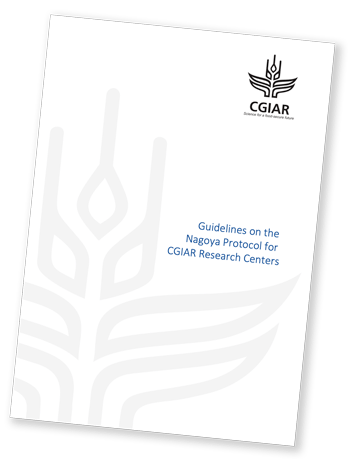
NagoyaGuidelinesCover

What’s in the Guidelines

Section 1: provides an overview of the relationship of the Nagoya Protocol to the ITPGRFA.

Section 2: considers when the Nagoya Protocol could apply to CGIAR genebanks and breeders accessing new plant genetic resources.

Section 3: analyses how the CGIAR Centers’ distributions of plant genetic resources could be affected by the Nagoya Protocol.

Section 4: focuses on issues that CGIAR Centers need to bear in mind concerning the operation of “checkpoints” established within countries as part of the overall monitoring and enforcement apparatus established by the Nagoya Protocol.

Section 5: considers how and when the Nagoya Protocol could apply to CGIAR Centers accessing, using and distributing traditional knowledge.

CGAIR CIMMYT
Share. Facebook Twitter Pinterest LinkedIn WhatsApp Reddit Tumblr Email
Abdallah el-Kurebe
  • Website
  • Facebook
  • Twitter
  • LinkedIn

Related Posts

ICRISAT, FAO back farmer-led pigeonpea seed enterprises in Mozambique

February 2, 2026

How Corteva Agriscience is boosting South Africa’s farming system

January 31, 2026

AI-driven project targets climate resilient crops for farmers in Africa

January 31, 2026

Leave A Reply Cancel Reply

EFCC arrests 10 suspects, truck for suspected illegal mining activities in Kwara

February 2, 2026

NTI releases 13,710 long-pending PGDE, NCE certificates

February 2, 2026

EBRD launches Nigeria operations with $100m trade finance support for Access Bank

February 2, 2026

Hajj 2026: NAHCON secures accommodation ahead of Saudi deadline

February 2, 2026
About Us
About Us

ASHENEWS (AsheNewsDaily.com), published by PenPlus Online Media Publishers, is an independent online newspaper. We report development news, especially on Agriculture, Science, Health and Environment as they affect the under-reported rural and urban poor.

We also conduct investigations, especially in the areas of ASHE, as well as other general interests, including corruption, human rights, illicit financial flows, and politics.

Contact Info:
  • 1st floor, Dogon Daji House, No. 5, Maiduguri Road, Sokoto
  • +234(0)7031140009
  • ashenewsdaily@gmail.com
Facebook Twitter Instagram Pinterest
© 2026 All Rights Reserved. ASHENEWS Daily Designed & Managed By DeedsTech

Type above and press Enter to search. Press Esc to cancel.