


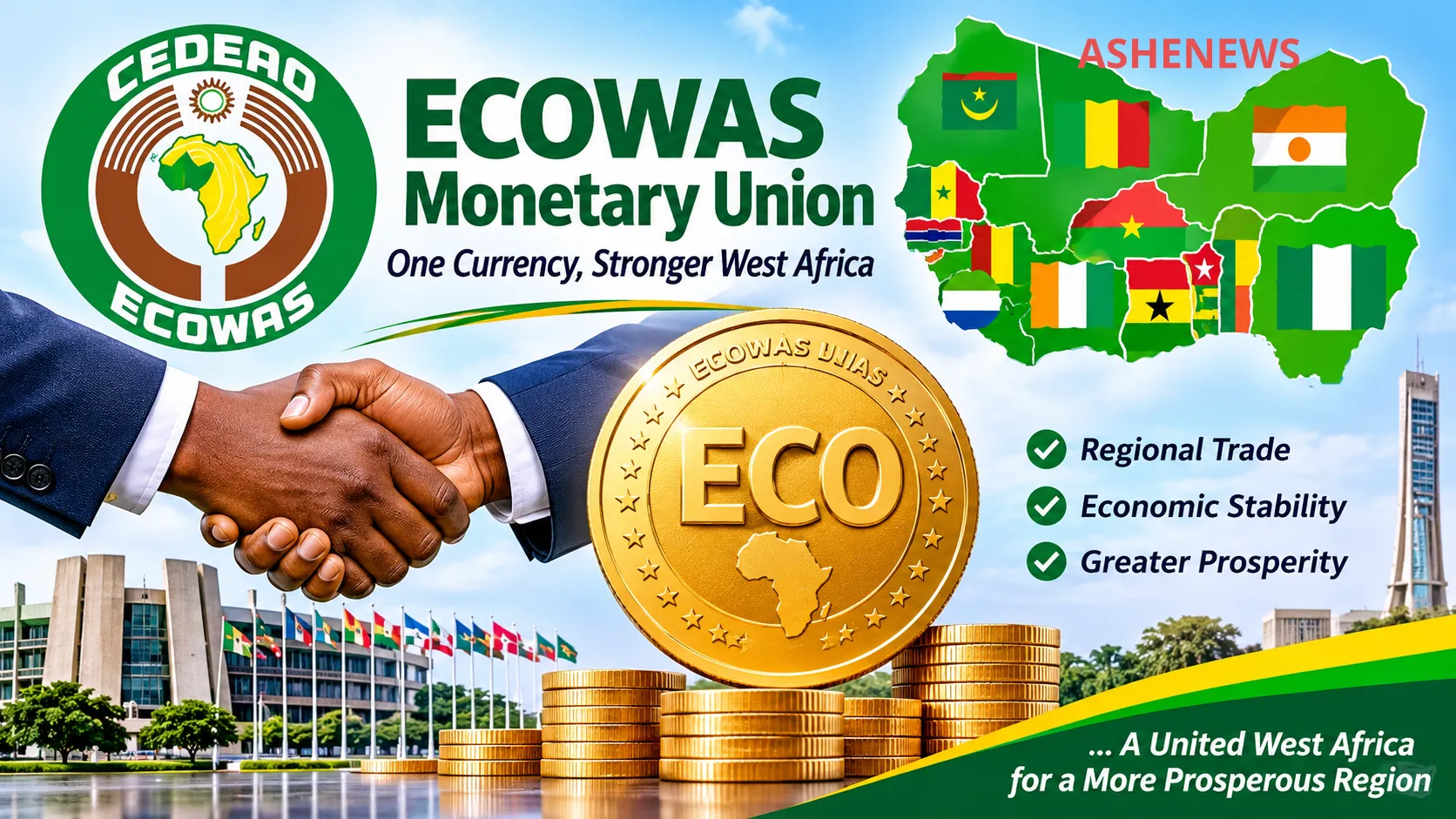
The proposed ECOWAS Monetary Union and the planned introduction of the ECO single currency from 2027 could become one of the most consequential economic projects in West Africa. But it could also become one of the region’s most difficult experiments if political solidarity is allowed to outrun economic reality.
The warning by the Governor of the Central Bank of Nigeria, Olayemi Cardoso, that financial responsibility should be matched by meaningful representation in the governance of the proposed union therefore deserves serious consideration.
Speaking at the sixth Presidential Task Force Meeting on the ECOWAS Single Currency Programme in Abidjan, Côte d’Ivoire, Cardoso called for equity, fairness and proportional representation in the governance structure of the proposed monetary union. He argued that while sovereign equality must remain fundamental, it should be balanced against the financial commitments, responsibilities and risks assumed by individual countries.
This is not simply a Nigerian demand for greater influence. It raises a fundamental question that ECOWAS must answer before a common currency is introduced: who bears the risks of the union, who pays for it, and who gets to decide how it is run?
That question matters because the economies entering the proposed monetary union are far from equal.
ALSO READ ECOWAS Monetary Union: Cardoso seeks equity, fair representation for major contributors
Nigeria remains by far the largest economy in West Africa. World Bank data put its 2025 nominal GDP at about $290.8 billion, compared with approximately $114.2 billion for Ghana and $99.8 billion for Côte d’Ivoire. S&P Global similarly puts West Africa’s combined nominal GDP above $700 billion in 2025, with Nigeria accounting for a very substantial share of the regional economy.
The disparity is even more important when considering the financial responsibilities that come with monetary integration.
Nigeria is currently operating with gross external reserves of about $54.02 billion, equivalent to more than 10 months of import cover, while its central bank has retained the Monetary Policy Rate at 23 per cent in an effort to consolidate the country’s disinflation gains and protect external stability.
These figures matter because a monetary union is much more than changing banknotes or replacing national currencies with a common one. It means surrendering important aspects of national monetary sovereignty to common institutions. Decisions on interest rates, liquidity, foreign reserves, exchange-rate management, banking regulation and, potentially, fiscal discipline would increasingly have regional consequences.
For smaller economies, the ECO could provide a larger and potentially more credible monetary and financial space. A common currency could reduce transaction costs, eliminate exchange-rate uncertainty among participating countries, facilitate cross-border trade and investment, deepen regional financial markets and make it easier for businesses to operate across national borders.
For ordinary West Africans, the practical benefits could be significant.
A trader moving goods between Lagos and Accra, a manufacturer buying inputs from another member state, a farmer selling produce across borders or a student travelling within the region would no longer have to deal with multiple currencies and their associated exchange-rate risks. A properly designed monetary union could also strengthen price transparency and make regional commerce more predictable.
The potential economic gains are substantial because West Africa already has a large trading base. ECOWAS says regional trade has averaged more than $208 billion, with Nigeria historically accounting for about 76 per cent of total regional trade.
But the same numbers that demonstrate Nigeria’s economic importance also explain why the governance question cannot be dismissed.
A monetary union cannot be sustainable if countries contribute according to one formula but exercise power according to another without a clear justification.
At the same time, Nigeria must be careful not to interpret proportional representation as economic domination. The essence of a monetary union is shared sovereignty. Smaller economies must not be made to feel that a common currency is merely an instrument for the largest economy to impose its preferences on the rest.
That is why the answer should not be either one-country-one-vote regardless of economic responsibility or one-dollar-one-vote regardless of national sovereignty.
ECOWAS needs a carefully negotiated governance model that combines sovereign equality with economic weight, financial contribution and systemic risk.
There are lessons to be learned from the convergence process itself.
The ECOWAS macroeconomic convergence framework requires member states to maintain an annual average inflation rate of no more than 5 per cent, a fiscal deficit of no more than 3 per cent of GDP, central bank financing of fiscal deficits within specified limits and gross external reserves equivalent to at least three months of imports. The framework also sets a public-debt ceiling of 70 per cent of GDP and limits exchange-rate variation.
These are not bureaucratic conditions. They are the foundation of monetary credibility.
A common currency cannot work if one country maintains fiscal discipline while another routinely finances deficits through monetary expansion. It cannot survive if inflation expectations diverge sharply between members or if countries repeatedly violate common fiscal rules without consequences.
The history of monetary integration elsewhere demonstrates that adopting a common currency does not automatically produce economic convergence. In fact, it can expose structural differences more sharply because countries lose the ability to use their individual currencies and exchange rates to absorb economic shocks.
This is particularly important for West Africa, where economies have different production structures, fiscal capacities, inflation dynamics, export bases and exposure to commodity-price movements.
Nigeria, for instance, is heavily influenced by oil and gas revenues, while Côte d’Ivoire and Ghana have different commodity and services structures. Smaller economies may be more vulnerable to external shocks, import dependence and fluctuations in food and energy prices.
A single monetary policy may therefore be appropriate for one economy at one point and restrictive for another.
This is why the proposed ECO should not be treated as a political trophy to be unveiled in 2027. It must be built on institutions capable of managing precisely these differences.
The fact that ECOWAS says the 2027 objective remains achievable is encouraging, but the remaining convergence and institutional questions must be resolved honestly rather than through political deadlines.
There is another complication that cannot be ignored: the political fragmentation of West Africa.
Burkina Faso, Mali and Niger withdrew from ECOWAS in January 2025, while remaining members of the West African Economic and Monetary Union. Their departure has altered the political and economic landscape within which the ECO project is being pursued.
That development makes it even more important for ECOWAS to demonstrate that the monetary union is an economic project rather than a political instrument.
For Nigeria, the stakes are particularly high.
The country should seek fair representation, as Cardoso has argued, but it must also demonstrate that its leadership comes with responsibility. If Nigeria expects greater influence because of the size of its economy and financial commitments, it should also be prepared to provide leadership in regional financial stability, trade facilitation, infrastructure, payment systems and crisis management.
The same principle applies to every other member.
The bigger economies cannot demand influence without accepting greater responsibility. Smaller economies cannot demand equal influence while expecting the larger economies to carry disproportionate financial risks. And no member should enter the union merely because of political pressure while failing to meet the economic requirements for sustainable monetary integration.
The proposed ECO should therefore be built around three principles: credibility, equity and accountability.
Credibility means that the currency must be backed by strong institutions, disciplined monetary policy, adequate reserves and enforceable convergence rules.
Equity means that every member must have a meaningful stake in the system, while governance should recognise differences in economic size, financial contribution and systemic risk.
Accountability means that governments and monetary authorities must be answerable for the commitments they make to the union.
If these principles are respected, the ECO could become more than a new currency. It could become an instrument for deeper African economic integration, allowing West African businesses and citizens to operate within a larger, more predictable economic space.
But if the region rushes to launch a currency without resolving the underlying questions of governance, fiscal discipline, reserve management and political trust, the ECO could merely replace one set of exchange-rate problems with a much larger regional monetary problem.
Cardoso is therefore right to insist that those carrying significant financial responsibilities should have a meaningful voice. But the broader lesson is that the ECO must belong to all participating countries, not merely to the biggest contributors.
West Africa does not need a currency simply because Europe has one. It needs a monetary union that works because its economies are sufficiently prepared, its institutions are credible and its members trust the rules.
The real measure of the ECO will not be the day its banknotes are issued. It will be whether, years later, West African citizens can say that the common currency made trade easier, investment stronger, prices more stable and economic opportunity more widely shared.
That is the standard ECOWAS must meet.
