


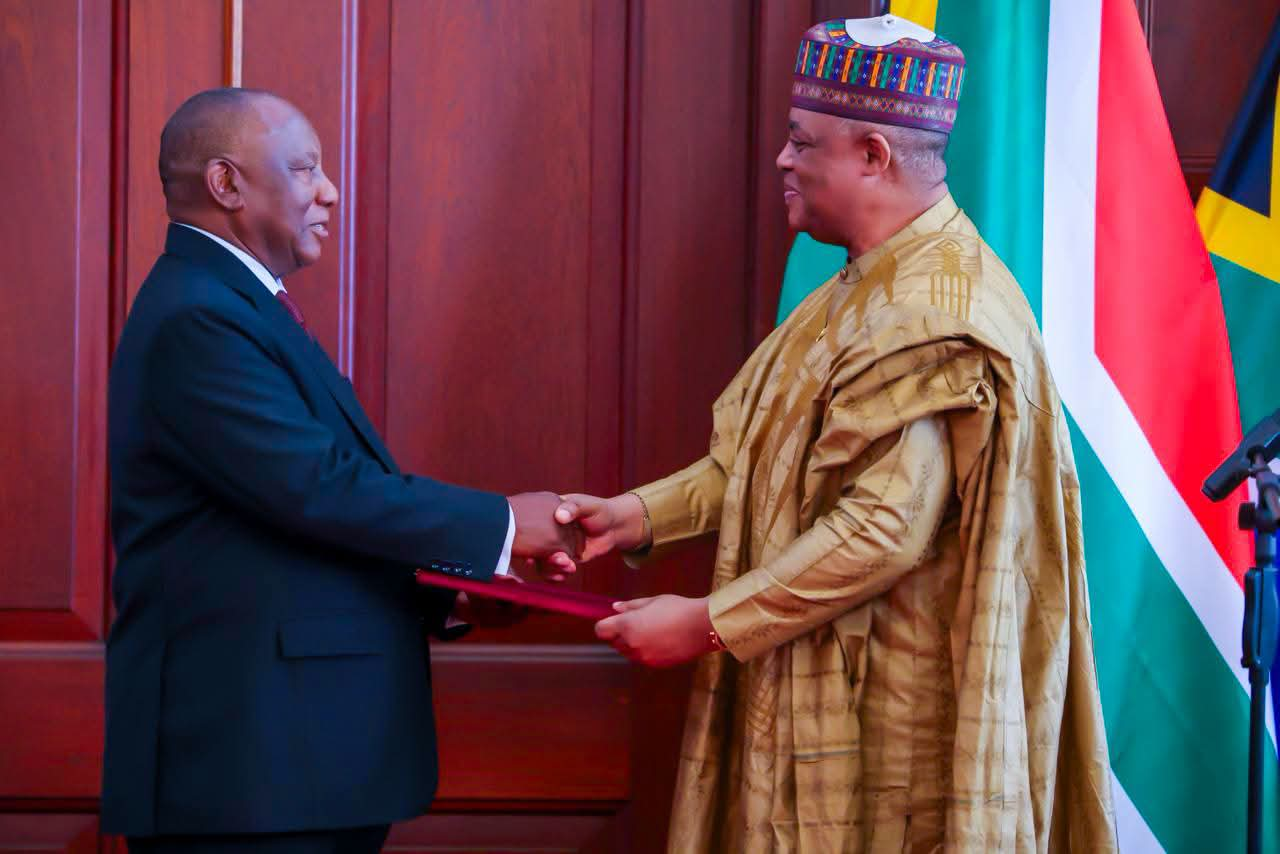
It was a great and historic morning today at the South African Presidential Guest House in Pretoria, where I had the honour and privilege of presenting my letters of credence to His Excellency, President Cyril Ramaphosa, President of the Republic of South Africa, alongside ambassadors from 14 other countries.
It was a beautiful and historic occasion. It marked the first posting of a substantive Ambassador of the Federal Republic of Nigeria to the Republic of South Africa in four years.
Given the importance of the occasion, one would have expected Nigeria’s presence to receive the same recognition and treatment accorded to every other country represented at the ceremony.
Sadly, that was not the case.
The entire event was livestreamed by the South African Presidency, and millions of Nigerians, South Africans, Africans and members of the international community were watching in real time.
All 15 ambassadors were formally introduced and each delivered a speech.
Curiously, however, the South African Presidency did not air the introduction of the Nigerian delegation or my speech.
Instead, the livestream was cut off when it was time for Nigeria’s presentation and only resumed after my speech had ended.
Of all the 15 ambassadors who were introduced and spoke at the ceremony, Nigeria was the only one whose presentation was excluded from the livestream.
That is not a minor technical detail. It is a matter that deserves to be addressed, particularly given the historical and strategic importance of relations between Nigeria and South Africa.
Nigeria and South Africa are two of the continent’s most influential countries. Our relationship goes beyond the exchange of ambassadors. It is rooted in history, African solidarity, economic interests, diplomacy and the sacrifices made during the struggle against apartheid.
For that reason, Nigeria cannot and should not be treated as an afterthought.
I raised the matter directly with President Ramaphosa during the photo session while we were still on the premises.
To his credit, the President responded promptly. He took me to the relevant officials, questioned them in my presence and directed them to resolve the matter immediately.
Unfortunately, by then it was too late. Nigeria had already been left out of the livestream.
Let me be clear: we were the only delegation that was excluded in this manner.
I do not know the motivation of those responsible, and I will not speculate beyond the facts available to me. But the incident inevitably raises questions about whether there are elements within the South African establishment who are uncomfortable with Nigeria’s voice or presence.
If that is the case, they should understand one thing: Nigeria is not going anywhere.
We are here to build bridges, deepen relations and advance the interests of our country. We are here because Nigeria and South Africa need each other, and because Africa needs its two major powers to work together rather than at cross-purposes.
We will remain in South Africa for as long as we are welcome and have the confidence of President Ramaphosa and his government.
Fortunately, the attempt to exclude Nigeria from the public broadcast did not prevent Nigerians from hearing what I had to say.
At least two Nigerian television stations were present at the ceremony and recorded my address in full. The Nigerian public will therefore have the opportunity to hear the speech that the South African Presidency chose not to broadcast.
There is also footage of my conversation with President Ramaphosa in which I raised the matter directly and he instructed his officials on what should be done.
I was subsequently offered an interview by SABC News, the South African state broadcaster.
I declined.
My decision was deliberate. I could not, in good conscience, participate in an interview with the very broadcaster whose government had just excluded Nigeria’s presentation from its livestream.
I told them instead to listen to my speech — the speech that their Presidency officials had refused to broadcast.
This is not about personal pride. It is about national dignity.
As an ambassador, my responsibility is not merely to represent myself. I represent the Federal Republic of Nigeria, its government and its people.
Wherever I serve, I will promote friendship, cooperation and mutual respect. But friendship cannot mean silence in the face of disrespect, just as diplomacy cannot mean surrendering national dignity.
I have immense respect and affection for South Africa and the South African people. I recognise the enormous contribution South Africa has made to Africa and the sacrifices that its people endured in the struggle against apartheid.
I also recognise the importance of maintaining strong and constructive relations between Pretoria and Abuja.
But precisely because I value that relationship, I believe that concerns such as this should be addressed honestly rather than swept under the carpet.
Nigeria expects to be treated with the same respect with which it treats South Africa.
We may disagree on issues. We may have different diplomatic perspectives. We may even have difficult conversations from time to time. But there must always be mutual respect.
That is the foundation of sustainable diplomacy.
I therefore commend President Ramaphosa for his intervention. He listened, he acted and he directed his officials to address the matter.
That is the conduct expected from a leader who understands the importance of Nigeria-South Africa relations.
As Nigeria’s representative in South Africa, I will continue to work for stronger relations between our two countries.
But I will also continue to insist that Nigeria’s voice be heard, Nigeria’s dignity be respected and Nigeria’s interests be properly represented.
We come to South Africa in peace and friendship.
We come with respect.
But we also come as Nigerians.
And we expect to be treated accordingly.
God bless the Federal Republic of Nigeria.
God bless the Republic of South Africa.
Amb. Femi Fani-Kayode (FFK)
