


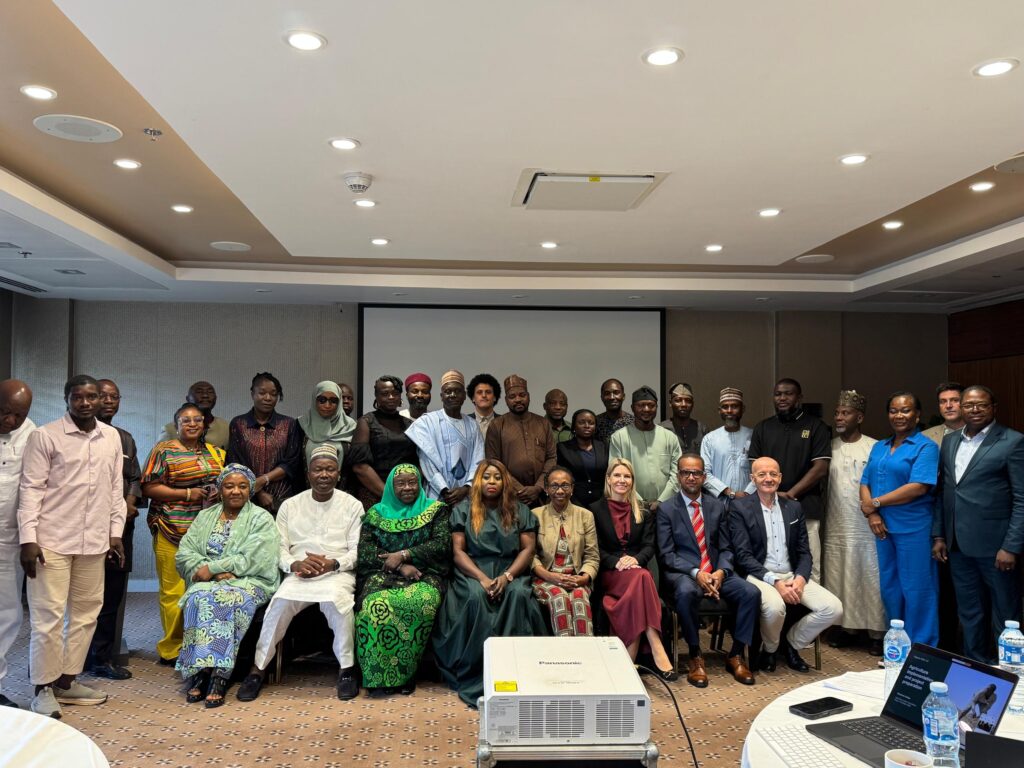
The National Council on Climate Change (NCCC) and its partners have called for reliable climate data, improved project preparation and coordinated investment to help Nigeria secure funding for its climate commitments.
They made the call on Monday in Abuja at a technical workshop on greenhouse gas (GHG) inventory and the Nationally Determined Contribution (NDC) tracking platform.
The workshop, organised by the NCCC in collaboration with the Greenhouse Gas Management Institute (GHGMI), was supported by the UN Environment Programme (UNEP) under the UK PACT Nigeria project.
It focused on developing investment-ready agricultural projects capable of attracting domestic and international climate finance.
The Director-General of the council, Dr Tenima Jekudemi, said the workshop would support Nigeria’s efforts to fulfil its commitments under the Paris Agreement through its third Nationally Determined Contribution (NDC 3.0).
Jekudemi, represented by Mr Amudi Felicitas, an assistant director at the council, said the initiative would help stakeholders translate Nigeria’s climate targets into practical actions.
She said UNEP’s support focused on agriculture and transport, two of the seven sectors covered by Nigeria’s NDC.
“This meeting is very strategic because it is our first engagement with national stakeholders focused on agriculture, to examine how NDC 3.0 measures and targets will be achieved,” she said.
Jekudemi said agriculture was vital to food security, livelihoods and climate resilience, while transport was essential to economic development.
She urged stakeholders across ministries, departments and agencies to strengthen their capacity to implement climate actions and achieve national targets.
Earlier, Mr Jerome Malavelle, coordinator of the NDC Action and Invest initiative at UNEP, said reliable emissions data and clear progress indicators were essential for securing international climate finance.
He said countries seeking funding needed credible baseline emissions data and evidence of progress in implementing climate interventions.
“International financiers need to understand how you will measure progress with the funding they have provided. That is required, and sometimes lacking, because it depends heavily on the quality of data,” he said.
Malavelle said engaging public and private financiers early in project development would help identify technically viable projects capable of attracting investment.
He advocated a shift from isolated, small-scale projects to a coordinated pipeline of strategic initiatives that could attract funding from multiple sources.
Similarly, Mr Tosin Akiyesi of the Federal Ministry of Agriculture and Food Security said Nigeria’s NDC 3.0, submitted to the UN Framework Convention on Climate Change (UNFCCC) in September 2025, placed agriculture at the centre of the country’s climate action.
He said the framework sought to balance food security and rural livelihoods with greenhouse gas emissions reductions and resilience to climate impacts.
Akiyesi said the priorities included climate-smart agriculture, crop diversification, sustainable land and forest management, improved irrigation, reduced post-harvest losses, and better livestock and manure management.
He said Nigeria required an estimated 337 billion dollars between 2026 and 2035 to implement NDC 3.0, comprising 195 billion dollars for mitigation, 141.5 billion dollars for adaptation and 500 million dollars for climate empowerment initiatives.
He added that the Nigerian Net Zero Investment Plan would support the transition to net-zero emissions through measures such as solar-powered irrigation and environmentally friendly farming practices.
Akiyesi said Nigeria mobilised about 2.5 billion dollars annually in climate finance, but the amount remained insufficient to meet its investment needs.
“There is a financing gap because the amount of money coming in and what is actually needed to run the projects are not the same,” he said.
Mr Solomon Asfaw, a climate investment expert supporting the development of an agricultural sector investment pipeline, said projects needed clear climate objectives, reliable baseline data, implementation arrangements, cost estimates and revenue projections to attract funding.
He said the workshop would help develop bankable projects suitable for financing by governments, multilateral institutions and private investors.
Mrs Julia Hawkins, the team’s technical lead on financial structuring, said matching projects with appropriate funding sources was essential to closing Nigeria’s climate finance gap.
She said the investment-planning process would integrate agriculture and transport priorities, clarify funding requirements and link projects with suitable financing arrangements.
Hawkins said the Nigerian Net Zero Investment Plan estimated Nigeria’s investment needs at about 38 billion dollars annually until 2030, while tracked climate finance stood at 2.5 billion dollars in 2021.
She said the figures highlighted the need for better project preparation and increased mobilisation of public and private capital to implement Nigeria’s climate commitments.
