


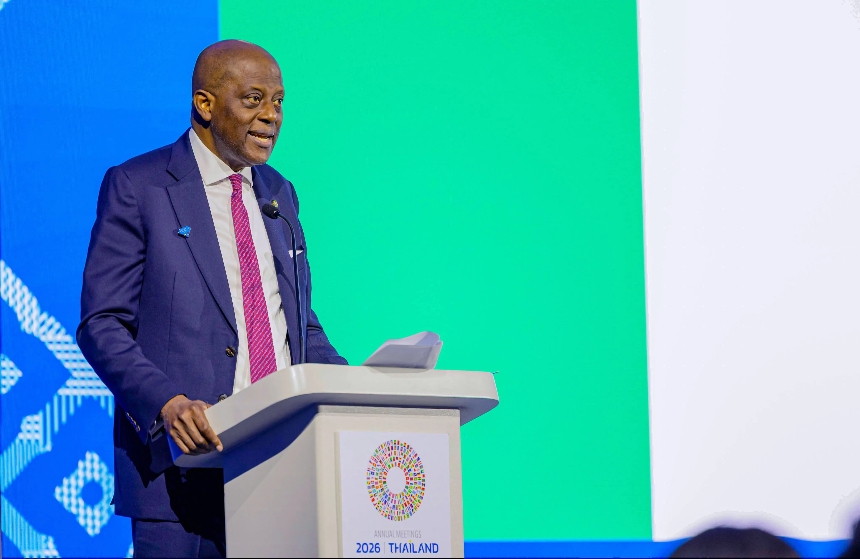
Nigeria’s headline inflation fell to 14.63 per cent in September 2026 from about 34.8 per cent at the end of 2024, while external reserves climbed above $55 billion, the Central Bank of Nigeria (CBN) Governor, Olayemi Cardoso, has said.
Cardoso disclosed this at a press briefing marking the conclusion of the 2026 IMF–World Bank Annual Meetings in Bangkok, Thailand, on October 17, highlighting what he described as progress in restoring macroeconomic stability and rebuilding investor confidence.
He said Nigeria’s external reserves had reached an 18-year high, while formal remittance inflows were approaching $1 billion monthly, reflecting improvements in the country’s external position.
The CBN governor also disclosed that banks had raised ₦4.65 trillion in fresh capital under the ongoing banking sector recapitalisation exercise, with domestic investors accounting for most of the funds.
He added that Fitch Ratings had revised Nigeria’s sovereign outlook from Stable to Positive, a development reflecting improved perceptions of the country’s economic prospects.
Cardoso said the annual meetings also provided opportunities to strengthen Nigeria’s international financial relationships through discussions with Finance Minister and Coordinating Minister of the Economy, Taiwo Oyedele; IMF First Deputy Managing Director Dan Katz; and World Bank Group President Ajay Banga.
He also held engagements with leading credit rating agencies and participated in global policy discussions on economic resilience, monetary policy and artificial intelligence.
On Nigeria’s financial relations with Asia, Cardoso highlighted efforts to expand cross-border payment systems, financial technology cooperation and trade finance.
He cited recent engagements in Singapore and a meeting with the Governor of the People’s Bank of China, ahead of a planned visit to Beijing, as part of efforts to deepen financial connectivity and facilitate trade between Nigeria and Asian economies.
Looking ahead, the CBN governor said the bank would sustain efforts to reduce inflation, preserve monetary and financial stability, and build a deeper financial system with stronger international connections.
He reiterated that achieving single-digit inflation remained the bank’s medium-term objective.
“We came to Bangkok with evidence of Nigeria’s progress and leave with stronger international relationships and a clearer understanding of the opportunities ahead,” Cardoso said.
