


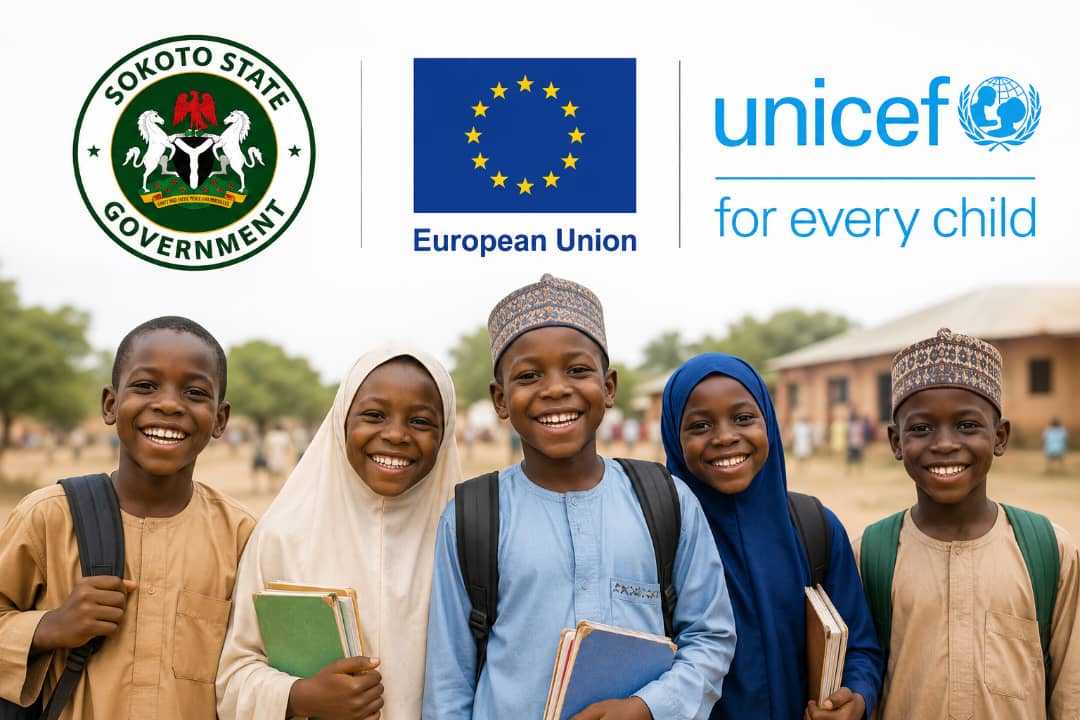
The Sokoto State Government, in partnership with the European Union (EU), UNICEF and other development partners, has unveiled a 10-year education strategy aimed at improving access, inclusion and learning outcomes across the state.
The State Education Strategic Plan (SESP) 2026–2035, alongside the State Education Sector Operational Plan (SESOP) 2026–2028 and Local Education Sector Operational Plans (LESOPs) 2026–2028, was unveiled on Friday at a dissemination workshop in Sokoto.
The plans are designed to make education more equitable and disability-inclusive while strengthening the sector’s ability to withstand insecurity, displacement, emergencies and climate-related challenges.
The LESOPs cover eight local government areas: Gada, Tureta, Gwadabawa, Tangaza, Goronyo, Isa, Sabon Birni and Yabo.
Speaking at the event, the Commissioner for Basic and Secondary Education, Prof. Ahmed Ladan Ala, described the plans as an important framework for tackling challenges in the state’s education sector.
He urged stakeholders to critically review the documents and contribute ideas that would make them more responsive to the needs of communities.
Ala endorsed the plans for implementation, stressing that their real value would be determined by the improvements they bring to education delivery.
UNICEF: Implementation is key
The UNICEF Sokoto Field Office Chief, Dr Michael Juma, said the plans provide an opportunity to tackle barriers that keep many children out of school or prevent them from completing their education.
He identified poverty, insecurity, displacement, socio-cultural barriers and limited learning opportunities among the factors affecting enrolment, retention and learning outcomes, particularly in northern Nigeria.
Juma said the plans must go beyond policy documents and translate into practical interventions that enable every child to access quality education and learn in a safe environment.
He identified implementation, sustainable financing and accountability as critical to achieving the objectives of the plans.
He also called for deliberate efforts to reach children in hard-to-reach communities, including girls, children with disabilities, Almajiri learners, nomadic children and children affected by insecurity, poverty and displacement.
He assured that UNICEF would continue supporting Sokoto State in strengthening its education system and translating the plans into action.
NIEPA: Impact will determine success
The Director-General and Chief Executive of the National Institute for Educational Planning and Administration (NIEPA), Dr A.D. Shofoyeke, said the Sokoto plans form part of a wider NIEPA-UNICEF initiative covering Lagos, Jigawa, Enugu, Sokoto and Adamawa states.
He said the collaboration began in 2025 with a review of existing education-sector documents and training for education planners and Education Management Information System (EMIS) officers.
The initiative has focused on evidence-based planning, gender-transformative education, equity and disability inclusion, as well as the development of local education-sector plans and annual performance assessments.
Shofoyeke said the success of the initiative would not be judged by the production of policy documents, but by their implementation and the impact on children and communities.
He urged the Sokoto Government to use the operational plans as a basis for preparing annual education budgets, noting that they align with government policies and programmes.
With the plans now unveiled, the focus shifts to implementation, funding and accountability to ensure that more children enter and remain in school, learning improves and the education system becomes more inclusive and resilient to the challenges facing communities across Sokoto State.
