


Kenya’s county governments have launched a new framework aimed at increasing youth participation, entrepreneurship and investment across the country’s agrifood economy.
The Model County Youth in Agrifood Systems Strategy, developed by the Council of Governors (CoG) with technical and financial support from the Alliance for a Green Revolution in Africa (AGRA), seeks to help counties create enabling environments for young people to establish and grow businesses across the agricultural value chain.
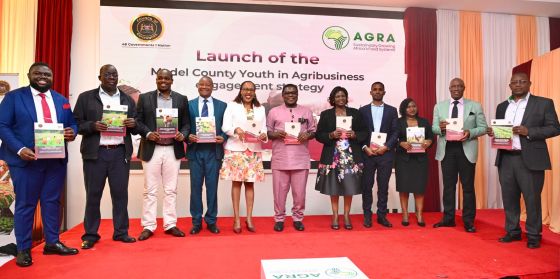
The strategy was unveiled at an event attended by governors, policymakers, young agripreneurs, development partners, financial institutions and private sector representatives.
The initiative is designed to shift the focus from discussions about youth unemployment to practical interventions, investment and partnerships that can create sustainable livelihoods and businesses for young people.
World Bank data cited by the organisers show that about 75% of Kenya’s population is below the age of 35, while more than 800,000 young people enter the labour market annually.
Agriculture remains a major contributor to the Kenyan economy, accounting for about 22.4% of gross domestic product directly and another 27% indirectly through linkages with manufacturing, distribution and other sectors.
However, the sector continues to face challenges in attracting young people, many of whom regard agriculture as labour-intensive, risky and offering limited economic opportunities.
The new strategy seeks to change that perception by positioning young people as entrepreneurs, innovators, investors, service providers and leaders across the agrifood value chain.
Speaking at the launch, CoG Chief Executive Officer Mary Mwiti said young people must remain central to Kenya’s development agenda.
“Young people must remain at the centre of our development agenda, and this strategy provides a practical pathway to gainful livelihoods, sustainable development, and scalable economic opportunities,” Mwiti said.
She said the partnership with AGRA and other stakeholders had produced a long-term and integrated framework that would give counties a structured approach to engaging young people while bringing the private sector into the process.
Representing AGRA, its Director for Policy and State Capability, Boaz Keizire, pledged the organisation’s continued support to county governments in implementing the strategy.
“We will work alongside counties to translate these solutions into real livelihoods, enterprises and opportunities for young people in agribusiness,” Keizire said.
Governor of Bungoma County, Ken Lusaka, said the Council of Governors would deploy a dedicated team to monitor implementation, support counties in rolling out the strategy and strengthen young people’s capacity to take advantage of opportunities in agribusiness.
The framework provides guidance to county governments on integrating youth priorities into county planning, improving access to finance and markets, promoting public-private partnerships and strengthening coordination.
It also seeks to create a more supportive environment for youth-led enterprises and provide young entrepreneurs with opportunities to present their businesses, innovations and ideas to potential investors and partners.
At the launch, youth-led agribusinesses from Kirinyaga, Bungoma, Kakamega, Nakuru and Meru counties showcased enterprises operating across different agricultural value chains.
Flagship interventions were also presented to development partners and private sector players as part of efforts to mobilise technical and financial support for implementation.
Stakeholders said greater youth participation would be critical as food systems face increasing pressures from climate change, population growth and changing consumer demands.
The strategy ultimately aims to turn Kenya’s large youth population into an economic advantage by creating county-level ecosystems where young people can progress from participating in agriculture to owning businesses, driving innovation and assuming leadership roles across the agrifood economy.
