


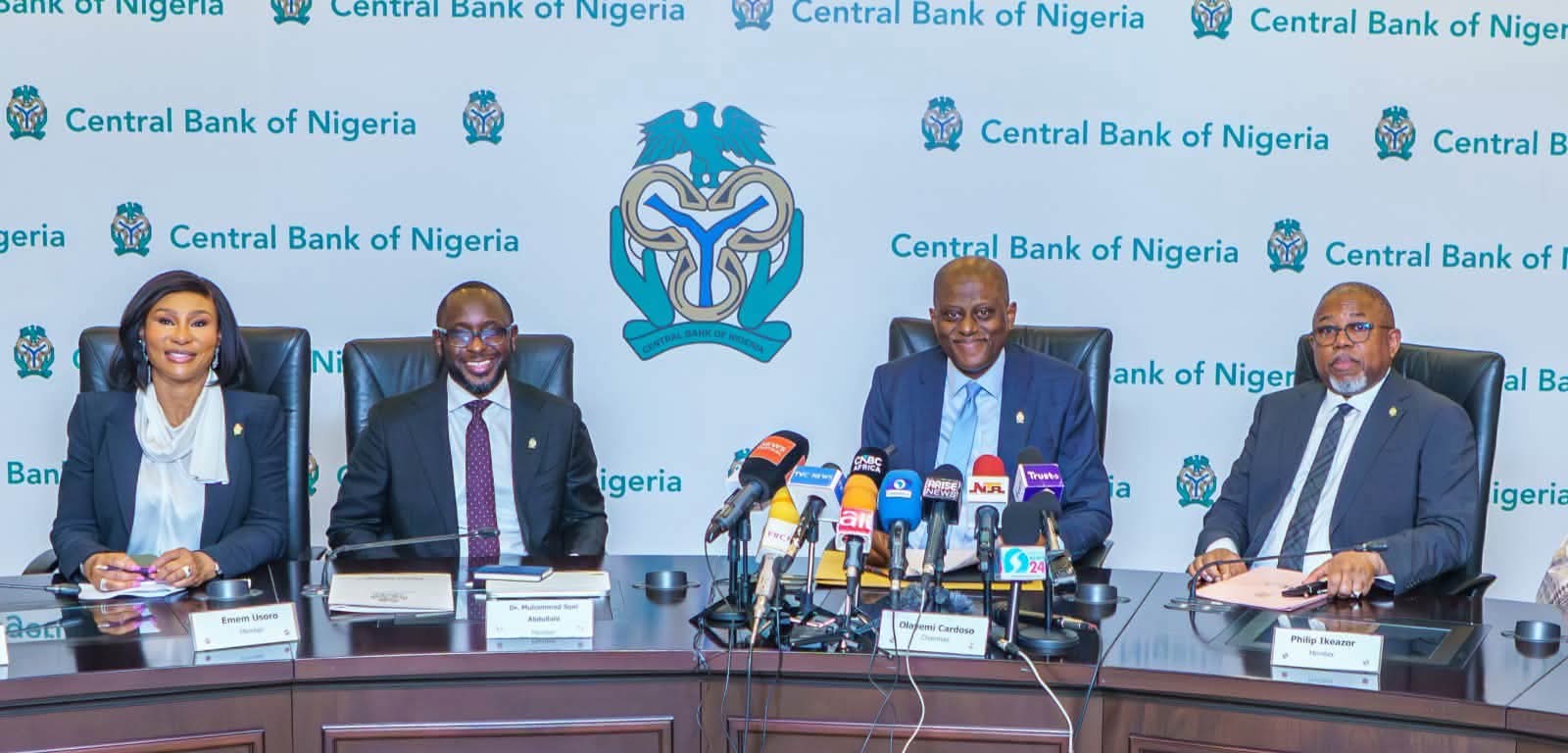
The Governor of the Central Bank of Nigeria (CBN), Olayemi Cardoso, has reaffirmed the Bank’s commitment to maintaining macroeconomic stability through coordinated and data-driven monetary policy.
Cardoso made the assertion while briefing journalists on the outcome of the 306th Monetary Policy Committee (MPC) meeting, where the Committee noted that the Nigerian economy remained on a resilient growth path despite heightened global uncertainties and renewed geopolitical tensions.
The MPC projected that economic output growth would remain strong in 2026, supported by improved crude oil production, expansionary Purchasing Managers’ Index (PMI) readings and the positive impact of ongoing economic reforms.
The Committee also reaffirmed its commitment to preserving price and financial system stability, while remaining prepared to take appropriate policy measures to moderate inflation and return it to a single-digit trajectory over the medium term.
On the banking sector, Cardoso welcomed the successful outcome of the recapitalisation exercise, saying it had strengthened the resilience of the financial system.
He described Nigeria’s banking sector as safe, sound and resilient, while explaining that recent supervisory actions against 46 microfinance banks were necessary to address longstanding regulatory and compliance infractions.
According to him, protecting depositors’ funds remains the foremost priority of the CBN.
On the foreign exchange market, the Governor reiterated the Bank’s commitment to maintaining a transparent, liquid and market-driven system based on the willing-buyer, willing-seller principle.
He said exchange rate outcomes would continue to reflect market fundamentals, while ongoing reforms were expected to strengthen confidence, improve competitiveness and promote long-term economic stability.
Cardoso also highlighted the introduction of the Nigeria Overnight Financing Rate (NOFR), describing it as a significant milestone in improving transparency in the financial market.
He explained that NOFR reflects actual overnight secured funding transactions between banks and would complement the Monetary Policy Rate (MPR), strengthen monetary policy transmission and support Nigeria’s inflation-targeting framework.
Addressing developments in the payments ecosystem, the Governor clarified that the commemorative ₦100 note, the standard ₦100 note and all approved naira denominations remain legal tender.
He noted that the future of payments was increasingly digital, adding that the CBN remained committed to developing a secure, inclusive and modern payment ecosystem aligned with global best practices.
Speaking on the Bank’s recognition as the 2026 Central Banking Award winner, Cardoso described the achievement as a reflection of the dedication, professionalism and collective efforts of the CBN’s staff and management.
He also commended the Nigerian media for its support, noting that the recognition reinforced the immense responsibility of central banking, where policy decisions have far-reaching implications for millions of Nigerians.
The Governor further said Nigeria’s economic reforms were gaining global recognition for strengthening economic stability, boosting investor confidence and laying the foundation for sustainable economic growth.
